22kW EV Chargers: Speed, Costs and Installation in the UK

- A 22kW EV charger is an AC charge point; the vehicle's onboard AC charging limit determines whether it can use the full output.
- Typical 22kW AC charging requires a suitable three-phase electrical supply and adequate spare capacity.
- A 7kW or 11kW charger may be more appropriate for overnight parking or vehicles with lower AC charging limits.
- Commercial sites should compare dwell time, charger utilisation, grid capacity and total installed costs before choosing 22kW charging.
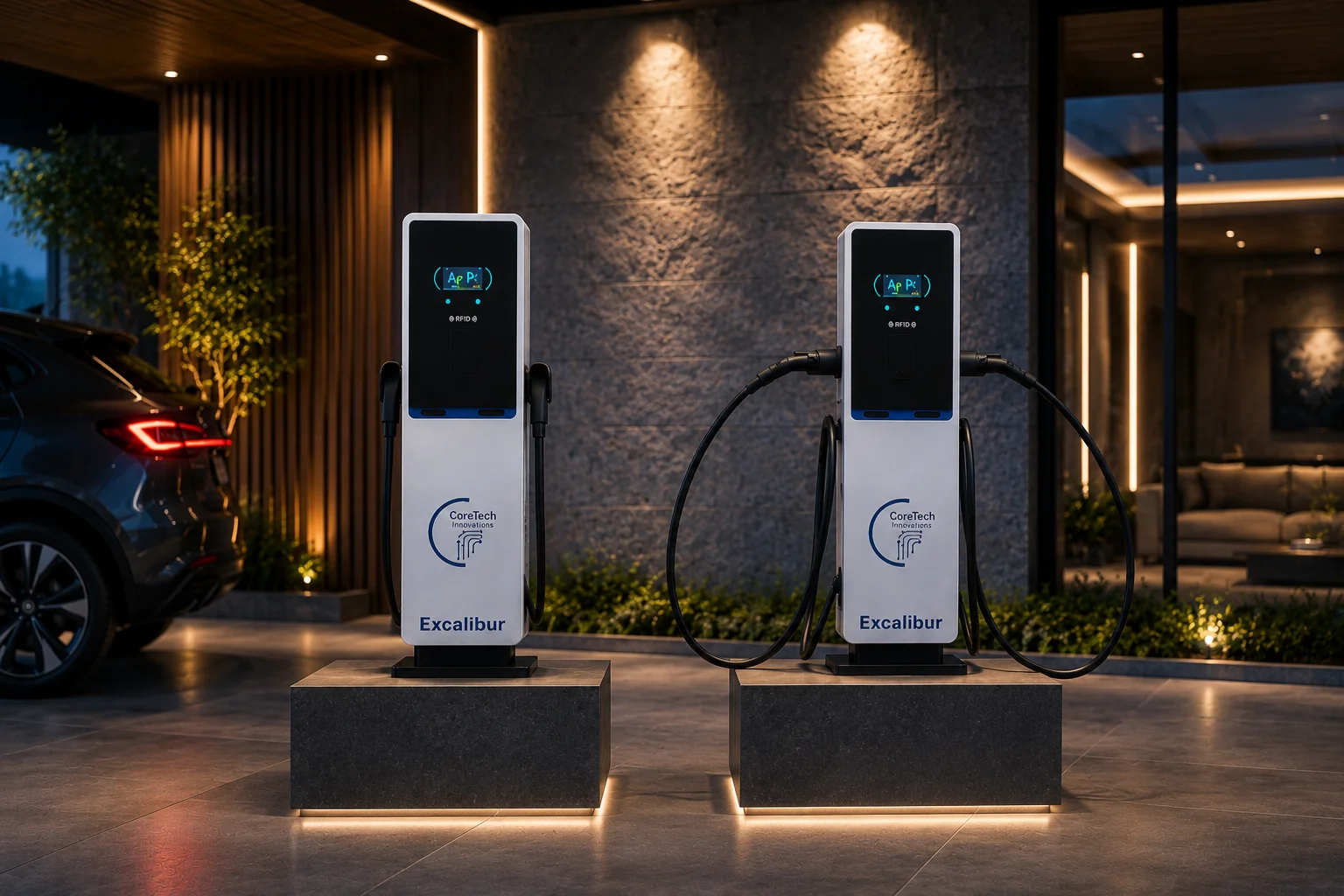
- CoreTech's Excalibur Socket Type is described in the existing article as offering dual 22kW AC outputs; current specifications must be confirmed.
- CoreTech supplies EV charging products throughout England, Scotland, Wales and Northern Ireland; installation coverage is separate.
Explore 22kW EV chargers in the UK: compare 7kW, 11kW and 22kW AC charging, vehicle compatibility, three-phase power, installation costs and commercial applications.
22kW EV Chargers: Speed, Costs and Installation in the UK
A 22kW EV charger can provide faster AC charging than a typical 7kW home wallbox, but only when the electric vehicle, electrical supply and installation support it.
This UK guide explains how 22kW AC charging works, which drivers and businesses might benefit, what a three-phase connection means and why a higher charger rating does not always translate into faster charging.
CoreTech Innovations is based in Cardiff and supplies EV charging products across England, Scotland, Wales and Northern Ireland. Installation and site assessment arrangements should be confirmed separately.
What Is a 22kW EV Charger?
A 22kW EV charger is an alternating-current (AC) charge point rated to supply up to 22 kilowatts under suitable conditions. It is often used at workplaces, commercial car parks and other destinations where vehicles remain parked for a period of time.
A 22kW rating describes the charger's maximum output, not a guaranteed charging rate for every vehicle. The vehicle's onboard AC charger determines how much AC power it can convert for the battery.
7kW vs 11kW vs 22kW EV Chargers
A 7kW-class AC wallbox is commonly suitable for overnight home charging. An 11kW AC charger may suit sites with three-phase electricity and vehicles capable of accepting that power. A 22kW AC charger can offer additional capacity for compatible vehicles and locations.
For illustration, delivering 22kWh of energy would take roughly 3.1 hours at 7kW, 2 hours at 11kW or 1 hour at 22kW before accounting for charging losses, power limits and charging behaviour. These are simplified energy calculations, not promises of real-world charging times.
If a car only accepts 7kW or 11kW AC, installing a 22kW charge point will not make that car charge at 22kW.
Can Your Electric Car Charge at 22kW AC?
Check the manufacturer's specifications for the vehicle's maximum AC charging rate. Some electric cars accept around 7kW or 11kW AC even when connected to a higher-rated charge point.
Do not confuse the vehicle's DC rapid-charging capability with its AC onboard charger. A vehicle advertised as supporting high-power DC charging may still be limited to a lower AC rate.
Also consider the charging cable, connector, charger configuration and available electrical supply; the usable rate is limited by the weakest applicable part of the charging arrangement.
Does a 22kW EV Charger Need Three-Phase Electricity?
A typical 22kW AC charge point requires a suitable three-phase supply, generally delivering around 32 amps per phase at nominal UK three-phase voltage. A standard single-phase domestic connection will not ordinarily support 22kW AC output.
A qualified installer should assess the supply, spare capacity, protection, earthing, cable routes and any network operator requirements before specifying equipment.
Having three-phase electricity does not automatically mean there is enough spare capacity for a 22kW charger, particularly where several charge points or other large electrical loads are present.
Is a 22kW Charger Worth It for Home Charging?
For many households, a lower-power wallbox can replenish everyday driving energy during an overnight parking period. Paying for a higher-rated charger or electrical supply upgrade may bring little benefit if the vehicle cannot accept 22kW AC.
A 22kW installation may be worth investigating where the home already has suitable three-phase capacity, the vehicle supports faster AC charging and the driver's parking window is short.
Compare your actual daily mileage, available charging hours, electricity tariff and total installation cost before deciding.
When Does 22kW Charging Make Sense for Businesses?
Workplaces, visitor destinations, hospitality sites and commercial car parks may consider 22kW AC charging when vehicles have limited dwell time and compatible onboard chargers.
For long-stay employee or overnight parking, managed lower-power AC charging may provide a better balance of cost and energy delivery. Sites serving many vehicles may benefit more from additional charging bays than from increasing the output of every bay.
Choose based on expected vehicles, parking duration, site capacity and operating model rather than charger power alone.
22kW AC Charging vs DC Rapid Charging
A 22kW AC charger uses the vehicle's onboard AC charger. DC rapid chargers convert electricity outside the vehicle and can deliver power through the vehicle's DC charging interface, subject to its battery and charging limits.
DC charging may suit rapid turnaround, but equipment, grid connections and operating costs can be higher. A 22kW AC unit should not be described as equivalent to a 50kW or higher DC rapid charger.
Consider whether drivers are parking for hours or stopping specifically to recharge before selecting the technology.
How Much Does a 22kW EV Charger Installation Cost in the UK?
The total cost depends on the charger, existing three-phase supply, spare electrical capacity, cable length, groundwork, distribution equipment, commissioning and any network upgrade.
Commercial projects may also require networking, access controls, payment systems, ongoing maintenance and support. The price of the charge point alone is not the complete installed cost.
Request an itemised site-specific quotation and verify any current grants or incentives against official eligibility rules rather than relying on a generic advertised installation price.
Load Management for Multiple 22kW Chargers
Several 22kW charge points operating together can create substantial peak demand. Dynamic load management can adjust charging output to share available capacity where compatible equipment and controls are installed.
For example, a site with multiple charging bays may be able to distribute a limited electrical budget across vehicles instead of supplying the maximum rated output to every charger simultaneously.
An electrical designer should assess demand, diversity, protection and expansion plans before a multi-charger installation is approved.
Choosing Charging Locations and Safe Installation
Position chargers with regard to accessible parking, cable reach, pedestrian routes, lighting, signage and vehicle movement. Installation should comply with applicable UK electrical and building requirements and be completed by competent professionals.
For public or commercial sites, review relevant accessibility guidance and any rules applicable to publicly accessible charging facilities, including payment and information requirements where relevant.
Avoid assuming that the shortest cable route automatically produces the best charging bay layout.
CoreTech Excalibur and 22kW Commercial Charging
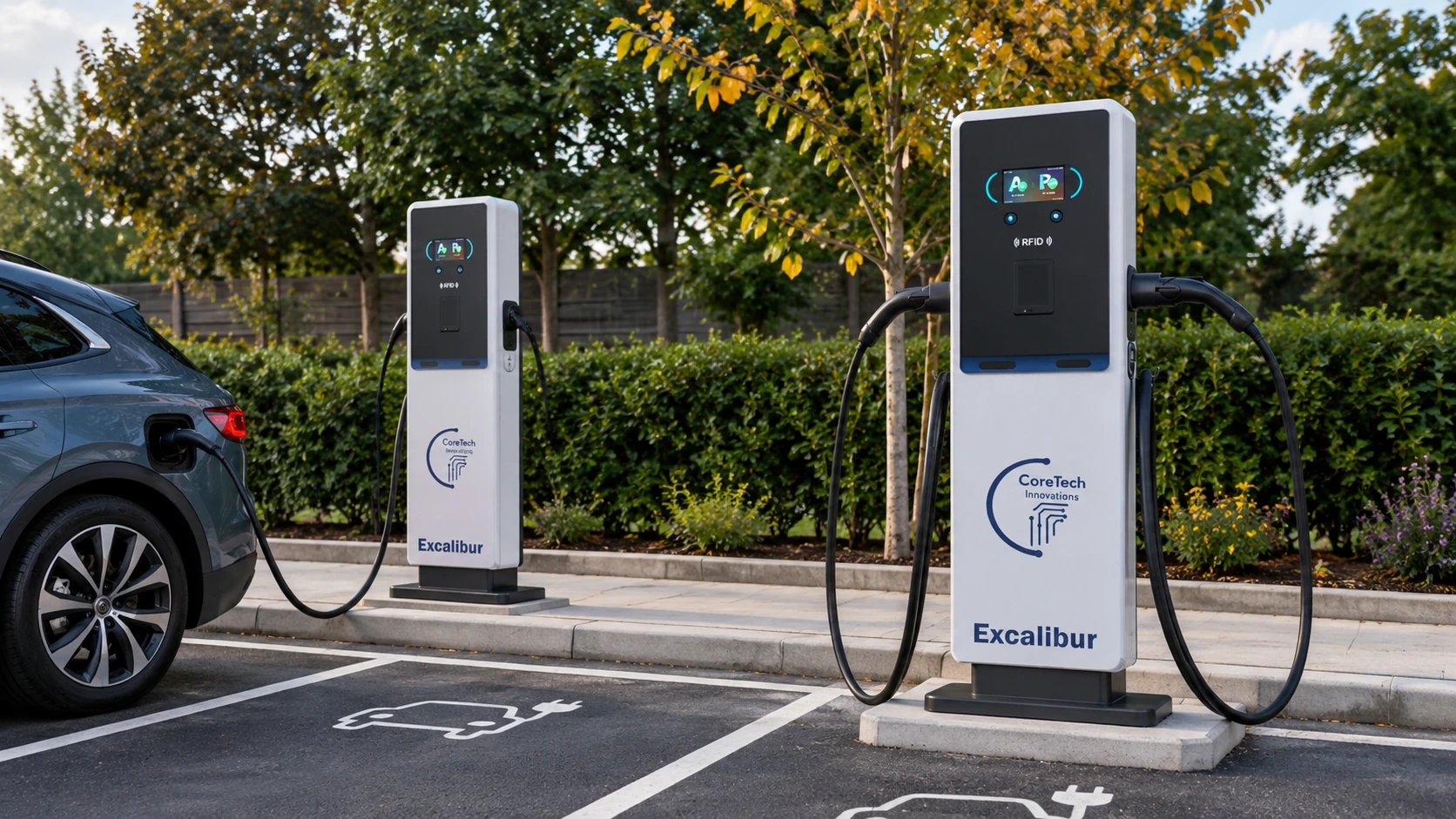
CoreTech's Excalibur range includes commercial EV charging products. The existing product information identifies an Excalibur Socket Type configuration with dual 22kW AC outputs; confirm the current model specification and operating conditions before purchasing.
Dual outputs do not guarantee that two connected vehicles will always receive 22kW each. Actual delivery depends on vehicle capability, electrical design, configuration and any load-management limits.
Compare available connector options, software features, warranty terms and installation requirements against the needs of the site.
22kW EV Charger Supply Across the UK
CoreTech Innovations supplies EV charging products throughout the UK, including England, Scotland, Wales and Northern Ireland, from its Cardiff base.
Whether you are selecting a charger for a business, workplace or suitable home installation, review the current product range and discuss the equipment requirements. Availability of installation, surveys and commissioning must be confirmed for the individual location.
How to Choose the Right 22kW Charging Solution
First confirm the vehicle's maximum AC charging capability. Next check whether the site has suitable three-phase electricity and sufficient spare capacity. Then consider how long vehicles park and how many need to charge at the same time.
Compare a 7kW, 11kW or 22kW AC option on total installed cost, practical energy delivery and future needs. If rapid turnaround is essential, assess DC charging as a separate option.
A charger is best selected after a realistic vehicle-and-site assessment, not on advertised power alone.
Frequently Asked Questions About 22kW EV Chargers
Is a 22kW EV charger faster than a 7kW charger? It can deliver more AC power to a compatible vehicle on a suitable supply, but a vehicle with a lower AC limit will not charge at 22kW.
Do I need three-phase power for a 22kW charger? A typical 22kW AC installation needs a suitable three-phase supply and adequate spare electrical capacity.
Can I install a 22kW EV charger at home? Potentially, if the property has suitable infrastructure, the installation is feasible and the vehicle can benefit; many households do not need this power level.
How long does 22kW charging take? It depends on battery energy required, the vehicle's AC charging limit and charging conditions. Divide required energy in kWh by actual average power in kW for a rough estimate.
Is 22kW the same as rapid DC charging? No. A 22kW AC charger and a DC rapid charger use different charging architectures and vehicle interfaces.
Does CoreTech deliver 22kW EV charging products across the UK? CoreTech supplies EV charging products throughout the UK; confirm current product specifications and local installation arrangements separately.