7kW EV Charger Buying Guide for Cardiff Homes: Costs, Features and Installation

- A 7kW EV charger provides a practical balance between charging speed, everyday usability and electrical requirements for many Cardiff homes.
- The Andro Core, Andro Max and Andro Vision all provide up to 7kW charging, with the main differences relating to connectivity, energy management and user experience.
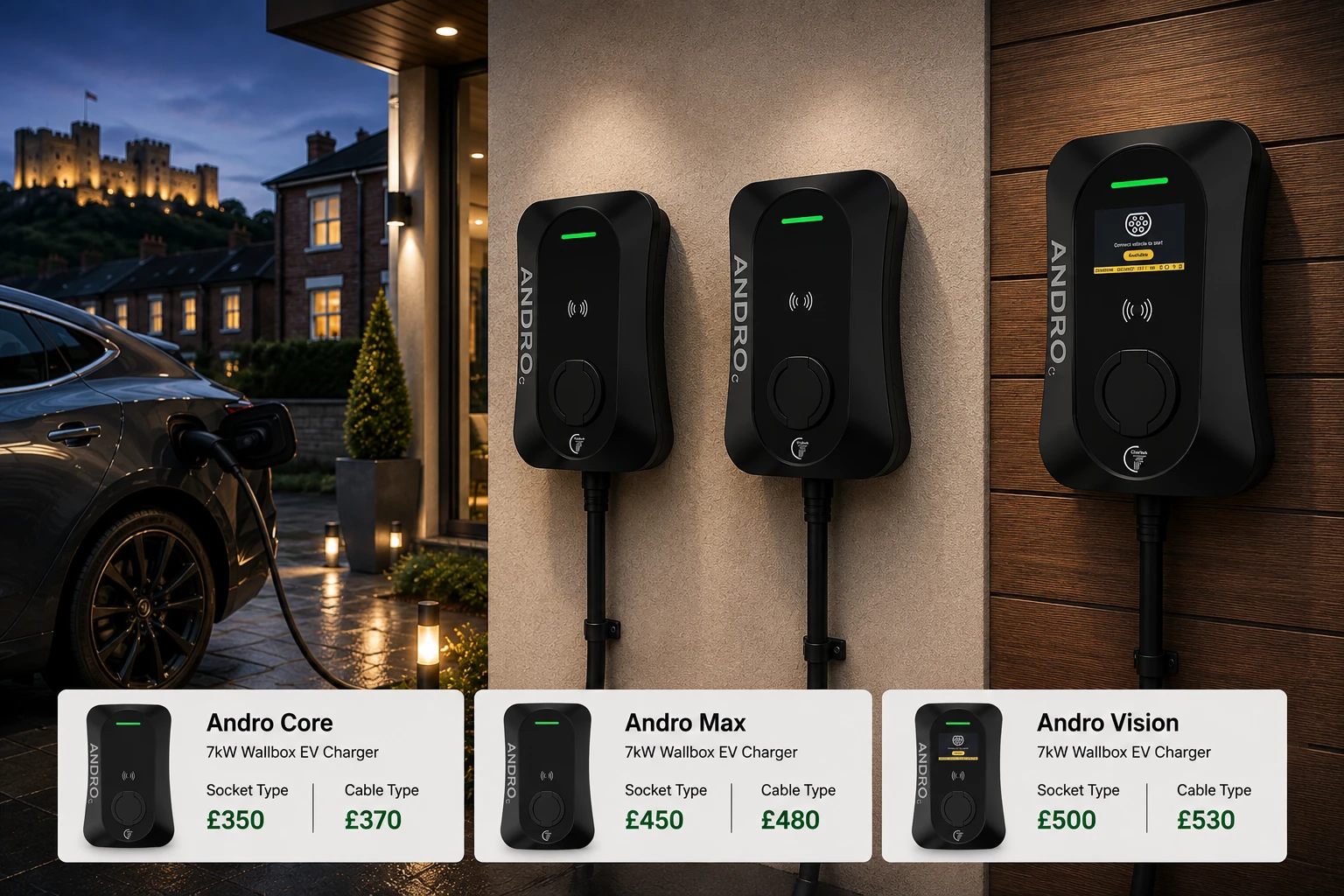
- Current CoreTech Innovations hardware prices start from £350 for the Andro Core Socket Type and rise to £530 for the Andro Vision Cable Type.
- Installation costs depend on the property's electrical capacity, consumer unit, cable route, charger position, protective equipment and any additional electrical work required.
- The best charger should match the vehicle, parking arrangement, smart-energy requirements, solar plans and likely future household energy needs.
Learn how to choose a 7kW EV charger for your Cardiff home, including current prices, charging speeds, smart features, solar compatibility, installation requirements and future energy needs.
What Is a 7kW EV Charger?
A 7kW EV charger is a dedicated charging point capable of supplying up to approximately seven kilowatts of power to a compatible electric vehicle.
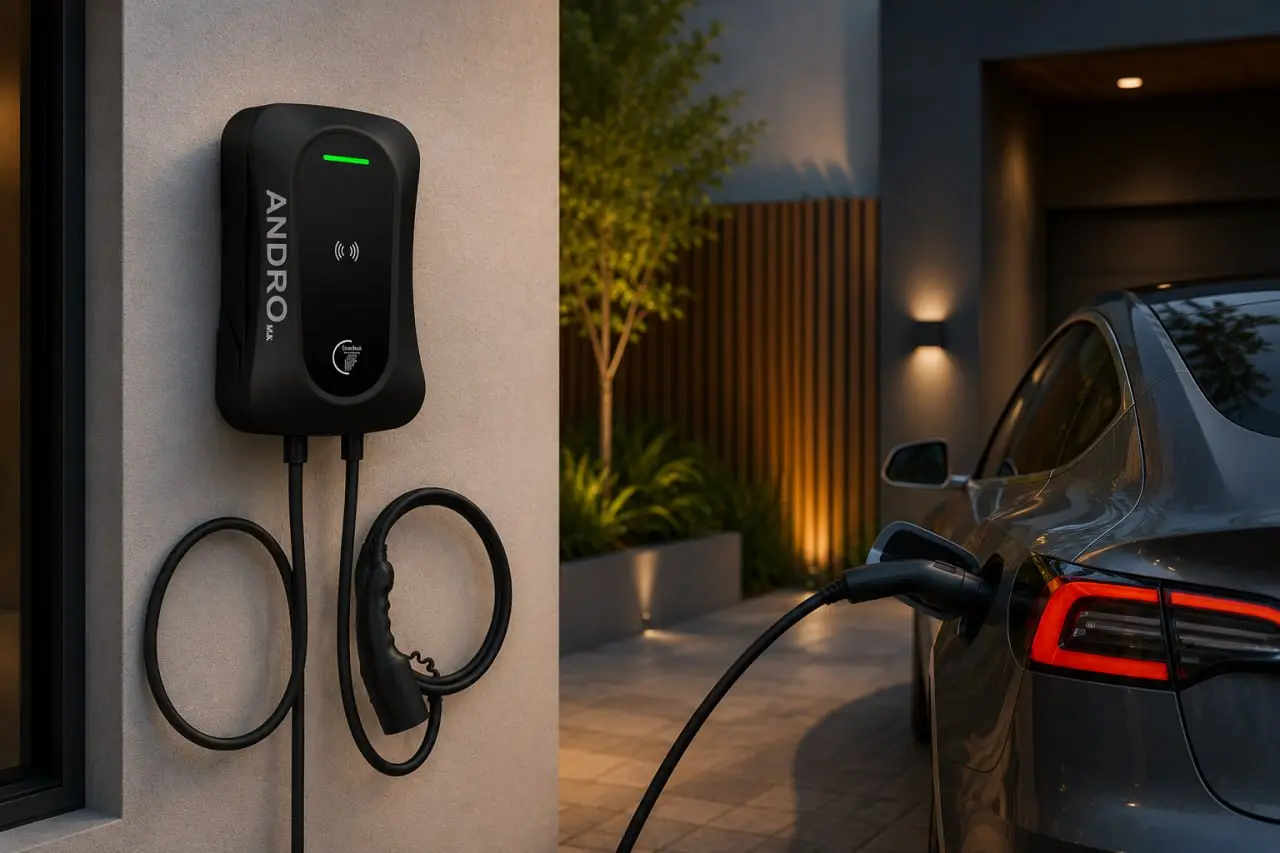
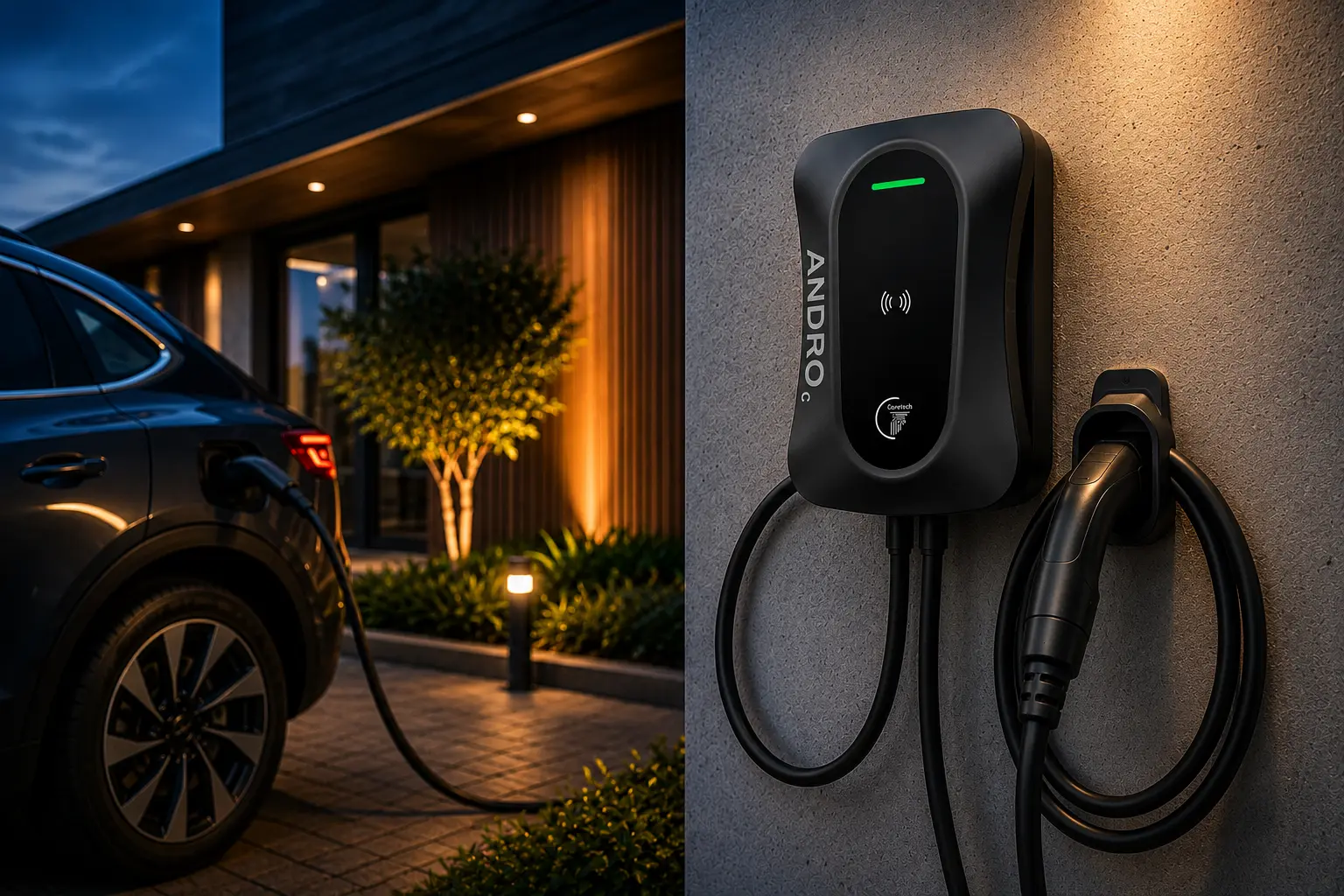
CoreTech Innovations' Andro Core, Andro Max and Andro Vision home wallboxes are all rated at 7kW and use a Type 2 vehicle connection.
The charger's maximum output does not necessarily determine the charging rate the vehicle will receive. If the vehicle's onboard AC charger supports a lower rate, the car will not draw the full 7kW.
Charging performance can also be affected by the property's electrical installation and energy-management settings, so checking the vehicle's maximum AC charging rate is an important first step.
How Fast Is a 7kW Home EV Charger?
Charging time depends mainly on how much energy needs to be added to the battery and how much power the vehicle can accept.
If approximately 35kWh needs to be added and the vehicle can accept the full charger output, a 7kW wallbox could theoretically provide that amount in around five hours.
Adding approximately 50kWh would theoretically take a little over seven hours.
Real charging times may be longer because of charging losses, temperature, vehicle limitations and battery-management behaviour.
For most drivers, home charging is more about replacing the energy used during normal daily journeys than repeatedly charging the battery from empty to full.
Why Does 7kW Make Sense for Home Charging?
Higher charging power is not always necessary at home because vehicles are often parked for several hours, particularly overnight.
For many households, a 7kW wallbox offers a useful balance between charging speed, electrical requirements and everyday practicality.
Public charging can then serve a different purpose by providing faster charging when additional range is needed away from home.
This allows home charging to cover routine everyday mileage while public charging provides greater flexibility for longer journeys.
7kW EV Charger Costs in Cardiff
CoreTech Innovations offers three main 7kW domestic wallbox ranges: Andro Core, Andro Max and Andro Vision.
The Andro Core Socket Type starts from £350, while the Cable Type version starts from £370. It focuses on straightforward 7kW charging, scheduling and energy-consumption reporting.
The Andro Max Socket Type starts from £450 and the Cable Type version from £480, adding features such as mobile-app control, Dynamic Load Balancing and solar PV integration.
The Andro Vision Socket Type starts from £500, while the Cable Type version starts from £530. It combines advanced smart charging functions with an LCD display.
These figures relate to charger hardware and should not be treated as complete installed prices. All three ranges provide the same headline 7kW output, with the price differences mainly reflecting connectivity, energy management and user interface.
Andro Core: Straightforward Everyday Home Charging
The Andro Core is the simplest fixed wallbox in the range and is designed for practical everyday domestic charging.
Its features include 7kW charging, Type 2 compatibility, charge scheduling, energy-consumption reporting, remote software updates, RFID access and emergency control.
For a household with one EV and a predictable overnight charging routine, this level of functionality may be entirely sufficient.
The Andro Core is therefore well suited to drivers who want scheduled home charging without paying for advanced energy-management features they may not use.
Andro Max: More Advanced Home-Energy Management
The Andro Max provides the same 7kW maximum charging output as the Andro Core but adds greater connectivity and home-energy management functionality.
Its additional features include Wi-Fi, Bluetooth, mobile-app control, Dynamic Load Balancing and solar PV integration.
Dynamic Load Balancing can be useful where several high-demand appliances operate at the same time because charging power can be adjusted according to electricity demand elsewhere in the property.
This does not increase the home's electrical capacity. Instead, it helps make more intelligent use of the capacity already available.
The Andro Max may therefore appeal to households with higher electricity demand, existing solar panels or plans to create a more connected home-energy system.
Andro Vision: Smart Charging with a Built-In Display
The Andro Vision includes many of the same advanced energy-management functions as the Andro Max, including app control, Dynamic Load Management, solar integration, scheduling and energy reporting.
One of its main visible differences is an LCD display that allows charging information to be viewed directly on the unit.
Some drivers may prefer checking charging information through an app, while others may value having the current charging status visible on the wallbox itself.
Choosing the Andro Vision is therefore less about charging speed and more about user experience and how the homeowner prefers to interact with the charger.
Socket Type or Cable Type?
Once the charger model has been selected, buyers also need to choose between a Socket Type and a Cable Type, often referred to as a tethered charger.
A Socket Type charger uses a detachable Type 2 cable that is connected between the wallbox and vehicle whenever charging is required.
A Cable Type charger keeps the charging lead permanently attached to the wallbox.
Both formats can provide the same 7kW charging performance. The main differences relate to convenience, appearance and parking layout.
Before choosing, consider where the vehicle's charging port is located, how the car is normally parked and where the charger can be positioned.
Which Smart EV Charging Features Are Actually Useful?
The term smart charger can include several different functions, and not every feature will provide the same value to every household.
Charge scheduling allows the vehicle to be connected when convenient while charging begins at a selected time.
Energy monitoring helps households understand how much electricity the EV uses over time, while app control can make it easier to manage charging remotely.
Dynamic Load Balancing is particularly relevant where household electrical demand is relatively high, while solar PV integration becomes more valuable where the home already has or plans to install solar panels.
The most sensible approach is to choose features that match how the household currently uses electricity or expects to use it in the future.
Do You Need Solar Compatibility?
Not every household needs a solar-compatible EV charger.
Where photovoltaic panels are already installed or form part of future plans, a compatible charger may provide greater flexibility in how locally generated electricity is used.
The Andro Max and Andro Vision both include solar integration among their listed features.
The practical value depends on how much solar electricity is generated, when the vehicle is parked at home and how the household manages its wider electricity use.
Solar compatibility is therefore best considered as part of the complete home-energy system rather than simply as another item on the charger specification sheet.
Software Support and Aftercare
The physical charger hardware is only one part of the long-term ownership experience.
Software support, remote updates, warranty arrangements and aftercare can also affect how useful and reliable the charger remains over time.
CoreTech Innovations lists remote software updates across its Andro wallbox range alongside warranty and aftercare provision.
Buyers should therefore consider not only what the charger can do when first installed, but also how the product will be supported during its working life.
How Much Does 7kW EV Charger Installation Cost?
There is no single installation price that applies to every Cardiff property.
A straightforward installation may involve an accessible consumer unit, short cable route and convenient private parking, while another property may require longer cabling, additional electrical equipment or more complex work.
The final cost can depend on cable length and routing, electrical capacity, charger position, protective equipment, load-management requirements and accessibility.
This is why the advertised hardware price should not be interpreted as the complete cost of having the charger installed.
A clear quotation should separate the charger hardware from any site-specific installation work.
Why Professional Installation Matters
An EV charger can draw a significant electrical load for several hours at a time, so the condition and capacity of the property's electrical system should be considered before installation.
A professional assessment can consider available electrical capacity, charger location, cable routing, protection requirements and electricity demand from other household equipment.
This can be particularly important in properties where the electrical installation has been altered or extended over time.
Where household electricity demand is becoming more complex, features such as Dynamic Load Balancing may help make better use of the available supply.
Each property should therefore be assessed individually rather than assuming that the same installation approach will suit every home.
Parking Considerations for Home EV Charging in Cardiff
Before buying a fixed wallbox, homeowners should consider where the vehicle will normally be parked.
A home charger is most straightforward where the property has suitable private off-street parking such as a driveway, garage or dedicated parking space.
Where a vehicle is normally parked on the street, additional practical considerations may apply, particularly if a public pavement separates the property from the vehicle.
Drivers in this situation should investigate the charging options available to them before purchasing a wallbox rather than assuming that a standard home installation will be suitable.
7kW vs Higher-Powered Home EV Charging
More charging power does not automatically mean a better home charging solution.
Higher-powered charging may require different electrical infrastructure, greater available capacity and a vehicle capable of accepting the higher AC charging rate.
For many households, the more useful question is whether the charger can comfortably replace the energy used during the day while the vehicle is parked at home.
From this perspective, a 7kW charger can provide a practical balance between charging performance, electrical requirements and everyday use.
Should You Choose a Charger for Your Current EV or Future Needs?
A wallbox may remain installed at a property longer than the vehicle currently using it.
It therefore makes sense to consider future requirements as well as the electric car you own today.
The household may eventually replace the vehicle, install solar panels, add battery storage, introduce a heat pump or purchase a second EV.
Thinking about these possibilities before selecting a charger can help ensure that the equipment remains useful as household energy requirements change.
A Simple Way to Choose Between Andro Core, Max and Vision
Choose the Andro Core if the priority is straightforward 7kW home charging, scheduling and energy reporting at the lowest hardware price within the Andro range.
Choose the Andro Max if mobile-app control, Dynamic Load Balancing or solar PV integration are important to the household.
Choose the Andro Vision if the advanced energy-management functions of the Max are required alongside an LCD screen displaying charging information directly on the unit.
After selecting the model, choose between Socket Type and Cable Type according to the parking layout and everyday charging preference.
This approach is more useful than assuming that the most expensive charger is automatically the best option.
What Should You Check Before Buying a 7kW EV Charger?
Before placing an order, check the maximum AC charging rate supported by the vehicle, whether the property has suitable private parking and whether the electrical system can support the installation.
Consider where the charger will be positioned, whether Socket Type or Cable Type is more convenient and whether Dynamic Load Balancing or solar integration would provide genuine value.
It is also worth considering whether another EV or additional home-energy equipment may be added in the future.
Finally, confirm exactly what is included in the installation quotation so that hardware and site-specific costs are clearly understood.
The Role of Home Charging Alongside Cardiff's Public Network
Public EV charging infrastructure remains important, particularly for drivers who cannot install charging equipment at home.
For households with suitable private parking, a 7kW wallbox allows the vehicle to charge while it is already parked for several hours.
Public chargers can then provide additional flexibility when travelling, charging away from home or when private charging is unavailable.
For many EV drivers, using home and public charging for different purposes provides a practical approach to everyday electric motoring.
Final Thoughts
For many Cardiff homeowners with suitable private parking and appropriate installation conditions, a 7kW EV charger offers a practical balance of charging speed, cost and everyday usability.
The Andro Core, Andro Max and Andro Vision all provide the same headline 7kW charging output, with the main differences relating to smart features, home-energy management, solar integration and user experience.
The Core provides straightforward functionality, the Max adds more advanced connectivity and energy management, and the Vision combines those smart features with a built-in display.
Installation costs and property conditions are equally important because the electrical system, cable route, parking arrangement and site requirements can all influence the final project cost.
The best charger is therefore not necessarily the most expensive model, but the one that best matches the vehicle, property, budget, charging routine and future home-energy plans.