Andro Core vs Andro Max: Which EV Charger Is Right for Your Cardiff Home?

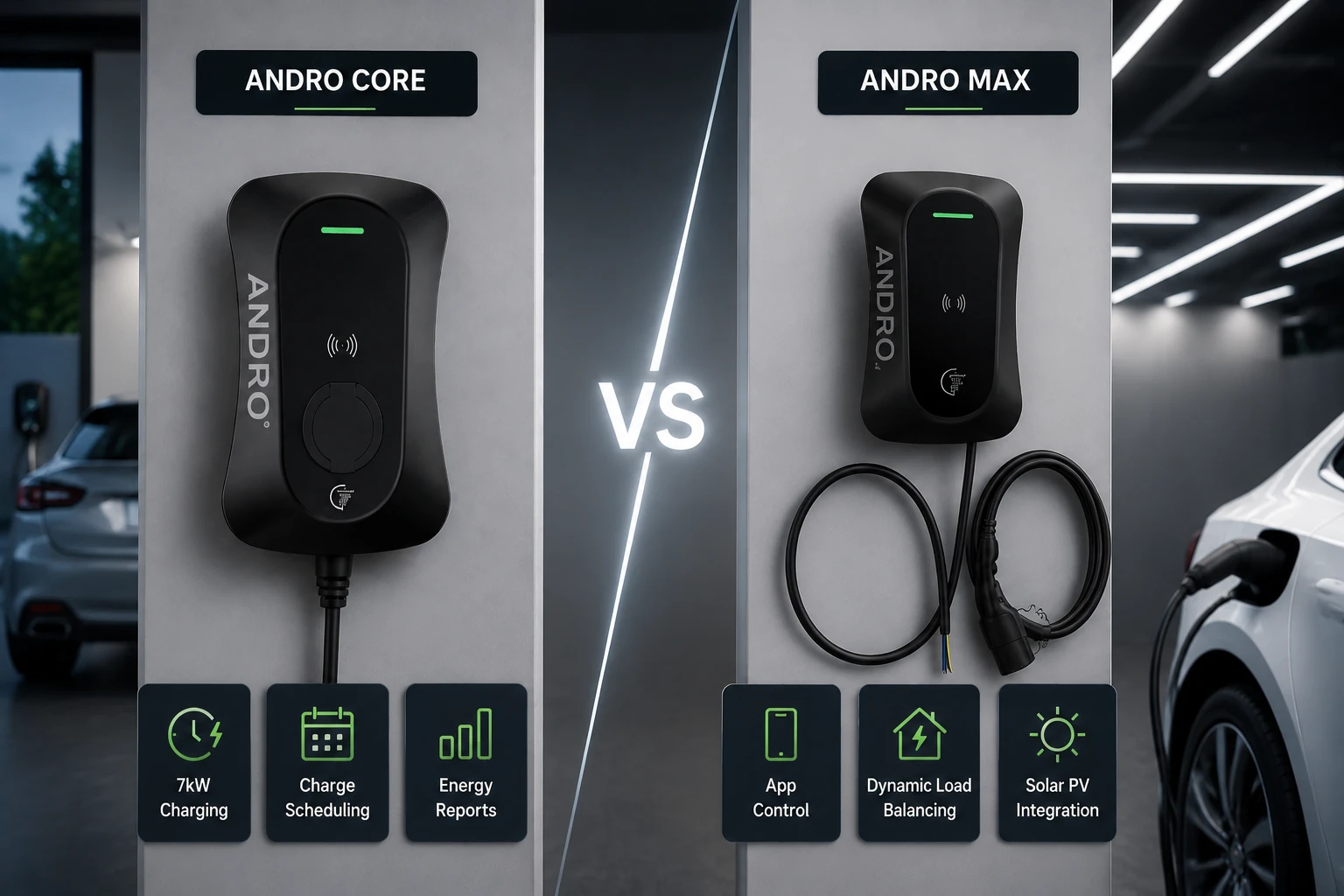
- The Andro Core and Andro Max both provide up to 7kW Type 2 charging for regular home use.
- The Andro Core is the lower-cost option and includes scheduling, energy reporting, RFID access and remote software updates.
- The Andro Max adds mobile-app control, Wi-Fi, Bluetooth, Dynamic Load Balancing and solar PV integration.
- The Andro Max does not charge faster than the Andro Core because both models have the same published 7kW maximum output.
- The better-value model depends on the household's electrical demand, charging routine, solar plans and need for connected energy management.
Compare the Andro Core and Andro Max EV chargers for Cardiff homes, including prices, smart features, app control, load balancing, solar integration and everyday charging suitability.
Andro Core and Andro Max at a Glance
The Andro Core and Andro Max are both 7kW domestic EV wallboxes designed for Type 2 electric vehicles. They are available in socketed and cable-type versions and share several core charging functions.
Both models include charging schedules, energy-consumption reporting, remote software updates, RFID access and emergency control.
The main differences relate to connectivity and energy management. The Andro Max adds Wi-Fi, Bluetooth, mobile-app control, Dynamic Load Balancing and solar PV integration.
As of 16 August 2026, the Andro Core is listed at £350 for the socketed version and £370 for the cable version, while the Andro Max is listed at £450 and £480 respectively.
What Do Both Chargers Have in Common?
Both the Andro Core and Andro Max provide a published maximum output of 7kW and operate from a 230V electrical supply.
Both models use the IEC 62196-2 Type 2 charging standard, which is widely used by modern electric vehicles across the UK and Europe.
For many Cardiff households, 7kW is a practical domestic charging level because vehicles can replenish their batteries over several hours while parked overnight.
The actual charging rate still depends on the vehicle's onboard AC charger, the property's electrical installation and other site-specific conditions.
Both models support scheduled charging, helping drivers align charging with suitable off-peak electricity tariffs where available.
Energy-consumption reporting provides greater visibility over electricity use, while remote software updates can help maintain functionality and compatibility over time.
What Is the Andro Core Designed For?
The Andro Core is the simpler and more affordable model, aimed at homeowners who want dependable everyday EV charging without advanced home-energy integration.
Its published features include 7kW charging, charge scheduling, energy-consumption reporting, remote software updates, RFID access and emergency control.
It may suit a Cardiff household with one electric vehicle, predictable daily mileage, a regular overnight charging routine and no immediate need for solar integration or Dynamic Load Balancing.
The Core may also appeal to drivers who prefer a straightforward charging arrangement and do not want to manage another household device through a mobile application.
What Does the Andro Max Add?
The Andro Max builds on the Core's main charging functions by adding connected controls and more advanced household energy management.
Its socketed version is listed at £450, while the cable-type version is listed at £480.
This places the Max around £100 to £110 above the equivalent Andro Core models.
The additional cost relates mainly to mobile-app connectivity, Dynamic Load Balancing and solar PV integration rather than a higher charging speed.
Mobile-App Connectivity
The Andro Max supports charging management through Wi-Fi, Bluetooth and a mobile application.
This allows owners to check or manage charging without standing beside the wallbox and can be useful for households with changing schedules or existing smart-home technology.
For drivers who follow the same charging routine every night, the Andro Core's built-in scheduling may already provide all the automation they need.
Dynamic Load Balancing
Dynamic Load Balancing allows the Andro Max to adjust EV charging power according to other electrical demand within the home.
If several high-demand appliances are operating at the same time, the charger can temporarily reduce the power allocated to the vehicle.
When household electricity demand falls, more charging power can become available again where appropriate.
This feature does not create extra electrical capacity. It helps use the property's existing capacity more intelligently.
It may be particularly useful for all-electric homes, larger households or properties using equipment such as electric showers, induction hobs and heat pumps.
Solar PV Integration
The Andro Max supports solar photovoltaic integration, making it the stronger option where solar-assisted EV charging is an important requirement.
A compatible setup can allow available solar generation to contribute towards vehicle charging rather than relying entirely on imported grid electricity.
The practical benefit depends on the size and orientation of the solar array, the amount of surplus generation available, whether the vehicle is at home during daylight hours and the design of any home-battery system.
For homeowners planning a broader low-carbon energy system, solar compatibility can provide greater flexibility for future upgrades.
Will the Andro Max Charge Your Car Faster?
Under comparable conditions, the Andro Max will not charge the vehicle faster than the Andro Core.
Both models have the same published maximum output of 7kW.
The Max's higher price pays for additional connectivity and energy-management features rather than a higher headline AC charging rate.
Dynamic Load Balancing may temporarily reduce charging power during periods of high household demand, but this is part of the system's energy-management function rather than a charging fault.
How Long Does a 7kW Home Charger Take?
Charging time depends on how much energy needs to be added to the battery rather than the battery's total capacity alone.
If a vehicle needs approximately 35kWh of energy, a 7kW charger could theoretically deliver that amount in around five hours.
Real charging may take longer because of power variation, charging losses, vehicle limitations and battery-management behaviour.
For overnight use, both the Andro Core and Andro Max provide the same basic charging-speed potential, subject to the vehicle and property.
Which Model Is Better for Managing Electricity Costs?
Both models support charging schedules, so either charger can help a household use lower-cost electricity periods where a suitable time-of-use tariff is available.
The Andro Core may be sufficient where the main cost-saving objective is simply to schedule charging during an off-peak window.
The Andro Max becomes more useful where energy management also involves coordinating EV charging with household demand or solar generation.
Advanced features do not guarantee savings on their own. Their value depends on the household's tariff, charging behaviour, electrical loads and ability to use solar energy.
Socketed or Cable Version?
Both the Andro Core and Andro Max are available in socketed and cable-type versions.
A socketed charger requires a separate Type 2 cable between the wallbox and the vehicle and may provide a tidier appearance when not in use.
A cable-type or tethered charger keeps the charging lead attached to the wallbox, making everyday charging quicker and more convenient.
The choice does not affect the published maximum charging output and is mainly a matter of convenience, cable storage and driveway layout.
Which Is Better for an Older Cardiff Property?
The age of a property does not automatically determine whether the Andro Core or Andro Max is more suitable.
The condition and capacity of the electrical installation, consumer-unit location, cable route, earthing arrangement and total household demand are more important considerations.
The Andro Max's Dynamic Load Balancing may be useful where available electrical capacity needs to be managed carefully, but it is not a substitute for a professional electrical assessment.
The final installed cost can therefore vary between two Cardiff properties even when both homeowners choose the same charger model.
Which Is Better for a Home with Solar Panels?
The Andro Max is the more appropriate option where solar integration is a key requirement.
Solar PV integration is included in the Max's published specification but is not listed among the Andro Core's features.
The actual benefit should be assessed across the whole energy system, including surplus solar generation, vehicle availability during the day and any home-battery arrangement.
For homeowners planning solar installation in the near future, choosing the Max may reduce the risk of wanting to replace the charger after the energy system is upgraded.
Which Is Better for a Second EV?
Neither the Andro Core nor the Andro Max is described as a dual-vehicle charging unit.
A household planning for two EVs should consider how many miles each vehicle covers, whether both need charging on the same night and whether a second charge point may be required later.
The Max's Dynamic Load Balancing may make it better suited to a home with increasingly complex electrical demand.
However, buying the Andro Max alone does not solve every two-vehicle charging requirement, so future expansion should still be professionally assessed.
Is the Andro Max Worth the Extra Cost?
The Andro Max is most likely to justify its additional cost when one or more of its advanced features addresses a real household requirement.
It may offer better value where the home already has solar panels, solar installation is planned, several high-demand appliances operate together or the owner wants direct mobile-app control.
The Andro Core may provide better value where there is one EV, charging mainly happens overnight, scheduling and energy reporting are sufficient and the household has no plans for solar integration.
The better-value charger is the model whose additional features are likely to be used regularly.
Andro Core or Andro Max: Practical Cardiff Scenarios
For a regular commuter travelling between Cardiff and Newport, returning home at a similar time and charging overnight, the Andro Core is likely to provide sufficient capability.
For a household with solar panels and a vehicle frequently parked at home during the day, the Andro Max is the stronger choice because its specification includes solar PV integration.
For an all-electric home using an electric shower, induction cooking and a heat pump, the Andro Max may provide greater value because of Dynamic Load Balancing.
For a driver who prefers simplicity and does not want app-based charging management, the Andro Core is likely to be the more proportionate option.
For a household planning future solar panels, battery storage or additional high-demand equipment, the Andro Max offers more flexibility for an increasingly connected energy system.
The Importance of Professional Installation
Whichever model is selected, installation quality is at least as important as the difference between the chargers.
A home EV charger is a sustained high-power electrical load and should be installed according to the property's electrical condition, parking layout and current UK requirements.
A professional site assessment can identify the correct cable route, protective equipment, load-management requirements and final charger position.
It can also help determine whether a socketed or cable-type model is more practical for the location of the vehicle's charging port and the shape of the driveway.
The Role of Home Charging in Cardiff's EV Future
Cardiff's future EV charging network will rely on a combination of home wallboxes, workplace charging, on-street infrastructure and public rapid charging.
Public charging remains essential for longer journeys and residents without private parking, while private wallboxes give eligible households the convenience of charging while the vehicle is already parked.
Smart home chargers can support this wider system by encouraging charging at manageable times and, where suitable, coordinating EV demand with household electricity use and renewable generation.
Final Verdict
The Andro Core is a strong choice for Cardiff households seeking straightforward, reliable 7kW home charging with scheduling and useful monitoring features.
The Andro Max is better suited to homes requiring more advanced connectivity and energy management through mobile-app controls, Dynamic Load Balancing and solar integration.
Neither model is universally better. Both provide the same headline 7kW output and Type 2 compatibility but are aimed at different levels of household energy complexity.
For a simple overnight charging routine, the Andro Core is likely to provide better initial value. For a solar-equipped home, a property with higher electrical demand or a household preparing for a more connected energy future, the Andro Max may be the more adaptable long-term choice.
The final decision should combine the product comparison with a proper assessment of the home, vehicle, parking space and future energy plans.