
Commercial EV Chargers UK: A Practical Guide for Businesses

- Commercial EV charging in the UK should be planned around drivers, parking duration, site electricity capacity and operating requirements.
- AC charging can suit workplaces and destinations with longer parking stays; DC charging may suit higher-throughput use cases where infrastructure permits.
- Actual 7kW, 11kW or 22kW AC charging performance depends on the vehicle, installation and power-management settings.
- Load balancing, access controls and management software can help operators run multi-charger sites, but features vary by product.
- Budget for surveys, electrical works, installation, software and maintenance rather than comparing charger purchase prices alone.
- CoreTech Innovations supplies commercial EV charging products across the UK; confirm Excalibur specifications and installation arrangements for each site.
Explore commercial EV chargers in the UK, from workplace and fleet charging to site planning, power capacity, installation costs, load balancing and charger management.
Commercial EV Chargers in the UK: A Practical Guide for Businesses
Commercial electric vehicle charging is becoming an important consideration for UK organisations that operate car parks, support employees, welcome visitors or manage electric fleets. A suitable charging facility can make daily journeys easier and give a business more control over how its vehicles are charged.
The right solution depends on who will charge, how long vehicles remain parked, the electrical capacity of the site and the way charging will be operated. This guide explains the decisions behind commercial EV charging, from initial demand assessment to long-term management.
CoreTech Innovations is based in Cardiff and supplies EV charging products to customers across the UK, including England, Scotland, Wales and Northern Ireland.
What Counts as Commercial EV Charging?
Commercial EV charging covers charging equipment used at workplaces, retail premises, hotels, offices, industrial sites, depots and other business properties. The same site may serve staff, company vehicles, customers and authorised visitors, each with different charging needs.
Unlike a typical private home installation, a business site may need multiple charge points, shared electrical capacity, user permissions, usage records and a process for maintaining equipment. Some sites also require public access or payment arrangements.
Commercial charging does not automatically mean ultra-rapid DC charging. For many premises, AC charging is appropriate when vehicles remain parked for several hours.
Which UK Businesses Benefit from EV Chargers?
Offices may offer charging for employees who park throughout the working day. Hotels and accommodation providers may offer overnight destination charging, while shops and leisure venues may serve visitors with shorter dwell times.
Logistics operators and service businesses may need predictable overnight or shift-based fleet charging. Commercial landlords and managed car parks may want to allocate access among different tenants or users.
A useful starting point is to identify the actual drivers, parking patterns and business objectives rather than selecting equipment based on headline charging power alone.
Start with a Site and Demand Assessment
Record the number of parking spaces, expected EV users, average parking duration, daily vehicle mileage and anticipated future demand. Consider whether charging will be private, restricted to approved users or accessible to the public.
A qualified electrical professional should assess incoming supply, distribution boards, cable routes, earthing arrangements and available capacity. The feasibility of additional charging points depends on the site, not merely the space available in the car park.
Accessibility, lighting, pedestrian routes, signage, physical protection and vehicle manoeuvring should also be considered early. These practical details can influence both safety and customer experience.
AC Versus DC Commercial EV Chargers
AC chargers supply alternating current that the vehicle converts to charge its battery. They are often suited to workplaces, hotels and other destinations where drivers park for extended periods. The vehicle onboard charger limits the AC power it can accept.
DC chargers convert electricity before delivering it to the vehicle and can support faster charging where compatible vehicles, site capacity and budgets permit. DC infrastructure can require substantially different electrical and operational planning.
For many business premises, the most appropriate choice comes from matching available dwell time and required energy to the electrical infrastructure rather than automatically selecting the highest-power charger.
Understanding 7kW, 11kW and 22kW AC Charging
Common AC charging power levels include approximately 7kW on suitable single-phase arrangements and 11kW or 22kW on suitable three-phase arrangements. These are indicative equipment categories, not guaranteed charging speeds for every vehicle.
Actual power depends on the vehicle onboard charger, the electrical installation, configured limits and any load-management system. A vehicle limited to 11kW AC will not draw 22kW simply because a 22kW charge point is available.
When several vehicles charge at once, site-wide capacity can matter more than an individual charger rating. This is particularly important for growing workplace and fleet installations.
How Many Charging Points Does a Business Need?
Begin with expected daily demand rather than the total number of parking spaces. Estimate how many vehicles need charging, how much energy each requires and how long each will remain connected.
A smaller number of well-utilised chargers may meet current demand, while an expandable electrical layout can support additional units later. Conversely, a depot with vehicles returning simultaneously may need more dedicated bays.
Consider queuing, charger availability, maintenance downtime and whether users can move vehicles once charging finishes. These operational factors can determine how many charge points are genuinely useful.
Load Balancing and Electrical Capacity
Load balancing can distribute available electrical capacity among compatible charging points and help manage demand when multiple vehicles are connected. The exact capabilities depend on the charging equipment, controllers and site design.
Some systems can adjust charging power in response to building electricity use or agreed site limits. This may reduce the need for all chargers to operate at maximum power simultaneously, but it does not remove the need for a proper electrical assessment.
Businesses should ask how the proposed system behaves at peak demand, whether minimum charging requirements can be met and what happens if communication or a management component becomes unavailable.
Smart Management, OCPP and Monitoring
Commercial operators may need charging session records, remote status information, fault alerts, energy reports and user management. These functions can be provided through compatible charging equipment and management software.
Open Charge Point Protocol, or OCPP, is a communication protocol that can enable compatible charge points to exchange information with central management platforms. Support for a named OCPP version does not guarantee every feature or interoperability with every platform.
Before purchasing, confirm the exact protocol version, tested software integrations, connectivity requirements, ongoing platform fees and arrangements for moving to another provider if needed.
RFID, User Access and Payment Options
A workplace may want to reserve charging for employees, while a hotel or commercial car park may need access for guests or the public. Some systems use RFID cards, mobile applications or other authorisation methods.
RFID can identify approved users on compatible chargers, but card support, account management and usage reporting vary by product and platform. It should not be assumed that a particular model includes these functions without checking its specifications.
Where drivers are charged a fee, the operator should assess the payment experience, pricing display, receipts, data handling and any applicable requirements for publicly accessible charging.
Commercial EV Charger Installation and Compliance in the UK
Commercial charging equipment should be specified and installed by appropriately competent professionals following the applicable electrical requirements and manufacturer instructions. Relevant obligations can vary with the location, site type and intended use.
An installation assessment may need to address electrical protection, earthing, cable routing, accessibility, planning constraints and arrangements with the electricity network operator. Businesses should verify which permissions and notifications apply to their project.
UK-wide supply does not imply that the same installer, approvals or site conditions apply everywhere. Obtain location-specific advice before committing to a design or installation schedule.
What Does Commercial EV Charging Cost?
Project costs can include charge points, electrical surveys, distribution upgrades, civil works, cabling, protective equipment, signage, installation, commissioning and software subscriptions. The cost of electricity and maintenance also affects ongoing operation.
A low equipment price may not produce the lowest total cost of ownership if the site needs substantial enabling works or the management platform has recurring fees. Equally, a high-power system may be unnecessary where vehicles park for many hours.
Compare quotations using the same assumptions about number of bays, charging power, network connectivity, service support and expansion. Avoid relying on generic installation price claims without a site survey.
Fleet EV Charging and Operational Planning
Fleet charging should be designed around vehicle duty cycles: when vehicles return, how much energy they need before the next departure and how many must charge simultaneously. This can differ substantially from employee or visitor charging.
Scheduled charging and load management may help align charging with available capacity and electricity tariff periods, subject to operational constraints. Charging reports can help managers review utilisation and identify recurring bottlenecks.
For critical fleet operations, consider contingency plans for equipment faults, network interruptions and vehicles that arrive with unexpectedly low battery levels.
Choosing Equipment: CoreTech Excalibur Commercial Chargers
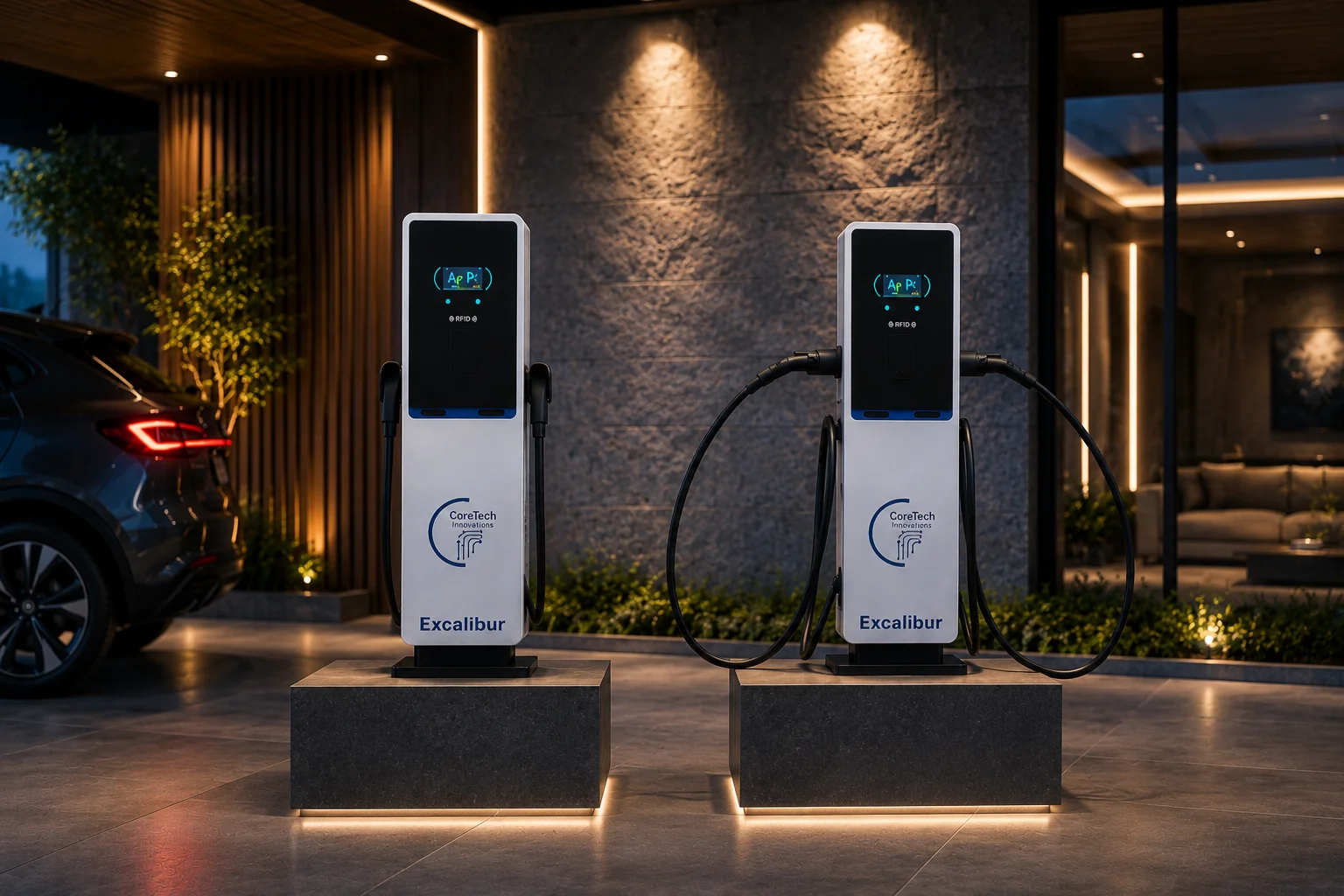
CoreTech Innovations offers the Excalibur range for commercial EV charging applications alongside other charging products. Businesses comparing equipment should review the current model documentation for output configuration, electrical requirements, physical design and supported management features.
For example, a dual-output charger may suit a site serving two vehicles, but the total available site capacity, vehicle compatibility and product-specific power-sharing behaviour must be confirmed before design decisions are made.
Do not assume that every Excalibur model supports RFID, OCPP, remote monitoring or a particular payment service. CoreTech can provide current product information to help customers assess suitable equipment.
Planning for Growth Across UK Sites
Businesses with several premises can benefit from defining consistent requirements for hardware, reporting, user access and maintenance while allowing for local differences in electricity supply and parking arrangements.
Consider future cable routes, distribution capacity, spare space for equipment and the commercial terms of any management platform. Expansion is often easier to plan before the first installation than after a car park is in regular use.
A phased approach can provide an opportunity to measure charger utilisation and refine the next stage based on actual demand rather than projections alone.
Commercial EV Charging FAQs
What is the difference between a commercial and a home EV charger? Commercial installations may require multiple charge points, shared power management, user permissions and operational reporting, depending on the site.
Is a 22kW charger always faster than a 7kW charger? No. Actual AC charging power depends on the vehicle, electrical supply and configured operating limits.
Do commercial chargers need OCPP? Not every installation needs OCPP, but it can be useful where compatible central management and future platform flexibility are priorities. Verify version and integration support.
Can employees and visitors use the same chargers? Potentially, yes, if the site layout, access controls and operating policies support both groups.
Does CoreTech supply commercial EV chargers outside Cardiff? CoreTech is Cardiff-based and supplies EV charging products across the UK. Installation arrangements should be confirmed separately for the intended site.