EV Charging for Company Cars: A UK Guide for Employers and Drivers

- Company car EV charging should be planned around daily mileage, vehicle parking and the time available to charge.
- Home charging may suit employees with suitable off-street parking, while workplace charging supports shared vehicles and drivers without home access.
- AC charging is often practical for longer stops; public DC charging may help on longer or time-sensitive journeys.
- Employers should define charger ownership, installation responsibility, charging expenses and employee reimbursement arrangements.
- CoreTech Andro and Excalibur ranges offer home and commercial product options; verify model specifications before selection.
- CoreTech supplies EV charging products throughout the UK; installation coverage must be confirmed separately.
Explore company car EV charging across the UK, from home and workplace chargers to public charging, employee reimbursements, electrical capacity and practical employer policies.
EV Charging for Company Cars: A UK Guide for Employers and Drivers
Company car EV charging works best when employers and drivers plan around real journeys, parking arrangements and the time each vehicle is available to charge. A company car used for commuting may have different requirements from one making frequent business trips.
This UK guide explains home, workplace and public charging options, how employers can approach electricity costs and reimbursement, and what to consider before choosing equipment.
CoreTech Innovations is based in Cardiff and supplies EV charging products throughout England, Scotland, Wales and Northern Ireland. Installation arrangements should be confirmed separately for each location.
How to Plan Charging for Electric Company Cars
Begin by identifying where each vehicle is normally parked overnight, how many miles it typically covers and whether journeys are predictable. Consider the battery capacity and charging capabilities of the actual vehicle rather than assuming every electric company car charges at the same rate.
A practical policy should account for employees with driveways, drivers using shared or rented parking, and staff who travel between multiple locations. Home, workplace and public charging can complement one another.
Home EV Chargers for Company Car Drivers
A dedicated home charger may be convenient when an employee has suitable off-street parking and a property that can accommodate a compliant installation. Charging while the vehicle is parked overnight can reduce dependence on public charging during the working day.
The electrical supply, charger location, cable routing and any required permissions should be assessed by a competent installer. Employees who rent or share a property may need permission before any work takes place.
Employers should agree who owns the charger, who pays for installation and maintenance, and what happens when the employee changes job, vehicle or address.
CoreTech Andro for Home Company Car Charging
CoreTech's Andro range offers wall-mounted EV charging products that may suit company car drivers with an appropriate home installation location.
Compare current model specifications, vehicle compatibility, charging features, electrical requirements and warranty information before selecting a charger. Do not assume a particular power output or feature without checking the product documentation.
Explore CoreTech's EV charger range for up-to-date product information and availability.
Workplace EV Charging for Company Cars
Workplace charging can support employees who cannot charge at home and vehicles that regularly return to business premises. It may also help businesses manage company car charging during the working day.
Assess the number of parking spaces, expected daily energy demand, how long cars remain on site and whether charging should be reserved for company vehicles or shared with staff and visitors.
Access controls, clear signage, maintenance and a process for reporting faults all contribute to a usable workplace charging arrangement.
CoreTech Excalibur for Commercial Charging
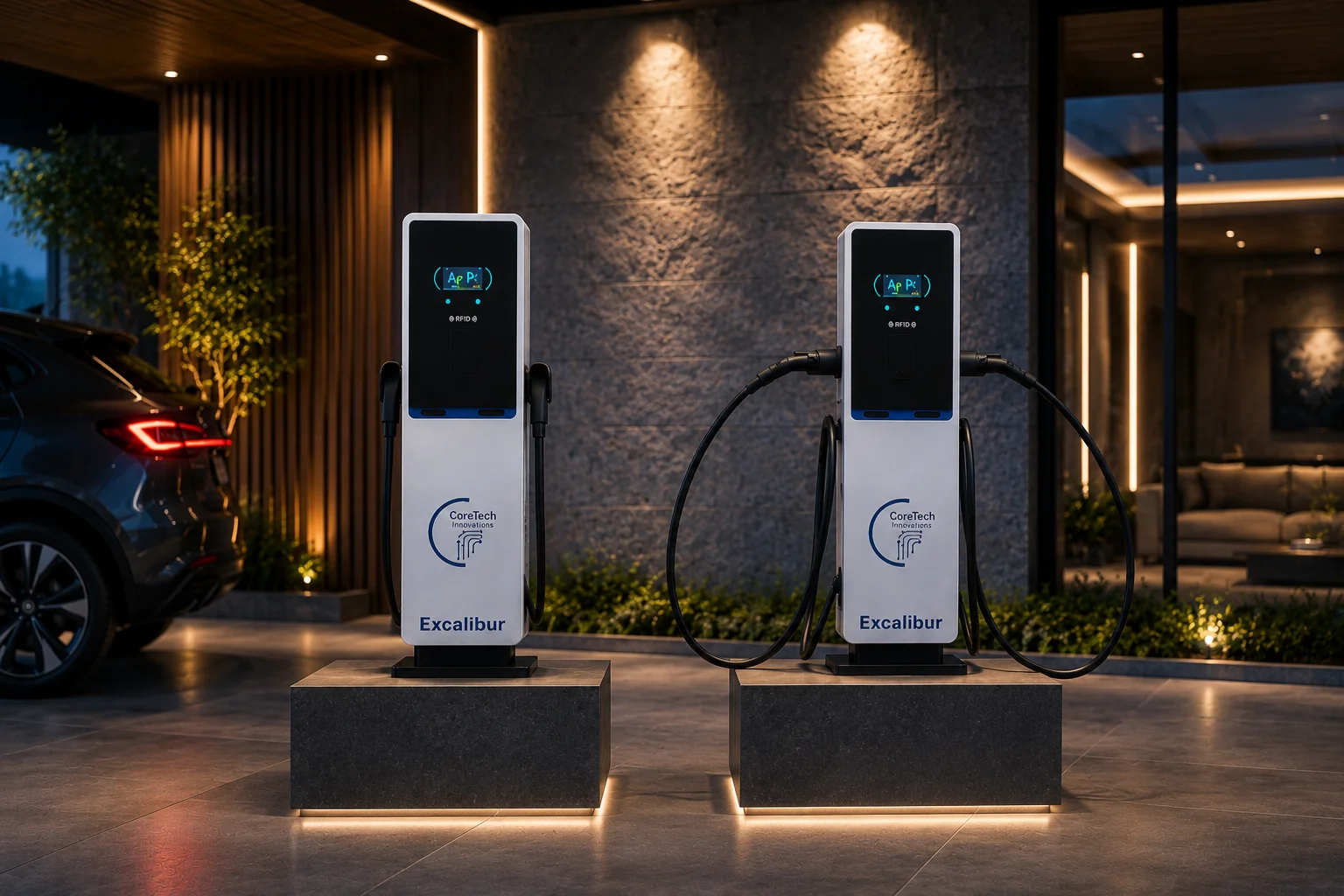
CoreTech's Excalibur range is intended for commercial EV charging applications and may be considered for workplace and company car charging projects.
The right equipment depends on site capacity, charging demand, parking layout and operational needs. Confirm the current product's power ratings, connectivity and any access or payment capabilities before purchase.
A site assessment should guide the equipment decision rather than the product name alone.
Home vs Workplace vs Public Charging: Which Is Best?
Home charging may be practical for employees with private parking and regular overnight stops. Workplace charging may be more useful for shared company vehicles, staff without home charging or vehicles parked at a depot.
Public charging can provide additional flexibility for long journeys and unexpected changes of route, although price, availability and charging speed vary between locations.
Many employers will benefit from a mixed approach rather than expecting every employee to use one charging method.
AC and DC Charging for Business Vehicles
AC charging often suits vehicles parked for several hours at home or work. Common charger ratings include 7 kW, 11 kW and 22 kW, but actual charging speed depends on the vehicle's onboard charger and the electrical installation.
DC rapid charging may help drivers who need a shorter stop during a journey, although the vehicle's charging curve, battery state and charger capability affect actual performance.
Match charging type to vehicle dwell time and operational requirements rather than selecting the highest advertised power.
Who Pays for Company Car Charging at Home?
Employers and employees should agree in writing how installation costs, electricity usage, reimbursements and ongoing support will be handled. Separate business-related charging from private use where that distinction is relevant to the company's policy.
Smart charging records or other agreed evidence may help document energy use, but employers should verify how any chosen system measures consumption and handles personal data.
UK tax treatment and HMRC advisory rates or reimbursement rules can change and depend on circumstances. Obtain current payroll or tax advice before setting a reimbursement policy; this article does not provide a fixed tax rate or entitlement.
Workplace Charging Costs and Electrical Capacity
The overall cost of workplace charging depends on equipment, number of charge points, electrical capacity, cable routes, groundwork, networking, commissioning and any supply upgrades.
A competent electrical professional should assess existing demand, protection requirements and whether load management could help multiple vehicles share available capacity.
Budget for ongoing electricity, software where applicable, maintenance and support, not just the initial hardware purchase. Request an itemised site-specific quotation.
Managing Employee Access, Charging Data and Policies
Set out which vehicles may use company-funded charging, when charging bays should be vacated and how employees report problems. Consider whether drivers need access to home, workplace and public charging within one policy.
Where charging data is collected, explain what is recorded, who can access it and how long it is retained, in line with applicable data protection obligations.
A clear policy reduces confusion about equipment ownership, charging expenses and responsibilities when an employee leaves the business.
Company Cars Without a Home Driveway
Employees without suitable off-street parking may rely on workplace or public charging. Some locations may offer other approved options, but charging cables should not be run across pavements or shared routes without appropriate permissions and safety arrangements.
Employers should evaluate the practical availability of charging near employees' homes and workplaces before assigning vehicles that depend on daily charging.
Charging arrangements should be equitable and realistic for different housing and parking circumstances.
Building a Scalable Company Car Charging Plan
Start with current vehicle numbers, expected mileage and where charging demand will occur. For workplace sites, consider whether cable routes, electrical distribution and parking layout can accommodate future chargers.
Review utilisation, driver feedback, electricity costs and operational disruption after deployment. Expand charging capacity when measured demand supports it rather than installing equipment based solely on assumptions.
Company Car EV Charger Products Supplied Across the UK
CoreTech Innovations supplies EV charging products throughout England, Scotland, Wales and Northern Ireland from its Cardiff base.
Employers can explore Andro home charging products and Excalibur commercial charging options for their company car arrangements. Suitability depends on the vehicle, site and current product specifications.
Product delivery across the UK does not imply that CoreTech provides installation in every area. Confirm installation and commissioning arrangements for each project separately.
Frequently Asked Questions About Company Car EV Charging
Can employees charge company cars at home? Yes, where parking, electrical infrastructure and required permissions make a compliant home installation possible.
Is a home or workplace charger better for company cars? The best arrangement depends on where vehicles are parked, daily mileage and whether drivers have suitable home parking. Some fleets use both.
Who pays for electricity used to charge a company car at home? That should be defined in the employer's policy, with current tax and reimbursement treatment checked against HMRC guidance and professional advice.
Do company cars need rapid charging? Not necessarily. Overnight or workplace AC charging may cover routine use, while public rapid charging can help during longer or time-sensitive journeys.
Does CoreTech supply company car chargers throughout the UK? Yes. CoreTech supplies EV charging products across the UK; installation availability must be confirmed separately.