EV Chargers for Restaurants: A Practical Guide for the UK

- Restaurant EV charging should be selected around customer dwell time, parking demand and available electrical capacity.
- AC charging often suits longer restaurant visits; DC charging may be worth assessing for shorter stays, subject to cost and infrastructure.
- The number and position of charging points should reflect actual car park usage, accessibility and possible future expansion.
- Compare installation and ongoing costs, and decide whether charging will be free or paid before choosing equipment.
- CoreTech is based in Cardiff and supplies EV charging products throughout the UK; installation coverage must be confirmed separately.
A practical guide to EV chargers for restaurants and hospitality venues in the UK. Compare AC and DC charging, customer dwell time, costs, electrical requirements and charging management.
EV Chargers for Restaurants: A Practical Guide for the UK
EV chargers for restaurants can make customer parking more useful while guests dine, meet friends or attend events. For restaurant owners, the important question is not simply which charger to buy, but which charging arrangement fits their visitors, premises and operating costs.
This guide explains the main choices for restaurants, cafés, pubs and other hospitality venues in the UK: AC versus DC charging, customer dwell time, number of bays, electrical capacity, pricing, accessibility and ongoing management.
CoreTech Innovations is based in Cardiff and supplies EV charging products throughout the UK. Product supply should not be confused with installation availability, which must be confirmed for each site.
Why Offer EV Charging at a Restaurant?
Guests who drive electric vehicles may value being able to charge during a planned meal rather than making a separate stop. Whether charging improves the customer experience depends on demand, parking availability and how reliably the facility is operated.
Charging can be offered as a customer amenity or as a paid service, but neither additional footfall nor charging revenue is guaranteed. Restaurants should assess local EV use, existing public chargers, parking occupancy and likely utilisation before investing.
AC vs DC EV Charging for Restaurants
AC chargers are often a practical starting point for sit-down restaurants where customers remain parked for an hour or more. Actual charging speed depends on the vehicle’s onboard AC charger, the charge point, site limits and the battery state.
DC chargers can add energy faster for compatible vehicles, potentially suiting high-turnover locations, but typically require more substantial equipment and electrical capacity. A short-stay takeaway and a destination restaurant may therefore need different approaches.
Compare total installed cost, available grid capacity, expected session duration and likely utilisation rather than assuming the highest rated charger is the best choice.
Match Charger Power to Customer Dwell Time
Start by estimating how long guests actually park. A restaurant with 90-minute dining visits has different charging requirements from a café where most visitors stay 20 minutes.
As an illustration, a charger delivering 7 kW continuously for two hours would supply about 14 kWh before charging losses and vehicle or site limitations. This is an example, not a guaranteed charging outcome.
Use typical visit length and vehicle compatibility to assess whether slower destination charging is useful or whether faster charging warrants a more detailed feasibility study.
How Many Charging Points Does a Restaurant Need?
The appropriate number of charge points depends on the size of the car park, current EV demand, peak dining periods, electrical capacity and expected growth. Starting with a manageable number of bays and planning for future expansion can avoid unnecessary upfront spending.
Consider whether a single unit can serve more than one parking bay, whether simultaneous charging will reduce available power and how vehicles will enter and leave the spaces.
Collect parking and occupancy data before choosing a configuration; there is no universal number of chargers that suits every restaurant.
Restaurant EV Charger Installation Costs in the UK
Total project cost is affected by charger type and quantity, electrical supply, distribution board capacity, cable runs, trenching, groundworks, signage, protective measures and any network upgrade.
Budget for ongoing electricity, maintenance, connectivity, payment processing and software charges where applicable. Request an itemised site-specific quotation and compare whole-life costs, not only equipment prices.
Any grants, tax treatment or regulatory obligations should be checked against current official eligibility and guidance before being included in a business case.
Free or Paid Charging for Restaurant Customers?
Free charging may be used as a customer benefit, but electricity and operational costs still fall on the business. Paid charging may recover some costs, depending on usage, tariffs and the provider’s fees.
Operators should decide who may use the bays, how drivers start a session, how prices are displayed and what support is available if charging fails.
Where charging is offered to the public, check current UK rules and any applicable requirements for payments, pricing transparency, accessibility and operation; obligations can vary by charger and site.
Electrical Capacity, Smart Charging and Site Assessment
A qualified installer should assess the existing electrical installation, available capacity, cable routing and protective requirements before equipment is selected.
Where several vehicles may charge at once, load management may help share available capacity, subject to compatible equipment and site design. A grid connection upgrade may still be necessary.
Landlord consent, lease restrictions, planning considerations and network operator requirements may also affect feasibility. Do not assume that an existing car park is automatically ready for EV charging.
Parking Layout, Accessibility and Customer Experience
Position charging bays so cables do not obstruct pedestrian routes or create trip hazards. Consider bay dimensions, accessible use, lighting, signs and safe movement around the car park.
Explain whether charging is reserved for diners, whether parking time limits apply and how customers can find help. Clear instructions and reliable maintenance matter as much as the equipment itself.
Choosing Commercial EV Charging Equipment: CoreTech Excalibur
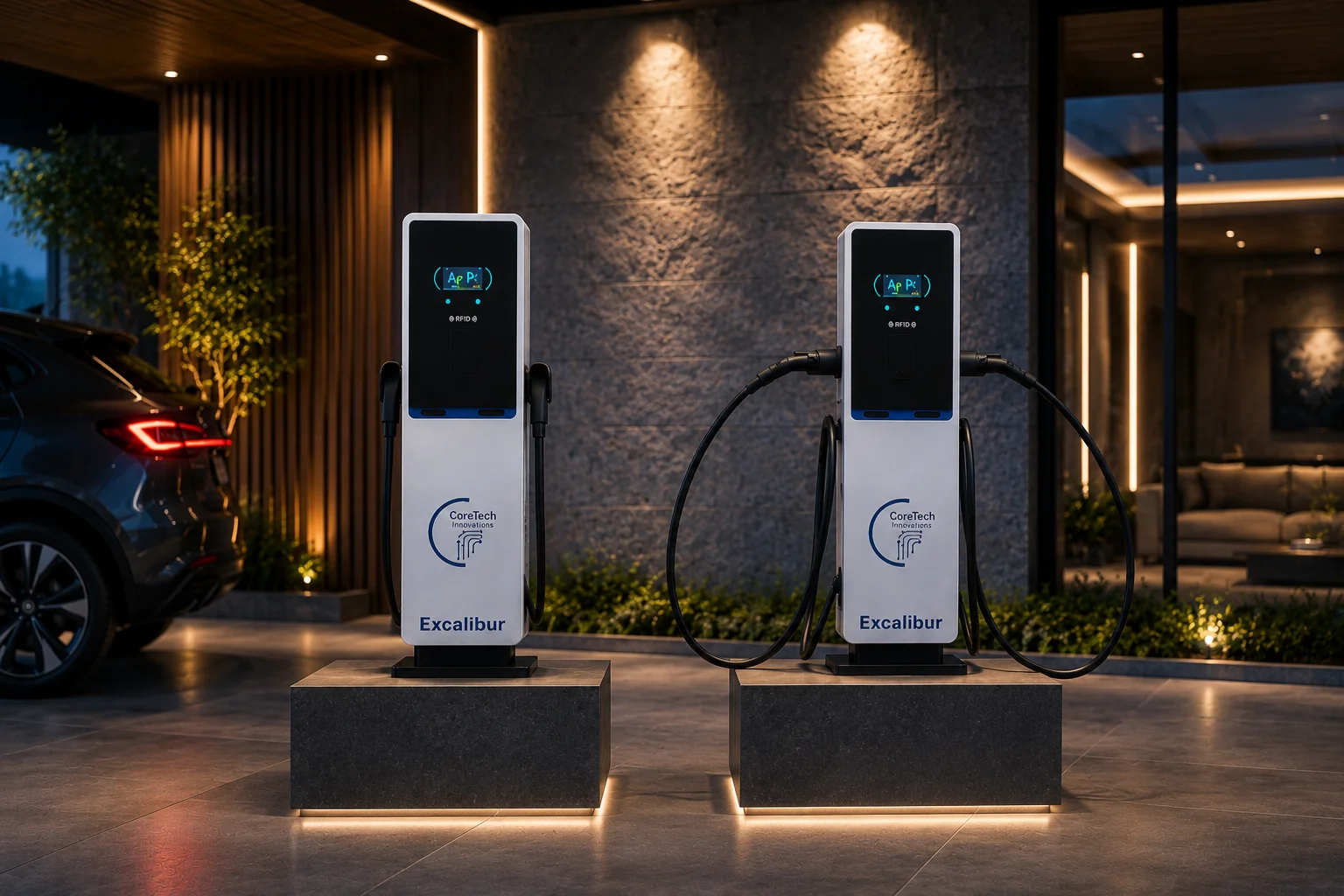
CoreTech’s Excalibur range is presented as an option for commercial EV charging applications, including hospitality sites. Suitability for a particular restaurant depends on the exact model, site power supply, charging requirements and desired management features.
Before purchasing, confirm the current model specifications, connector type, rated output, connectivity, payment compatibility, warranty and any required accessories with CoreTech. Features should not be assumed to be available on every configuration.
Explore the current CoreTech EV charger range for product details, and request guidance based on your premises rather than choosing by headline power alone.
EV Charger Product Supply Across the UK
CoreTech Innovations operates from Cardiff and supplies EV charging products to customers throughout the UK, including restaurants and hospitality businesses in England, Scotland, Wales and Northern Ireland.
Businesses outside Cardiff can enquire about equipment for their premises. Product delivery does not automatically mean CoreTech offers installation in every location; confirm delivery terms and installation coverage separately before ordering.
Restaurant EV Charging in Cardiff
For restaurants in Cardiff, the same national considerations apply: visitor dwell time, available parking, electrical capacity, accessibility and total operating cost.
CoreTech’s Cardiff base provides a local point of contact for product enquiries. Restaurant owners in Cardiff can discuss suitable equipment and ask whether installation support is available for their specific address.
Frequently Asked Questions
What type of EV charger is best for a restaurant? For longer dining visits, AC charging may be suitable; short-stay or high-turnover sites may consider DC charging after assessing demand, capacity and cost.
How much does restaurant EV charger installation cost? Costs vary with charger type, electrical capacity, cable routes, groundworks and any upgrades. A site survey and itemised quote are more reliable than a generic price.
Can restaurants charge customers to use EV chargers? Charging may be free or paid. Operators should assess electricity costs, payment arrangements and any applicable UK requirements.
How many EV charging points should a restaurant install? Base the decision on parking usage, expected EV demand, peak periods, power capacity and expansion plans.
Does CoreTech supply restaurant EV chargers outside Cardiff? CoreTech supplies EV charging products throughout the UK. Installation availability must be confirmed separately for each location.
Is Excalibur suitable for a restaurant? It may be an option for commercial sites, but the appropriate model and features should be checked against the premises and current product specifications.