EV Charging for Flats and Apartments in the UK: Complete Guide

- EV charging in flats and apartment buildings is possible where parking rights, electrical infrastructure and required permissions align.
- An allocated bay does not automatically give a resident permission to install electrical equipment or route cables through shared areas.
- Communal charging needs an agreed approach to access, electricity metering, billing, maintenance and future expansion.
- Electrical capacity and simultaneous charging demand should be assessed before selecting hardware for a multi-resident building.
- CoreTech Andro wallboxes may suit appropriate individual installations, while Excalibur commercial chargers may suit certain shared sites.
- UK apartment developments should plan around their specific property and jurisdiction rather than assuming one solution fits every building.
A practical UK guide to EV charging in flats and apartment blocks, covering allocated and communal parking, permissions, electrical capacity, metering, shared charging and suitable CoreTech options.
EV Charging for Flats and Apartments in the UK: Complete Guide
EV charging in a flat is possible in many circumstances, but the practical route is often more complex than installing a wallbox beside a private driveway. The decisive questions are who controls the parking space, where electricity can be supplied from and who can authorise work in shared parts of the building.
Across the UK, leaseholders, tenants, freeholders, managing agents and residents associations may all be involved. This guide explains how to evaluate private and communal charging without assuming that every apartment development needs the same hardware or management arrangement.
CoreTech Innovations is based in Cardiff and supplies EV charging products to customers across the UK. The best starting point is a clear description of the building and its parking arrangements, rather than a preferred charger model.
Can You Charge an Electric Car When You Live in a Flat?
Yes, where suitable parking, an appropriate electrical supply and the necessary permissions are available. A flat does not automatically rule out convenient charging, although some buildings will need a coordinated approach rather than a charger installed for one resident.
An allocated bay beside the building may be relatively simple to assess. A basement car park, detached parking court or multi-storey structure can present different cable routes, fire-safety considerations and ownership boundaries.
If you park on a public road rather than on property controlled by the building, a private charger may not be practical. Public or destination charging may then remain part of your routine.
Understand Who Owns and Controls the Parking Area
Before requesting quotations, establish whether the bay is demised to an individual flat, allocated under a lease or licence, or part of a shared car park. These arrangements are not interchangeable, and the right to park does not necessarily include permission to alter electrical infrastructure.
Review the lease or tenancy documents and ask the managing agent or freeholder who can approve cable routes, fixings, electrical work and access to communal areas. Where several parties have an interest, written agreement is more reliable than informal approval.
The relevant legal and property arrangements can differ across England, Wales, Scotland and Northern Ireland. Obtain advice specific to the building rather than assuming one UK-wide consent process.
Dedicated Parking Bays Versus Communal Parking
A dedicated bay may suit an individually assigned charging point, especially if a feasible electrical route and suitable metering arrangement exist. However, the location of the consumer unit and ownership of intervening spaces still matter.
In communal parking, allocating chargers to particular residents may reduce flexibility. A shared installation can instead support access rules and a fair method for recording consumption, depending on the equipment and management platform chosen.
The right model should reflect occupancy, visitor parking, turnover of residents and the expected number of electric vehicles over the coming years.
Electrical Capacity and a Professional Site Assessment
A qualified electrical professional should assess available capacity, distribution equipment, earthing arrangements, protection, cable routes and any other site-specific requirements before a charger is selected. Apartment blocks often have several loads sharing common infrastructure.
Adding several chargers without assessing simultaneous demand can create unnecessary constraints or lead to an unsuitable design. The assessment should also consider whether a separate supply, alterations to distribution equipment or engagement with the relevant network operator may be necessary.
A product rating alone does not establish the charging speed that a particular site or vehicle can achieve. Available supply, vehicle capability and managed charging settings all affect the outcome.
How Load Management Can Help Shared Buildings
Where multiple charging points are planned, managed charging can help distribute the available electrical capacity rather than assuming every vehicle must draw maximum power at once. This can be useful in apartment car parks where cars are parked for long periods.
For example, overnight dwell time may allow charging sessions to be scheduled or shared across several vehicles, although actual performance depends on driving needs, charger compatibility and the control system.
Ask potential suppliers how their proposed solution handles simultaneous sessions, connection loss, future expansion and reporting. Do not assume every charger or configuration supports the same load-management features.
Who Pays for the Electricity?
An apartment charging project needs a clear billing approach. If electricity is taken from a private supply, responsibility may be relatively straightforward; if it comes from a communal supply, the building needs an agreed method of measuring and recovering costs.
Possible approaches include individually metered circuits, charging-platform records or an agreed managed service, subject to the equipment and site. The building should also decide how standing costs, maintenance and any shared infrastructure investment are handled.
Residents and managers should document the policy before equipment is installed. A charger that works technically but cannot be billed fairly can become difficult to operate.
Permissions, Building Rules and Safety Responsibilities
Permanent electrical works may require consent from a landlord, freeholder, factor, managing agent or other relevant party. Building policies, insurance arrangements and applicable safety requirements also need to be reviewed.
Installation must be planned and carried out by appropriately competent professionals under the requirements applicable to the property and jurisdiction. Cable protection, pedestrian routes, accessible parking and fire-safety considerations should be assessed for the specific site.
Avoid running an extension cable through a window, across a pavement or through shared corridors as an improvised alternative to a properly designed installation.
Individual Wallboxes: When the Andro Range May Fit
Where a flat has a suitable dedicated bay and a compliant fixed installation is feasible, a wall-mounted charger from CoreTech's Andro range may be worth evaluating. A dedicated home charging point can suit residents who charge regularly in the same parking space.
The model should be selected only after confirming the vehicle connection, electrical design, cable arrangement and any required site-management features. An individual wallbox does not automatically solve communal access or billing needs.
Browse the current CoreTech EV charger catalogue at https://www.coretechinnovations.co.uk/evchargers/ and confirm the exact product specifications before making a purchasing decision.
Communal Charging and the Excalibur Range
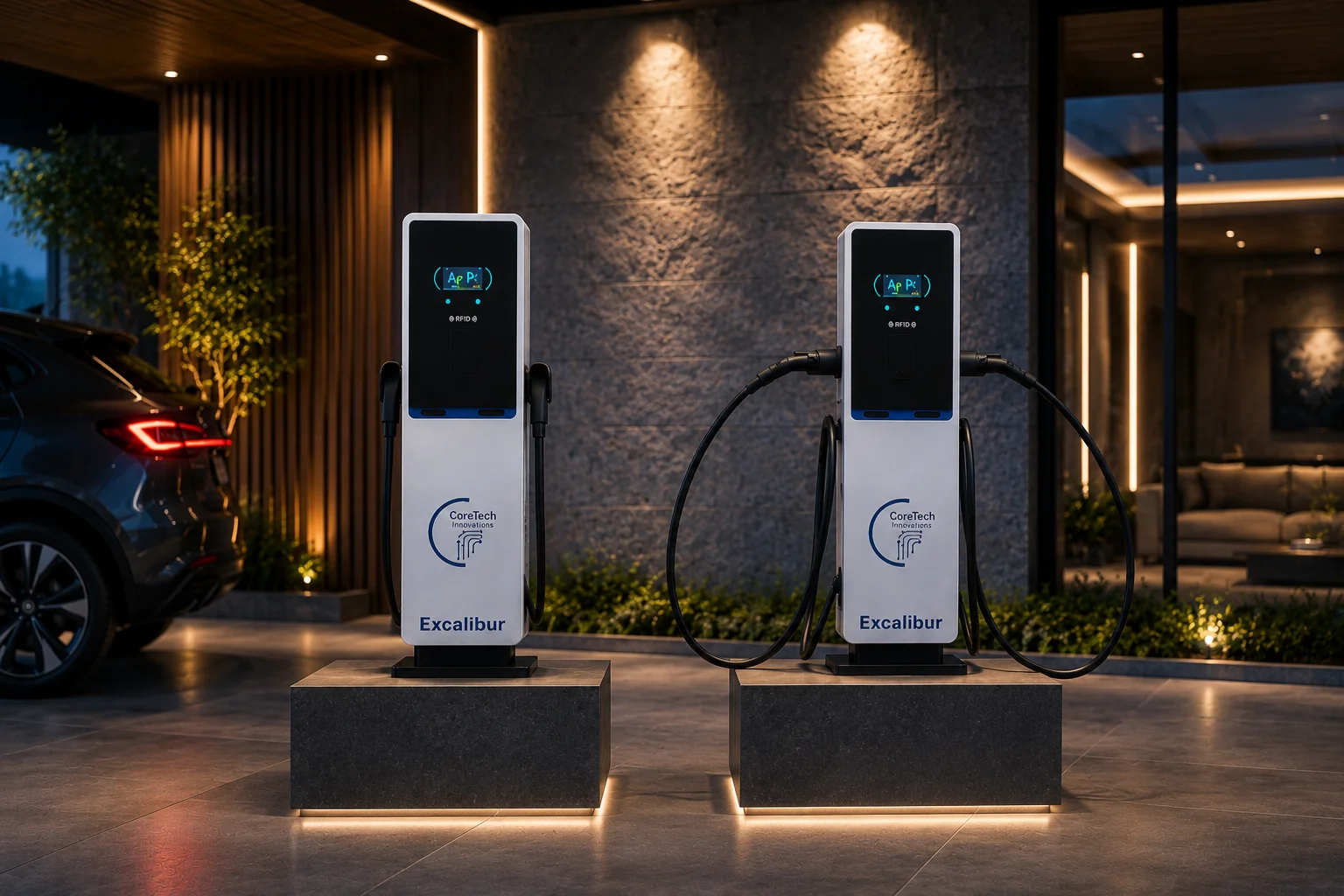
Larger developments or shared parking areas may need commercial charging equipment and a coordinated management arrangement. CoreTech's Excalibur range is intended for commercial EV charging applications and can be considered when assessing these environments.
A communal project should be specified around expected users, vehicle dwell times, access control, monitoring, maintenance and the ability to expand. Whether a particular Excalibur configuration is suitable depends on the site and the verified product capabilities.
Property managers should request a site-specific technical proposal rather than assuming that a commercial charger is the right answer for every apartment block.
What About Portable EV Charging?
Portable charging equipment can appear attractive where residents cannot install a permanent wallbox. However, portability does not remove the need for a suitable electrical connection, appropriate protection and permission to use the supply.
CoreTech's Hero 7 is a portable charging option, but it should only be considered where the vehicle, connector, power source and intended usage meet the product's current instructions. A communal socket is not automatically an authorised or safe charging point.
For renters who are mainly choosing between a removable device and a fixed charger, a separate renters-focused guide is more relevant than a building-wide infrastructure plan.
Planning a Phased Rollout for an Apartment Block
A development does not necessarily need to install a charging point in every bay immediately. A phased plan can begin with an assessment of likely demand, a suitable electrical strategy and a limited first deployment.
The design should consider where future cabling or distribution equipment could go, whether parking layouts might change and how additional residents would join the scheme. The economics of future expansion should be compared with the cost of providing some shared infrastructure at the outset.
Record the assumptions behind the design so that future property managers and residents can understand what was installed and what capacity remains.
Questions Residents Should Ask Their Managing Agent
Ask who controls the parking bay, who can authorise installation, whether there is a usable electrical route and whether the building already has a charging policy. Also ask how electricity consumption would be measured and whether insurance or maintenance responsibilities would change.
If other residents are interested, gathering their requirements together may help the building evaluate a coordinated approach. It can also reveal whether the main need is individual overnight charging, shared visitor charging or a mixture of both.
Written answers to these questions will make conversations with electricians and charger suppliers more productive.
Questions Property Managers Should Ask Suppliers
Request clarity on the proposed electrical design, expected simultaneous charging demand, installation responsibilities and ongoing support. Ask what monitoring and billing functions are included, which require a separate service and what happens if internet connectivity is interrupted.
Compare whole-life considerations such as maintenance, software arrangements, user onboarding and replacement parts rather than comparing the charger purchase price alone. Require confirmation of the exact model specifications and compatibility with the proposed management system.
For multi-building estates, it is especially important to understand whether the solution can be administered consistently across sites without promising capabilities the equipment does not provide.
Choosing a UK Apartment EV Charging Solution
There is no universal EV charger for flats in the UK. A resident with a privately controlled bay may need an individual solution, while a managing agent responsible for communal parking may need a coordinated commercial design.
CoreTech Innovations supplies home and commercial EV charging products across the UK, including the Andro and Excalibur ranges. Explore https://www.coretechinnovations.co.uk/evchargers/ for current options and contact the team with details of your building, parking layout and proposed usage.
Product supply should not be confused with a guarantee of installation coverage. Any installation scope, permissions and site suitability should be confirmed separately before committing.
Frequently Asked Questions
Can I install an EV charger in an allocated parking space? Possibly, but the lease, permission arrangements, electrical route and technical suitability must all be checked. An allocated bay alone does not authorise installation.
Can a block of flats share EV chargers? Yes, shared charging can be considered where the parking layout, electrical capacity, access arrangements and billing approach support it.
Who pays for electricity used by communal chargers? That depends on the metering and management arrangement agreed for the building. The policy should be documented before use.
Is an Andro or Excalibur charger right for my apartment building? Andro may suit suitable individual wallbox arrangements; Excalibur may be relevant to commercial or communal projects. Confirm model specifications and obtain a site assessment.
Do rules differ across the UK? Property rights, consent procedures and applicable requirements can vary by jurisdiction and building. Seek advice appropriate to your location and circumstances.