7kW vs 22kW EV Chargers: Which Charging Speed Is Right for You?

- 7kW and 22kW describe maximum AC charger output; the vehicle’s onboard AC charging limit determines how much power it can actually accept.
- A suitable 7kW single-phase charger can be practical for many UK households, particularly when vehicles charge overnight.
- A full-power 22kW AC installation generally needs suitable three-phase electricity and adequate available capacity.
- A 22kW charger does not guarantee faster charging for cars limited to 7kW or 11kW AC.
- Compare site-specific installation costs, parking duration, vehicle compatibility and any commercial load-management requirements before buying.
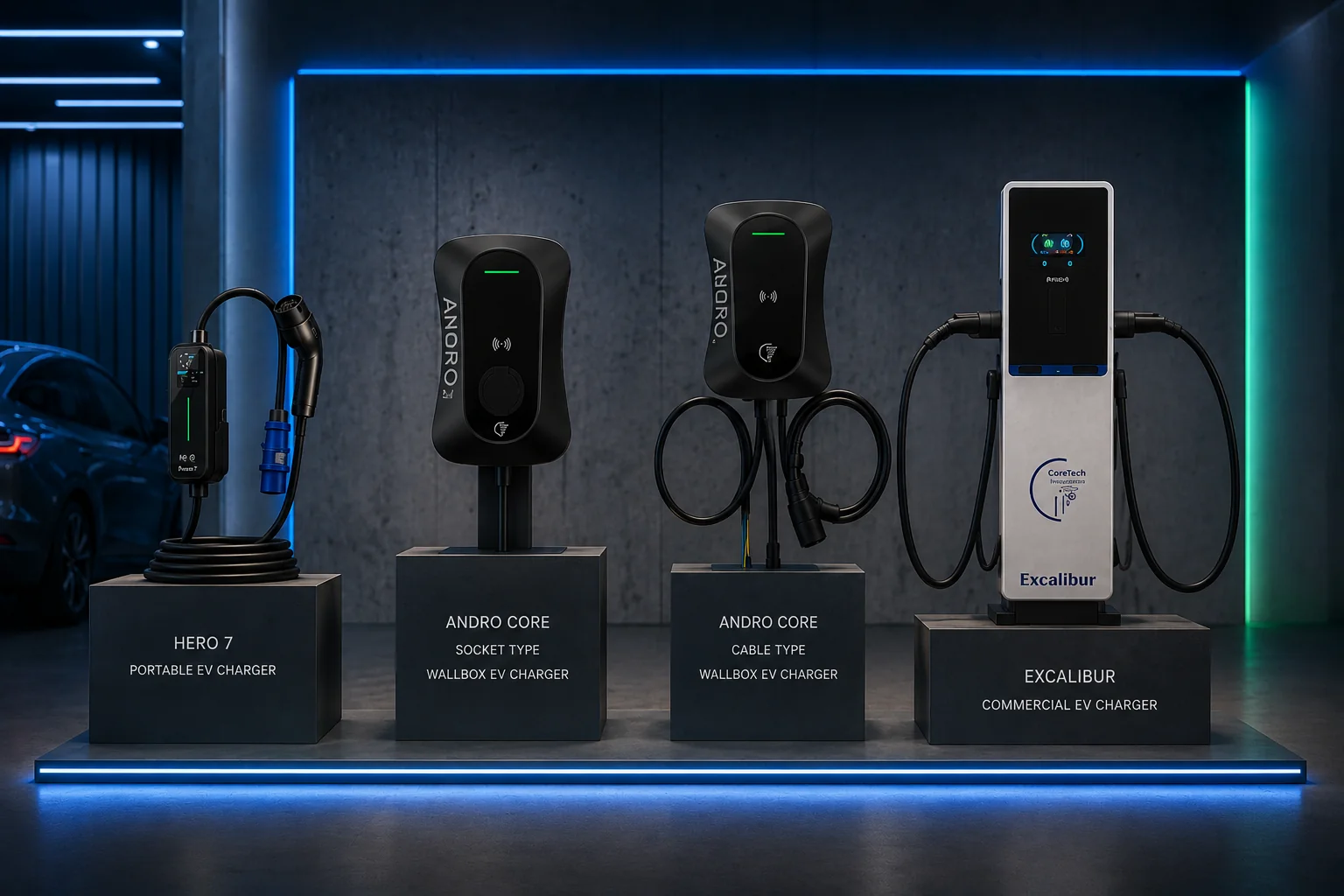
- CoreTech offers Andro residential and Excalibur commercial charging options and supplies EV charging products throughout the UK.
Compare 7kW vs 22kW EV chargers in the UK, including real charging times, single-phase vs three-phase power, vehicle compatibility, installation costs and home or workplace suitability.
7kW vs 22kW EV Chargers: Which Charging Speed Is Right for You?
Comparing a 7kW vs 22kW EV charger is about more than the number on the product label. Your electric vehicle’s onboard AC charger, the electrical supply at the property and the time available to charge all affect the result.
This guide explains the practical differences for UK homeowners, workplaces and commercial sites, including example charging times, installation considerations and how to avoid paying for capacity you cannot use.
7kW vs 22kW EV Chargers: Quick Comparison
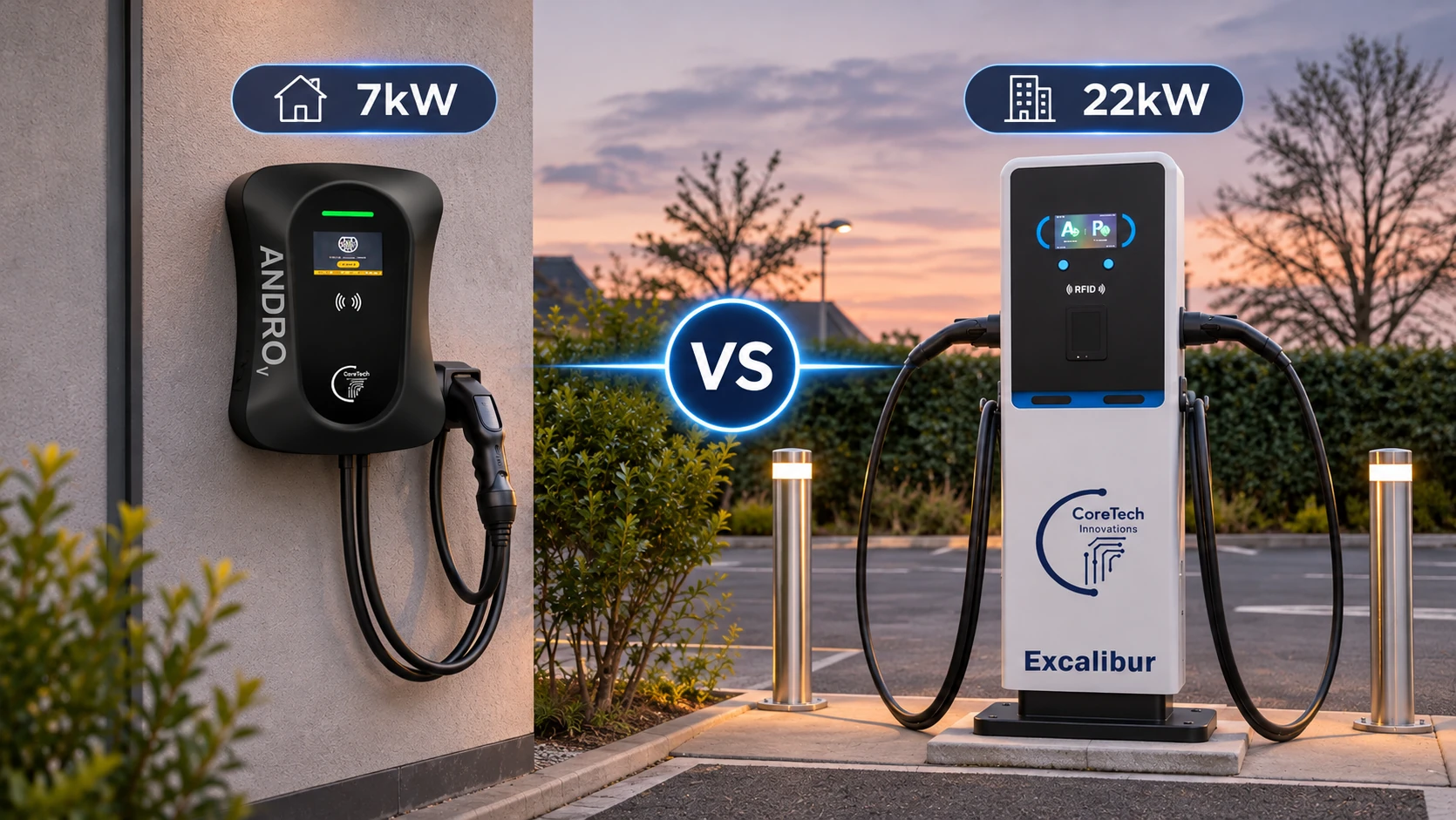
A typical 7kW AC charge point is designed for single-phase installations and is a common option for home charging. A 22kW AC charge point generally needs a suitable three-phase supply and is more often considered at workplaces and commercial premises.
A 22kW charger offers a higher maximum AC output, but the vehicle may accept only 7kW or 11kW AC. In that case, connecting it to a 22kW charger will not deliver 22kW to the battery.
Neither rating guarantees a particular charging time. The vehicle, battery state of charge, temperature, power-sharing arrangements and charging losses can all affect actual performance.
How Fast Is 7kW Charging Compared with 22kW?
As a simplified illustration, adding 35kWh of energy at a constant 7kW would take about five hours before losses. At a constant 22kW it would take about one hour and 36 minutes before losses, but only if the vehicle can actually accept 22kW AC.
If the same vehicle is limited to 11kW AC, the theoretical time to add 35kWh is about three hours and 11 minutes even when connected to a 22kW point. These are illustrative calculations, not guaranteed real-world charging times.
Charging speed can also vary as the battery approaches a higher state of charge, and electricity drawn from the grid may exceed the energy ultimately stored in the battery.
Does Your Electric Car Support 22kW AC Charging?
The onboard charger inside the vehicle converts incoming AC electricity into the DC electricity stored by the battery. Its rated AC input is therefore critical when comparing 7kW and 22kW charging points.
Check the manufacturer’s specification for maximum AC charging power, not just the maximum DC rapid-charging figure. A vehicle advertised as capable of high-power DC charging may still have a much lower AC limit.
The cable, connector, phase availability and charging point configuration also need to be compatible.
Single-Phase vs Three-Phase Electricity in the UK
A nominal 7kW home charge point commonly operates from a suitable single-phase supply. A nominal 22kW AC charge point normally relies on a suitable three-phase electrical connection.
Three-phase power is not available at every UK home, and having a three-phase supply does not by itself prove there is enough spare capacity for a 22kW installation.
A qualified installer should assess maximum demand, existing circuits, earthing, protection, cable routing and whether the distribution network operator must be notified or consulted.
Is a 7kW EV Charger Enough for Home Charging?
For many drivers who park overnight, a suitable 7kW home charger can provide a practical charging routine without the added complexity of higher-power AC equipment.
The right answer depends on daily mileage, vehicle efficiency, available parking time, tariff arrangements and the car’s AC charging limit. Someone who drives a modest distance each day may not benefit from installing 22kW equipment.
CoreTech’s Andro range includes 7kW wall-mounted charging options. Confirm current model features and installation requirements before choosing.
When Does a 22kW EV Charger Make Sense?
A 22kW AC charger may be worth considering where compatible vehicles need more energy during shorter parking windows and the site already has suitable three-phase capacity.
Examples include some workplaces, business car parks, fleet premises and commercial sites with repeat charging demand. The benefit is smaller if most visiting vehicles cannot accept more than 7kW or 11kW AC.
For short stops, compare 22kW AC with suitable DC charging options rather than assuming the higher AC rating is always the best solution.
7kW vs 22kW EV Charger Installation Costs
There is no reliable universal UK installation price for either rating. Total cost depends on existing supply capacity, distance from the consumer unit or distribution board, cable routes, groundwork, protection, network work and the equipment selected.
A 22kW project may involve additional electrical infrastructure or a supply upgrade, particularly where three-phase power is absent. Commercial projects may also require access controls, connectivity and maintenance arrangements.
Ask for a site-specific quotation and compare whole-life cost, including electricity, software, maintenance and any network charges, rather than comparing hardware prices alone.
Does a 22kW Charger Use More Electricity?
Charging power (kW) is the rate at which energy can be delivered, while energy (kWh) is the amount used. A faster charger can deliver the same energy in less time; it does not automatically mean that the vehicle needs more kWh for the same journey.
The total electricity purchased can differ because of charging losses, battery conditions, time-of-use tariffs and operating patterns. A higher-power session can also affect site peak demand and electricity charges in some commercial arrangements.
Compare your expected kWh requirement and tariff structure, not just the charger’s maximum output.
AC Charging vs DC Rapid Charging
Both 7kW and 22kW charging points discussed here are AC chargers. The car’s onboard charger limits the AC power it can accept.
DC rapid charging uses a different charging architecture and can bypass the vehicle’s onboard AC charging limit, subject to the vehicle’s DC capability and the charger. A 22kW AC point should not be described as equivalent to a DC rapid charger.
Choose equipment around typical parking duration, electrical infrastructure, vehicle compatibility and the cost of providing the service.
Choosing Chargers for Workplaces and Commercial Car Parks
For workplace charging, employees may remain parked for several hours, making managed AC charging an option even where faster equipment is available. Visitor or fleet parking may have different requirements.
Review simultaneous charging demand, bay accessibility, safe cable routes, user authentication, payment arrangements and whether dynamic load management is needed.
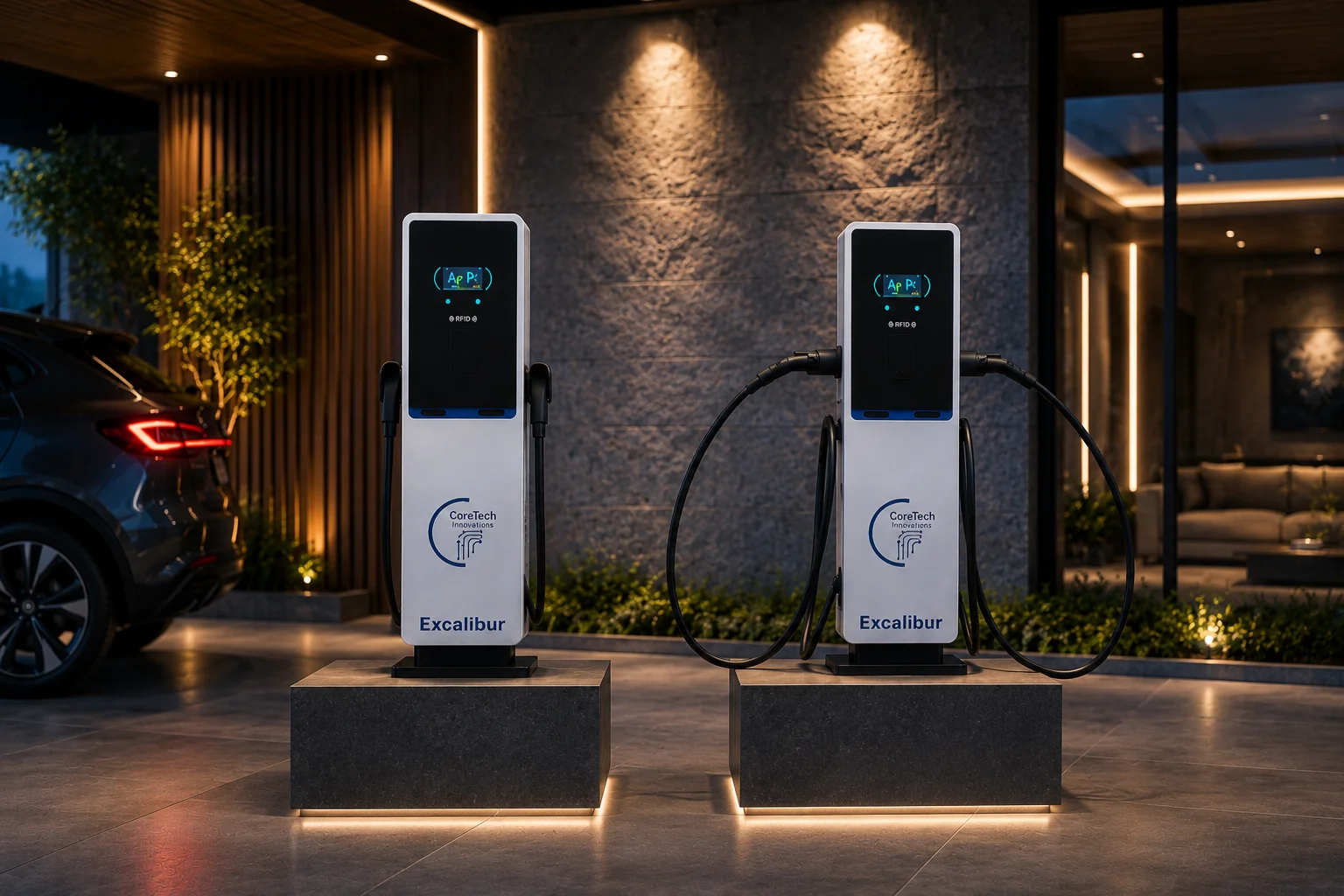
CoreTech’s Excalibur commercial range includes the Excalibur Socket Type, described in the existing article as offering dual 22kW AC outputs. Verify the current product specification and whether simultaneous output depends on available site capacity.
Andro and Excalibur EV Charging Options from CoreTech
CoreTech’s Andro range is positioned for residential wall-mounted charging, including 7kW options, while Excalibur is positioned for commercial EV charging applications.
Choose a model only after checking its published technical specifications, the vehicle’s charging limits, electrical supply and required features. Do not assume every charger in a range has identical capabilities.
CoreTech Innovations is based in Cardiff and supplies EV charging products throughout England, Scotland, Wales and Northern Ireland. Product delivery across the UK should not be confused with a guarantee of nationwide installation services.
A Practical Checklist Before Buying a 7kW or 22kW Charger
Check the vehicle’s maximum AC charging power and your typical daily energy needs. Estimate how long the car will normally be parked and whether faster AC charging would make a meaningful difference.
Confirm whether the property has single-phase or three-phase power, ask a competent installer to assess capacity and obtain a written installation quotation.
For commercial sites, also consider simultaneous use, load management, accessible bays, payment requirements and future expansion.
Frequently Asked Questions About 7kW and 22kW EV Chargers
Is a 22kW charger three times faster than a 7kW charger? Not necessarily. The theoretical power ratio is about 3.1, but actual charging depends on the car’s AC limit, supply and operating conditions.
Can I use a 22kW charger with a car limited to 7kW AC? Often yes, provided the connector and charging system are compatible, but the car will not draw 22kW AC.
Do I need three-phase electricity for a 22kW AC charger? A full-power 22kW AC installation generally requires a suitable three-phase supply and sufficient capacity.
Is 7kW enough for overnight charging? It can be for many drivers, depending on battery energy needed and the available overnight window.
Does CoreTech deliver EV chargers outside Cardiff? Yes. CoreTech supplies EV charging products throughout the UK; installation availability should be confirmed separately.