How to Choose an EV Charger in the UK: Complete Buying Guide

- Choose an EV charger around parking access, vehicle compatibility and everyday charging needs rather than the highest advertised power.
- Home wallboxes, portable charging equipment and commercial chargers suit different locations and operating requirements.
- Actual AC charging power depends on the vehicle onboard charger, electrical supply and charger settings; 22kW is not always faster.
- Compare installation requirements, smart features, electricity tariffs and ongoing costs before buying.
- Fixed charging equipment requires a suitable electrical assessment and competent installation; portable equipment also needs an approved supply.
- CoreTech Innovations supplies Andro, Hero 7 and Excalibur EV charging products across the UK; verify individual specifications and installation arrangements.
Compare home wallbox, portable and commercial EV chargers in the UK. Understand 7kW vs 22kW, vehicle compatibility, smart features, installation and charging costs.
Choosing an Electric Vehicle Charger in the UK: Where to Start
Choosing an electric vehicle charger in the UK starts with your parking arrangements, driving routine and the electrical supply available at the property. A charger that suits a detached home with a driveway may be inappropriate for a flat, a shared car park or a business depot.
This guide compares home wallboxes, portable charging equipment and commercial charging points. It explains charging power, connector compatibility, smart features, installation considerations and total costs so that UK buyers can make an informed shortlist.
CoreTech Innovations is based in Cardiff and supplies EV charging products across England, Scotland, Wales and Northern Ireland. Product supply across the UK should not be taken as a guarantee of installation coverage at every address.
First Check Where You Can Park and Charge
If you have a dedicated driveway or private parking bay close to your electricity supply, a fixed wallbox may be a convenient everyday solution. The parking position, cable route and access to the property all affect what can be installed safely.
Flats, rented homes and shared residential car parks introduce additional questions about permission, ownership of electrical infrastructure and who pays for electricity. On-street parking without an approved charging arrangement can make home charging impractical.
Where a private charge point is not feasible, compare reliable workplace, destination and public charging options before purchasing hardware. Do not assume that a portable charger solves the absence of a suitable socket or safe parking access.
Home Wallbox, Portable Charger or Commercial Charger?
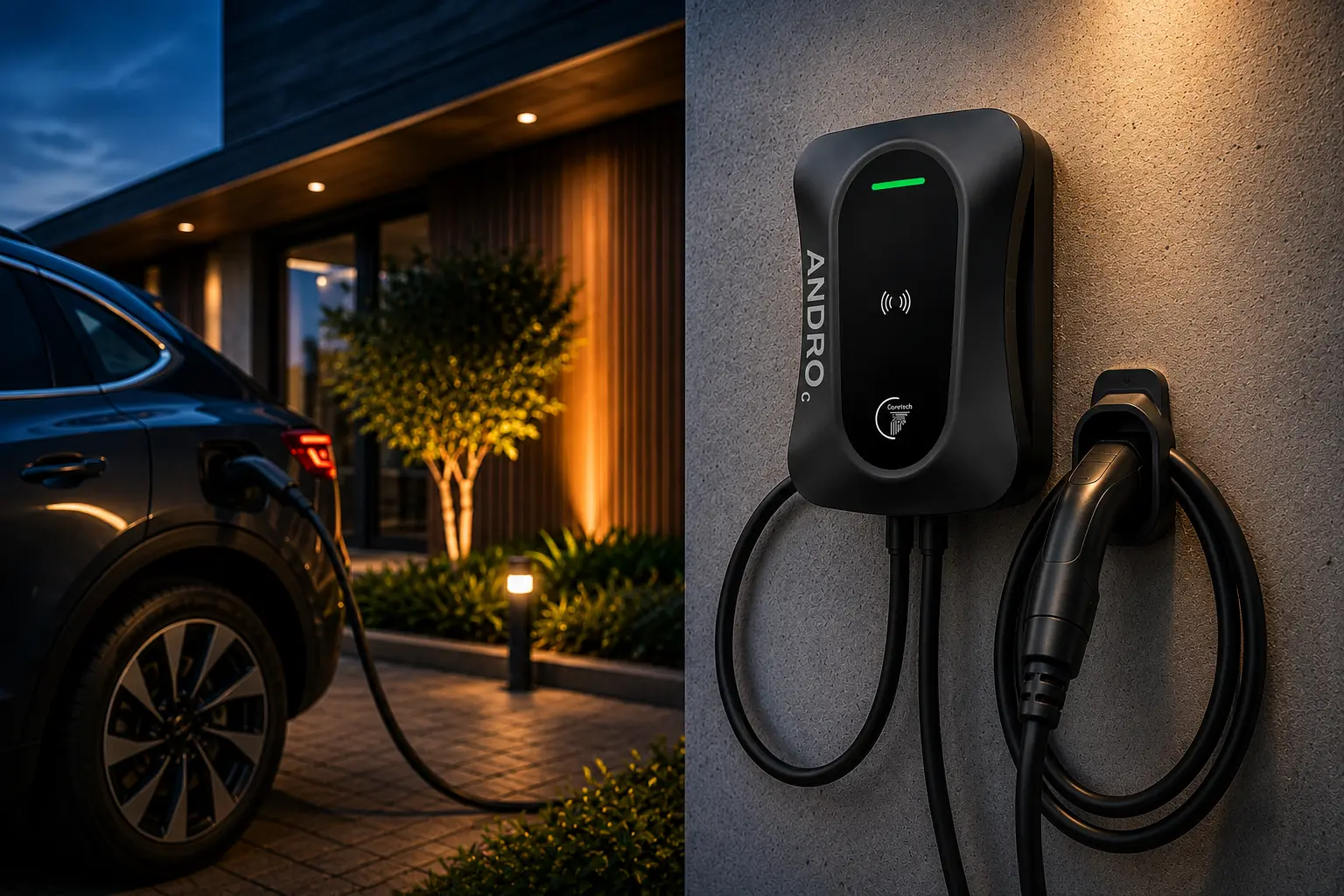
A home wallbox is fixed charging equipment designed for regular use at an appropriate parking space. Depending on the model, it may offer scheduling, access controls, monitoring and integration with other home energy systems.
A portable EV charging unit can be useful where its connectors, supply arrangements and manufacturer instructions permit safe operation. Portable does not mean suitable for every household socket, extension lead or temporary electrical connection.
Commercial charging equipment is intended for settings such as workplaces, hotels, car parks and fleets. These sites may need multiple outlets, managed access, usage reporting, load management and different electrical infrastructure. Choose by actual use rather than product label alone.
Understand 3-Pin, Type 2 and Vehicle Compatibility
Most modern UK and European AC electric cars use a Type 2 connection, but buyers must confirm the connector and charging arrangement supported by their specific vehicle. The cable may be attached to the charger or supplied separately for a socketed unit.
A domestic three-pin socket is not equivalent to a dedicated wallbox. Sustained vehicle charging can place significant demands on a socket and its wiring, and suitability must be assessed against the equipment instructions and electrical condition.
Check whether the vehicle is fully electric or plug-in hybrid, whether the charger is tethered or untethered, the required cable length and any manufacturer limitations. Connector compatibility alone does not establish the charging speed available.
What Do 7kW, 11kW and 22kW Mean?
Charging power is usually expressed in kilowatts (kW), while the energy delivered over time is measured in kilowatt-hours (kWh). For example, a nominal 7kW charger operating for one hour could supply around 7kWh before accounting for operating conditions and losses.
Approximately 7kW AC charging is commonly associated with suitable single-phase installations. Higher AC ratings such as 11kW and 22kW typically require suitable three-phase infrastructure and a vehicle capable of accepting that power.
A 22kW charge point will not make a vehicle with a lower-rated onboard AC charger accept 22kW. The vehicle, supply, charger configuration and any load management can all limit actual power.
Estimate How Long Home Charging Takes
A simple estimate divides the energy needed by the average charging power: energy required (kWh) divided by power (kW) equals approximate hours. If a vehicle needs 28kWh and charging averages 7kW, the idealised calculation is about four hours.
Actual charging time can be longer because of charging losses, battery conditions, vehicle limits and changes in available power. A driver who tops up daily often needs far less energy than the full battery capacity.
For a useful comparison, estimate your typical daily or weekly mileage, energy consumption and time parked at home. The highest advertised power is not necessarily the most economical or practical option.
Smart EV Charging: Scheduling, Monitoring and Apps
Smart features can make charging more convenient, but the available functions vary by charger model, firmware and service. Useful options to compare include scheduled charging, energy consumption reports, user access and compatible mobile applications.
Charging schedules may help drivers shift energy use into lower-priced tariff periods where the electricity contract supports them. Some systems also provide solar-related functions or coordination with other household electrical loads, subject to compatible hardware.
Check whether an app needs a subscription, whether essential features work without an internet connection, what happens during an outage and how software updates are supported. Do not assume every smart charger includes all these capabilities.
Wi-Fi, Bluetooth and Connectivity Requirements
Wi-Fi can connect a compatible charger to a home network and potentially to internet-based services. Bluetooth commonly supports local communication with a nearby device. Neither wireless method directly increases the electrical charging power.
An outdoor wall or detached garage may have weaker Wi-Fi coverage than the main house. Walls, distance, network settings and interference can affect connectivity, so check signal quality at the proposed charger location.
Ask whether setup, scheduling, monitoring and authorisation work through local or cloud services, and what charging functions remain available if the connection drops. Product documentation should provide the definitive answer.
Electrical Safety and Professional Installation
A fixed EV charge point should be assessed and installed by a competent professional in accordance with applicable electrical requirements, manufacturer instructions and the conditions at the property. This is not a suitable do-it-yourself electrical project.
The assessment may cover the incoming supply, consumer unit, protective devices, earthing arrangements, cable route, charger location and potential interactions with other large electrical loads. Network operator notification or approval may be necessary depending on the installation.
Requirements and procedures can vary across the UK and between properties. Request a site-specific quotation that explains the proposed electrical works rather than relying on a generic installation price.
How Much Does an EV Charger Cost to Own?
Total cost includes more than the charger purchase price. Installation labour, cabling, electrical upgrades, mounting arrangements, optional software fees, maintenance and electricity consumption may all contribute.
As an illustrative electricity-only calculation, adding 20kWh at 25p per kWh costs £5.00 before considering charging losses and other bill components. At 10p per kWh, the same 20kWh costs £2.00. These are hypothetical rates, not current UK tariff quotes.
When comparing tariffs, consider the daily standing charge, peak and off-peak rates, any eligibility requirements and the electricity used by the rest of the household. A lower overnight rate does not automatically produce the lowest total bill.
Renters, Flats and Shared Parking: Additional Checks
Before ordering equipment for a rented home, flat or managed parking area, establish who owns the parking bay, walls and electrical supply and whether written permission is needed. Shared installations may require a plan for access control and electricity billing.
Cable routing across pedestrian areas can create accessibility and safety concerns. An approved solution may require coordination with a landlord, managing agent or local authority rather than simply choosing a different charger.
Where a private installation is not available, a realistic charging plan should account for public charger availability, pricing and the time needed to charge during ordinary journeys.
Choosing Chargers for Workplaces and Business Sites
Commercial EV charging requirements differ from those of a single household. Businesses should estimate how many vehicles need energy, how long they park, the available site capacity and whether charging is for staff, visitors or a fleet.
Features such as load balancing, user permissions, RFID access, remote monitoring and OCPP-based management may be relevant, but support depends on the exact equipment and software configuration. Confirm protocol versions and integrations before purchase.
CoreTech offers Excalibur commercial charging products. Review current product specifications and the site electrical assessment before choosing a model or assuming a particular feature is included.
Comparing CoreTech Andro, Hero 7 and Excalibur
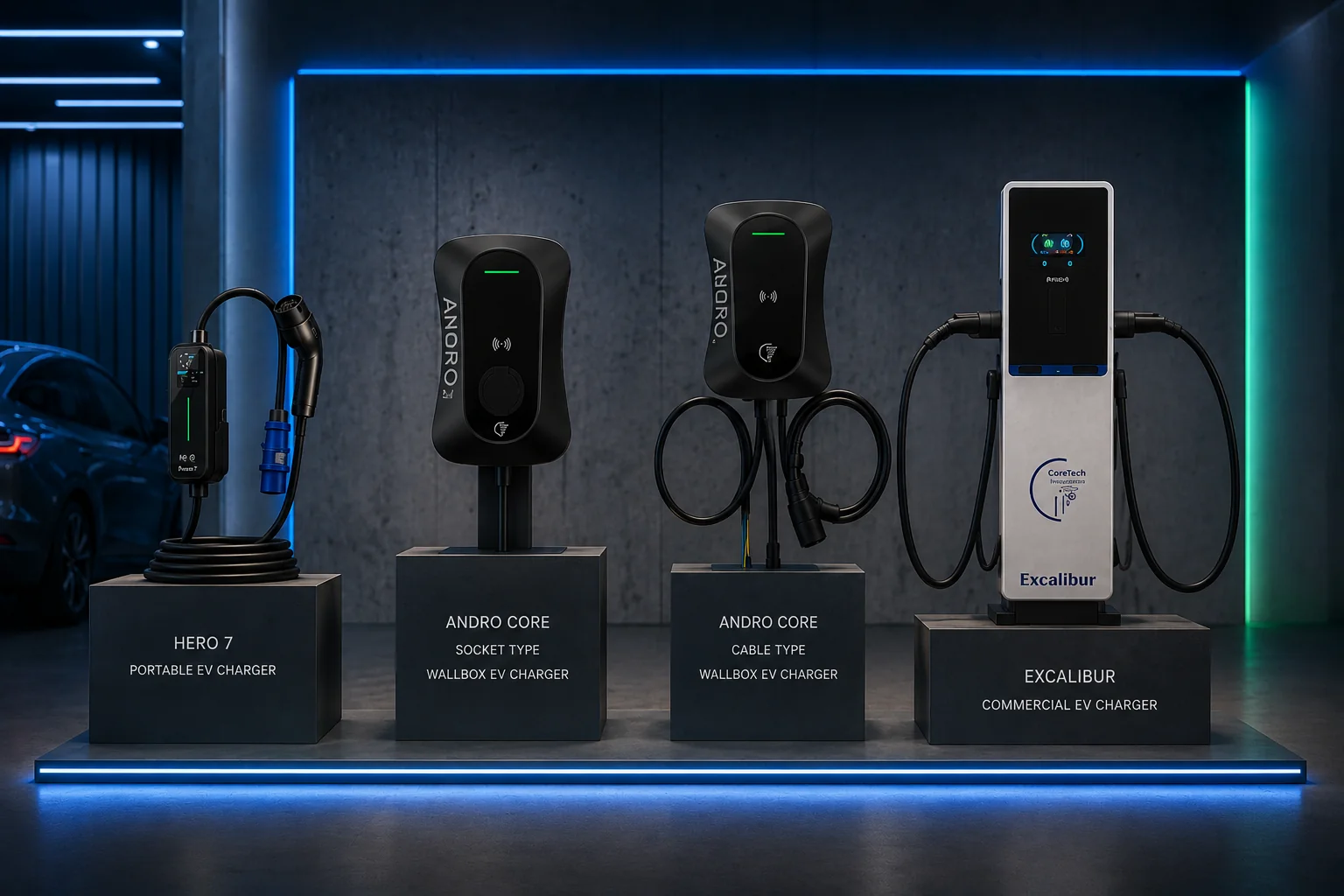
CoreTech Innovations offers Andro residential wallbox charging products, Hero 7 portable charging equipment and Excalibur commercial charging solutions. These categories serve different parking arrangements and operating requirements.
For an Andro wallbox, confirm the exact model rating, tethered or socketed configuration, vehicle compatibility and any supported smart functions. For Hero 7, confirm the approved supply and connection requirements before using it away from a fixed charging point.
For Excalibur, consider the number of vehicles, outlet configuration, site capacity and management requirements. Do not infer RFID, OCPP, load balancing or specific output behaviour without checking the individual model documentation.
A Practical EV Charger Buying Checklist
Before placing an order, write down your vehicle model, connector type, normal parking location, approximate weekly mileage, desired charging window and whether other drivers will share the charger.
Next, confirm the available electrical supply with an appropriate professional, assess cable routing and mounting space, and compare charger power, warranty, software, connectivity and access features. Ask for a complete installed-cost breakdown where installation is being arranged.
Finally, consider future vehicle changes and possible second-car charging. Future-proofing should be based on feasible electrical capacity and product compatibility rather than paying for features that cannot be used at the property.
Buying EV Charging Equipment Across the UK
Whether you are choosing a wallbox for a home in England, a portable unit for travel in Scotland, or commercial chargers for a site in Wales or Northern Ireland, the same core questions apply: compatibility, safe electrical supply, charging routine and total cost.
CoreTech Innovations is a Cardiff-based supplier of EV charging products across the UK. Explore the current EV charger range and contact the team to confirm product specifications and suitability for your intended application.
Any installation, local permissions and service availability should be checked separately for the specific address. A carefully chosen product and a properly assessed installation are more valuable than a headline charging-power claim.
Frequently Asked Questions About EV Chargers
Which EV charger is best for a UK home? The best choice depends on off-street parking, electrical capacity, vehicle compatibility, charging habits and the features you need. A suitable wallbox is often convenient for regular home charging.
Is a 22kW charger always faster than a 7kW charger? No. The vehicle onboard charger and available electrical supply may limit AC charging below the charger rating.
Can I use a portable EV charger in any socket? No. Use only an approved, suitable electrical supply and follow the product and vehicle instructions; have any uncertainty assessed by a competent professional.
Do I need Wi-Fi for a home EV charger? Not necessarily. Connectivity requirements and the effect of losing internet access vary by charger and its features.
Can I save money by charging overnight? Potentially, where your electricity tariff offers lower prices at relevant times. Compare the full tariff and household electricity use.
Does CoreTech sell chargers outside Cardiff? Yes. CoreTech supplies EV charging products across the UK, while installation arrangements and product suitability should be confirmed separately.