Smart EV Charger Cardiff: Why Homeowners Are Choosing Andro Core

- Andro Core provides 7kW Type 2 home charging with scheduling, energy-consumption reporting, RFID access and remote software updates.
- Scheduled charging can help Cardiff homeowners fit EV charging around predictable daily routines and suitable electricity tariff periods.
- Andro Core focuses on straightforward smart charging without mobile-app control, Wi-Fi, Bluetooth, solar integration or dynamic load balancing.
- Socketed and cable versions allow homeowners to choose the Andro Core configuration that best suits their driveway and everyday charging routine.
A practical guide to the Andro Core 7kW smart EV charger for Cardiff homeowners, covering scheduled charging, energy reporting, Type 2 compatibility, installation and everyday home charging.
Smart EV Charger Cardiff: Why Homeowners Are Choosing Andro Core
For many Cardiff households, owning an electric vehicle changes the daily routine in a fairly simple way: instead of visiting a petrol station, the car can be charged while it is already parked at home.
The charger chosen for that job matters. Some homeowners want advanced integration with solar panels, dynamic load management and mobile applications. Others simply want a dependable 7kW wallbox that can schedule charging, record energy use and provide the essential controls needed for everyday EV ownership without unnecessary complexity.
That is where the Andro Core fits within the Core Tech Innovations home-charging range.
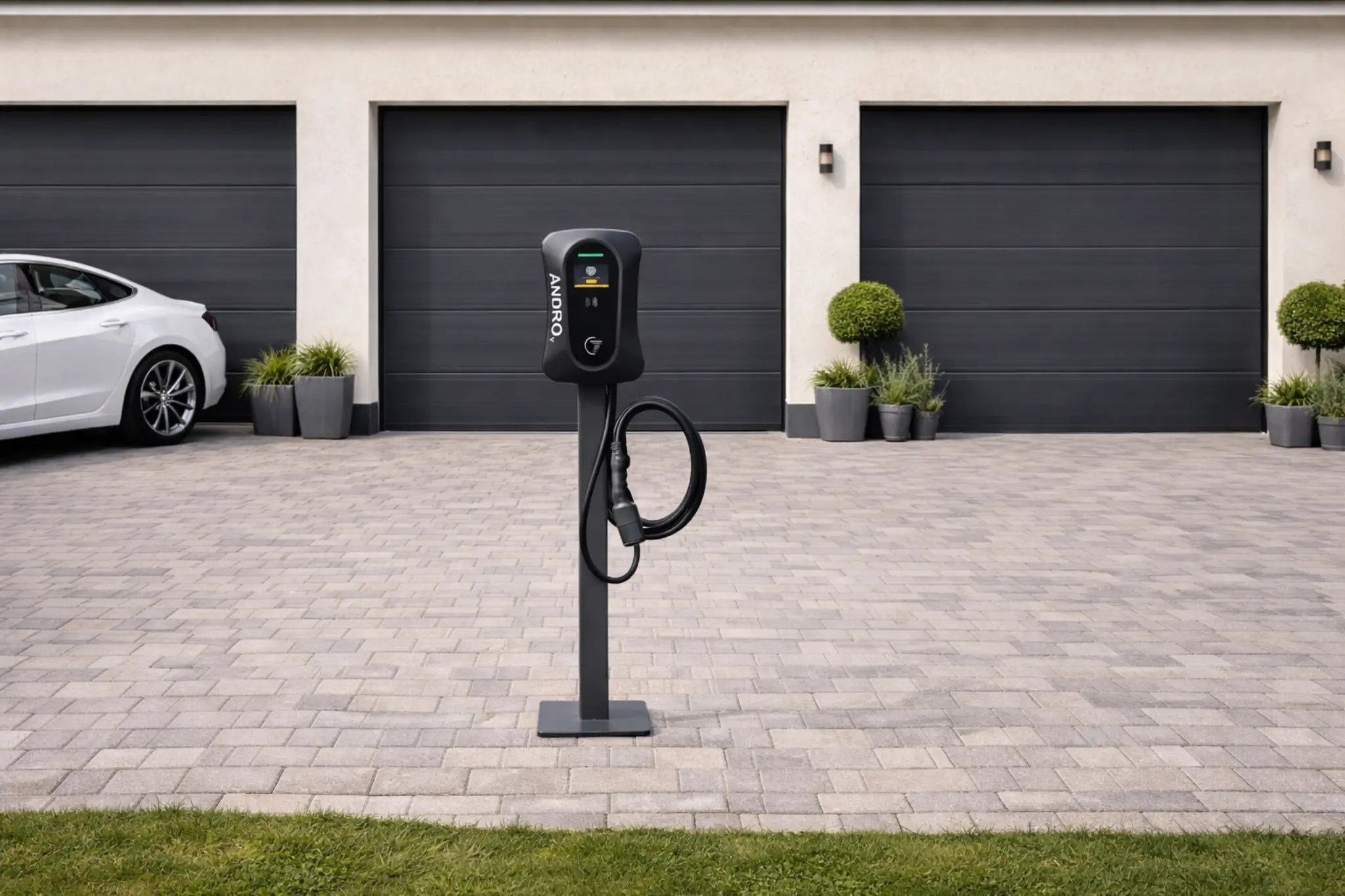
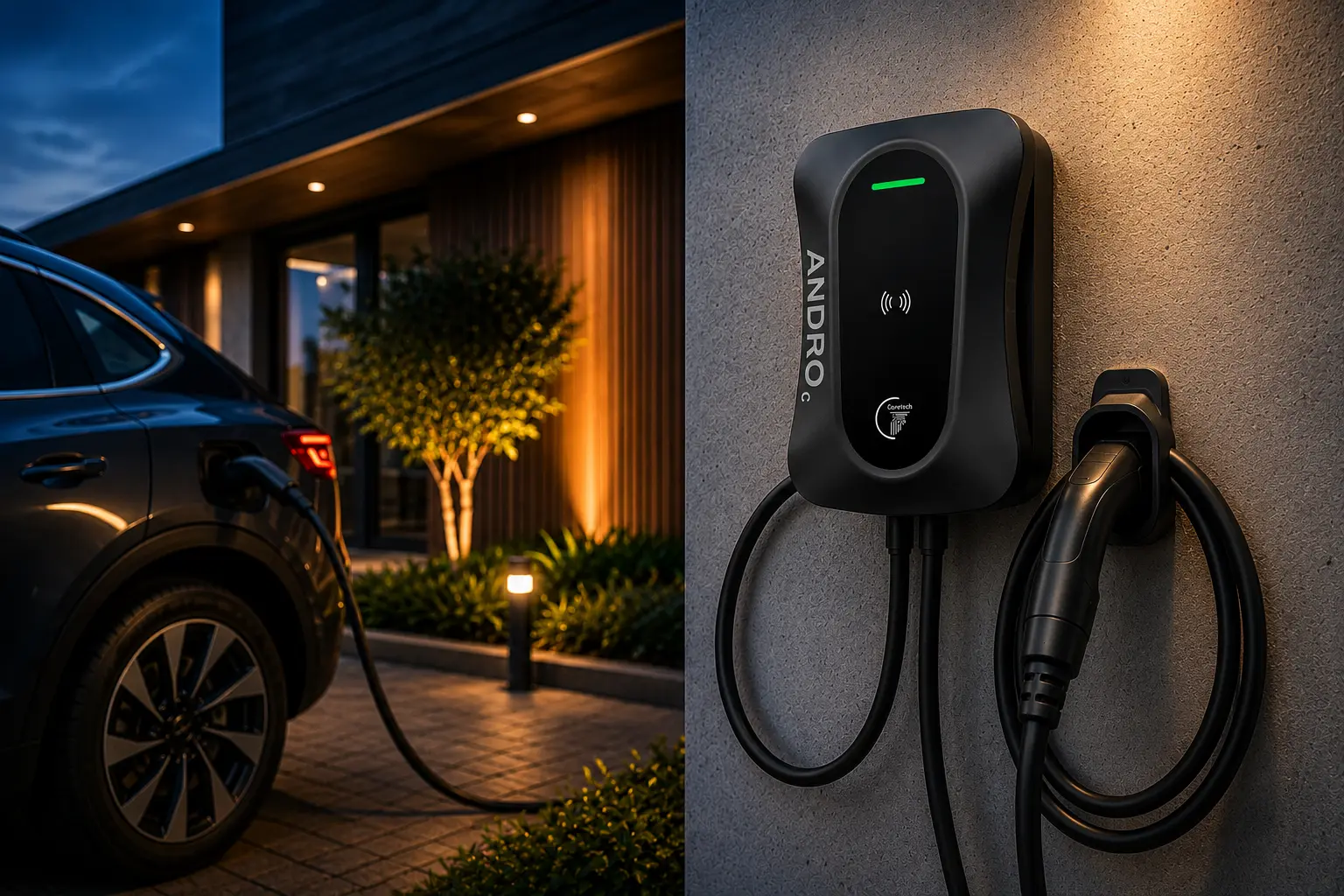
The Andro Core is a 7kW Type 2 wallbox available in socketed and cable versions. Its published specification includes charge scheduling, energy-consumption reporting, remote software updates, RFID access and an emergency button. Importantly, Core Tech does not list mobile-app control, Wi-Fi or Bluetooth control among the Andro Core's specifications; these more connected functions are associated with higher-tier products such as the Andro Max.
For Cardiff homeowners who want straightforward smart charging rather than the most feature-heavy charger available, that distinction can make the Core an appealing option.
Why Smart Home Charging Matters in Cardiff
Cardiff's EV charging landscape is developing steadily. Cardiff Council says it is installing charging points across the city to give residents and businesses greater confidence when switching to electric vehicles. It currently lists council-provided charging points in areas including Canton, Cathays, Penylan, Plasnewydd and Riverside, while also planning further provision in residential areas.
Public charging is important, particularly for residents who do not have private parking. For households with suitable off-street parking, however, a home charger offers something public infrastructure cannot always provide: a regular charging point available where the car spends much of the night.
Instead of treating charging as a separate journey, the driver can connect the vehicle after arriving home and allow it to charge before the next trip.
That is particularly useful for everyday driving in and around Cardiff. A commuter travelling around the city or making regular journeys towards Newport, Barry or elsewhere in South Wales may not need a complete battery recharge every evening. In most cases, home charging simply replaces the energy used during the day.
What Makes the Andro Core a Smart Charger?
The word smart can be misleading because it is sometimes assumed to mean that every charger must be controlled from a mobile phone.
In reality, smart charging is broader than app control. It is about managing when electricity is delivered to the vehicle and providing useful information about charging sessions.
The Andro Core's published specification includes charge scheduling, allowing start and end times to be set for electricity use. It also provides an energy-consumption report, showing information such as energy used and charging time, together with remote software updates intended to help maintain compatibility over time.
These functions address some of the most practical needs of home EV charging without requiring the owner to manage the charger continuously.
The UK Government's July 2026 Clean Flexibility Roadmap also identifies EV smart charging as an increasingly important part of the electricity system, with the potential to shift demand and reduce charging costs for consumers.
For a homeowner, the concept is much simpler than the policy language suggests: plug the car in when convenient and arrange for charging to take place at a more suitable time.
Scheduled Charging Can Be More Useful Than Constant Remote Control
Consider a Cardiff homeowner who arrives home at around 6pm each weekday.
The vehicle could begin charging immediately, but there may be no need for it to do so. If the household uses an electricity tariff with a suitable cheaper period later at night, scheduled charging can delay the session until that window begins.
The driver does not need to go outside at midnight to connect the car. The vehicle can already be plugged in, with the charger configured to operate according to the selected schedule.
For many households, this is the smart feature that matters most.
Mobile control can certainly be useful for people whose routines change regularly, but it is not essential for every charging pattern. Someone who drives similar distances, parks in the same place and charges during predictable overnight periods may find scheduling entirely sufficient.
This helps explain the position of the Andro Core within Core Tech's range. It provides practical charging automation without including every connected feature available on the more advanced models.
A 7kW Output Suits Everyday Home Charging
The Andro Core has a published maximum output of 7kW from a 230V supply.
For many domestic situations, this provides a useful balance between charging performance and the time the vehicle naturally spends parked at home. A car does not usually need rapid public-charger speeds when it is sitting on the driveway for several hours overnight.
As a simple illustration, adding around 35kWh of energy at a continuous 7kW would theoretically require roughly five hours. Actual charging time may be longer because of vehicle limits, charging losses and variations in charging power.
What matters more is that most drivers do not arrive home with a completely depleted battery. If a day's journeys use only part of the available energy, the charger needs to replace that amount rather than charge the entire battery from zero.
The vehicle's own AC charging capability also matters. A car that can accept less than 7kW will charge at its own lower limit even when connected to a 7kW wallbox.
Type 2 Compatibility Keeps the Choice Straightforward
The Andro Core uses the IEC 62196-2 Type 2 connection standard and is described by Core Tech as compatible with most existing electric vehicles.
Type 2 is widely used across the UK and European EV market, making it a practical choice for homeowners who may change vehicles during the lifetime of the charger.
That future compatibility deserves consideration.
A home wallbox may remain installed longer than the first EV used with it. A household buying its first electric car today may replace that vehicle several years later without wanting to replace the charging equipment at the same time.
Choosing a widely used connection standard and equipment that supports software updates can therefore be more important in the long term than selecting features purely around today's car.
Energy Reporting Makes Charging More Visible
One difference between EV ownership and petrol or diesel driving is that home charging becomes part of household electricity consumption.
Without some form of reporting, it can be difficult to separate vehicle energy use from the rest of the home's demand.
The Andro Core's energy-consumption reporting is designed to provide information about energy used and charging time.
This can help a homeowner understand charging patterns more clearly.
For example, if the household's electricity use rises noticeably after purchasing an EV, charging reports can provide useful context. A driver can see whether the change corresponds with mileage and how frequently the car is being charged, rather than simply looking at the total household bill.
That visibility can also make it easier to assess whether a different charging schedule or electricity tariff might better suit the household.
Why Simplicity Can Be an Advantage
There is a tendency when buying technology to assume that more functions automatically mean a better product.
With EV chargers, the more useful question is whether the household will actually use those functions.
Core Tech currently positions several domestic wallboxes at different levels. The Andro Core sits towards the more straightforward end of the range, while the Andro Max and Andro Vision offer additional connectivity and home-energy management functions.
For someone with solar panels or substantial electrical loads, moving to a more advanced model may be worthwhile. For another homeowner with one EV, predictable mileage and a simple overnight charging routine, those additional capabilities might remain unused.
The Core's appeal is therefore not that it provides every available smart-home feature. It is that it concentrates on a smaller set of useful everyday charging functions.
Its published specification includes: • 7kW Type 2 charging • Charge start and end scheduling • Energy-consumption reporting • Remote software updates • RFID access • An emergency button
For many drivers, that may be enough.
Socket or Cable Version?
The Andro Core is available in two formats.
The socket version has a Type 2 socket and requires the driver to connect a separate charging cable. The cable version keeps the vehicle charging lead attached to the wallbox.
Neither approach is inherently better.
A socketed charger can look neater when the vehicle is away because there is no permanently attached cable hanging beside the unit. It can also give the owner flexibility over the detachable cable being used.
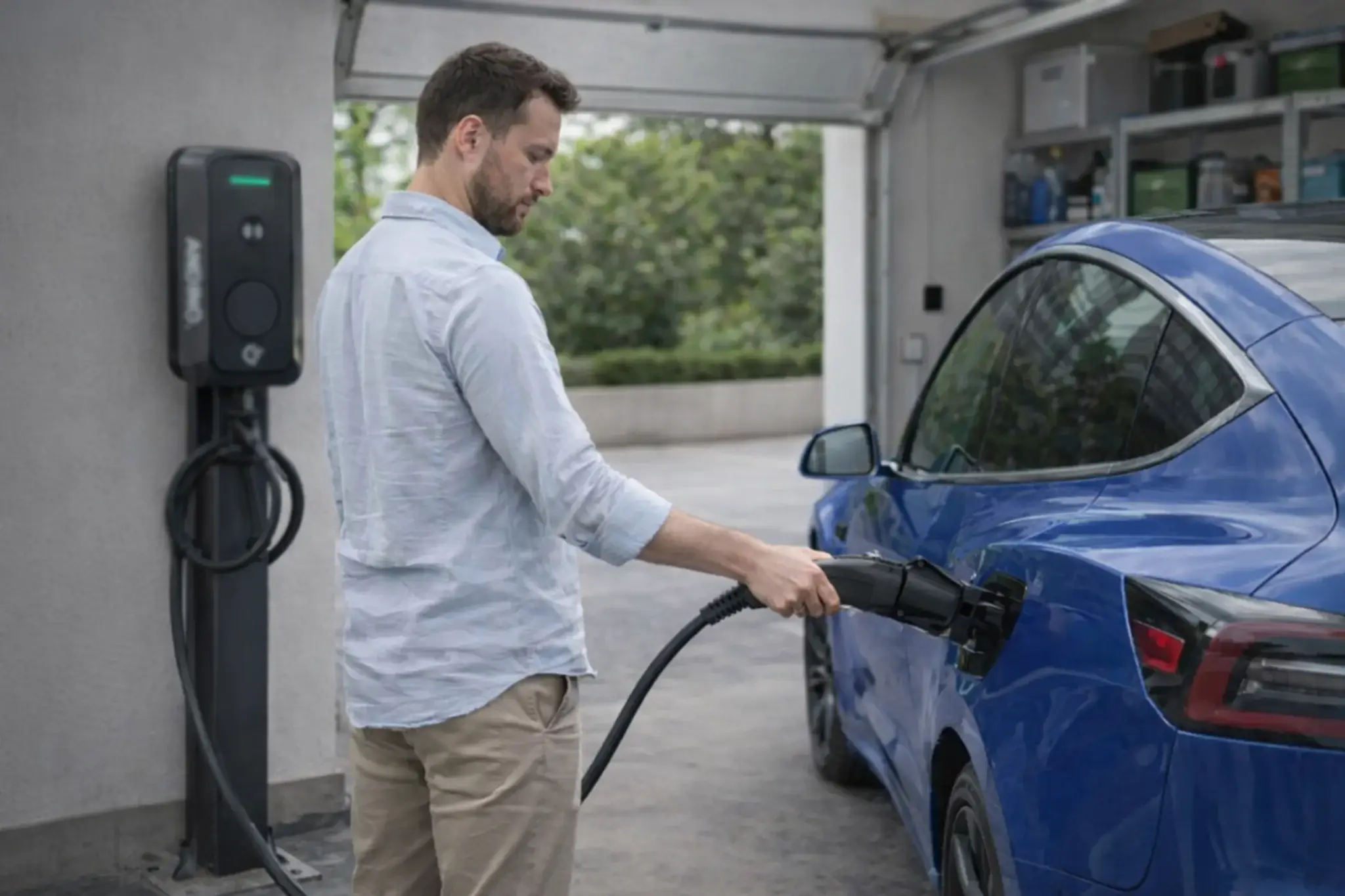
An attached-cable model is often more convenient for routine charging. The driver parks, takes the cable from the wallbox and plugs it into the vehicle without retrieving a separate lead from the boot.
For a Cardiff homeowner, driveway layout is often a better guide than specification sheets alone. The position of the vehicle's charging port, the usual parking direction and where the cable can be stored safely should all influence the decision.
Installation Matters as Much as the Charger
A home EV charger should not be selected independently of the property where it will operate.
Cardiff has a varied housing stock. A charger installed at a modern property with an accessible consumer unit and private parking may involve a relatively straightforward cable route. Another home may require more consideration because of its existing electrical installation, extensions, detached garage or the distance between the consumer unit and parking space.
The charger hardware price should therefore not be confused with the final installed cost.
A professional assessment should consider the home's electrical capacity, protective arrangements, cable route and position of the wallbox before a final installation quotation is agreed.
This becomes increasingly important as homes add other significant electrical loads, including heat pumps, induction cooking and additional electric vehicles.
Off-Street Parking Still Needs to Be Considered
Not every Cardiff household can install a conventional home wallbox.
Cardiff Council's current EV information makes a distinction between home charging and the needs of households relying on street parking. The council is actively seeking suitable locations for additional on-street charging in streets without driveways, private garages or other private parking. It is also gathering views about cross-pavement charging needs.
For a homeowner with private off-street parking, the installation route is generally more straightforward.
Residents without it should check the current council position and any permissions required before assuming that a private charging cable can simply reach a car parked on the public highway.
When Might Andro Core Not Be the Right Choice?
The Andro Core will not suit every Cardiff home.
A household with photovoltaic panels may want a charger designed to integrate directly with solar generation. A property with several substantial electrical loads may benefit from dynamic load management. Someone who specifically wants to start, stop or monitor charging through a mobile application may prefer equipment where app control is explicitly included in the specification.
Within the Core Tech range, those requirements may point towards models such as the Andro Max, rather than the Core.
That distinction is worth making because choosing a charger should not become a contest between "basic" and "better".
The appropriate charger is the one whose functionality matches the home.
If scheduling, energy reporting and dependable 7kW charging meet the requirement, additional connected features may simply go unused. If the household is becoming more electrically complex, choosing a model with broader energy-management capabilities may make more sense.
Cardiff's Wider Charging Network Still Has an Important Role
Home charging does not eliminate the need for public infrastructure.
Cardiff Council continues to provide and plan public charging across the city, including residential locations, and says suitable suggestions for new on-street sites are assessed using factors such as pavement width and public parking availability.
That mixed approach is important.
A homeowner might use a 7kW wallbox for ordinary weekly mileage but rely on rapid public charging during a long journey. A resident without a driveway may depend much more heavily on local public infrastructure. Workplace and destination charging provide additional options.
The future of EV charging in Cardiff is therefore unlikely to revolve around a single type of charger. Home wallboxes, on-street units, workplace facilities and faster public chargers will each serve different situations.
Is Andro Core the Right Smart EV Charger for Your Cardiff Home?
For a household with private parking and a relatively straightforward charging routine, the Andro Core has a clear role.
It provides a 7kW charging output while retaining functions that many owners are likely to use regularly: scheduling, consumption reporting, RFID access and software updates.
Its strongest case is therefore not built on having the longest feature list.
It is better suited to the Cardiff homeowner who wants a dedicated home charger that can be configured around everyday electricity use without necessarily needing mobile-app control, solar integration or dynamic load balancing.
Before buying, the property should still be assessed properly. Vehicle compatibility, electrical capacity, parking arrangements, cable position and future household energy plans can all influence which charger represents the better long-term choice.
Looking Ahead
Smart charging is becoming increasingly important as electric vehicles become more closely connected with the wider electricity system.
The UK Government expects EV smart charging to contribute to a more flexible energy network, while Cardiff and the wider Welsh transport system continue to expand charging provision for drivers both with and without private parking.
For homeowners, however, smart charging does not have to mean adding unnecessary complexity.
Sometimes the most useful technology is the technology that quietly does the job required of it: charging at an appropriate time, keeping energy use visible and leaving the car ready when it is needed.
That is the space the Andro Core occupies. For Cardiff households looking for a 7kW home EV charger, its combination of scheduled charging, energy reporting and straightforward operation provides a practical alternative for those who do not require more advanced connected features.