What Is Dynamic Load Balancing for EV Chargers and Do Cardiff Homes Need It?

- Dynamic Load Balancing, often shortened to DLB, is designed to adjust EV charging power according to the electricity demand within a property.
- DLB can be particularly useful when several electrical appliances may be operating while an EV is charging.
- Not every Cardiff household will have exactly the same charging or electrical requirements, so the need for load management should be considered as part of the overall installation.
- CoreTech's Andro Max and Andro Vision 7kW wallbox chargers include Smart Load Management (DLB).
- Both models also support smart features including app connectivity, charge scheduling, energy consumption reporting and solar PV integration.
- A suitable EV charging setup should be based on the property, electricity supply, charging requirements and professional assessment rather than charger features alone.
Learn how Dynamic Load Balancing works with home EV charging, why household electricity demand matters and whether this smart charging feature could be useful for your Cardiff property.
What Is Dynamic Load Balancing for EV Chargers and Do Cardiff Homes Need It?
Home EV charging should be convenient enough to fit naturally into everyday life. You arrive home, connect the car and expect it to charge while the rest of the household continues using electricity as normal.
But an EV charger is not the only electrical equipment operating in a home.
Heating equipment, cooking appliances, washing machines, tumble dryers and other electrical devices may all contribute to household electricity demand at different times of the day.
This is where Dynamic Load Balancing can become useful.
Rather than allowing EV charging to operate without considering changing household demand, Dynamic Load Balancing is designed to adjust the power available for charging according to what is happening elsewhere in the property.
For Cardiff homeowners considering a smart EV charger, understanding this feature can help determine whether it is relevant to their home and charging habits.
What Is Dynamic Load Balancing on an EV Charger?
Dynamic Load Balancing is a smart load-management function used to manage the relationship between EV charging and other electrical demand within a property.
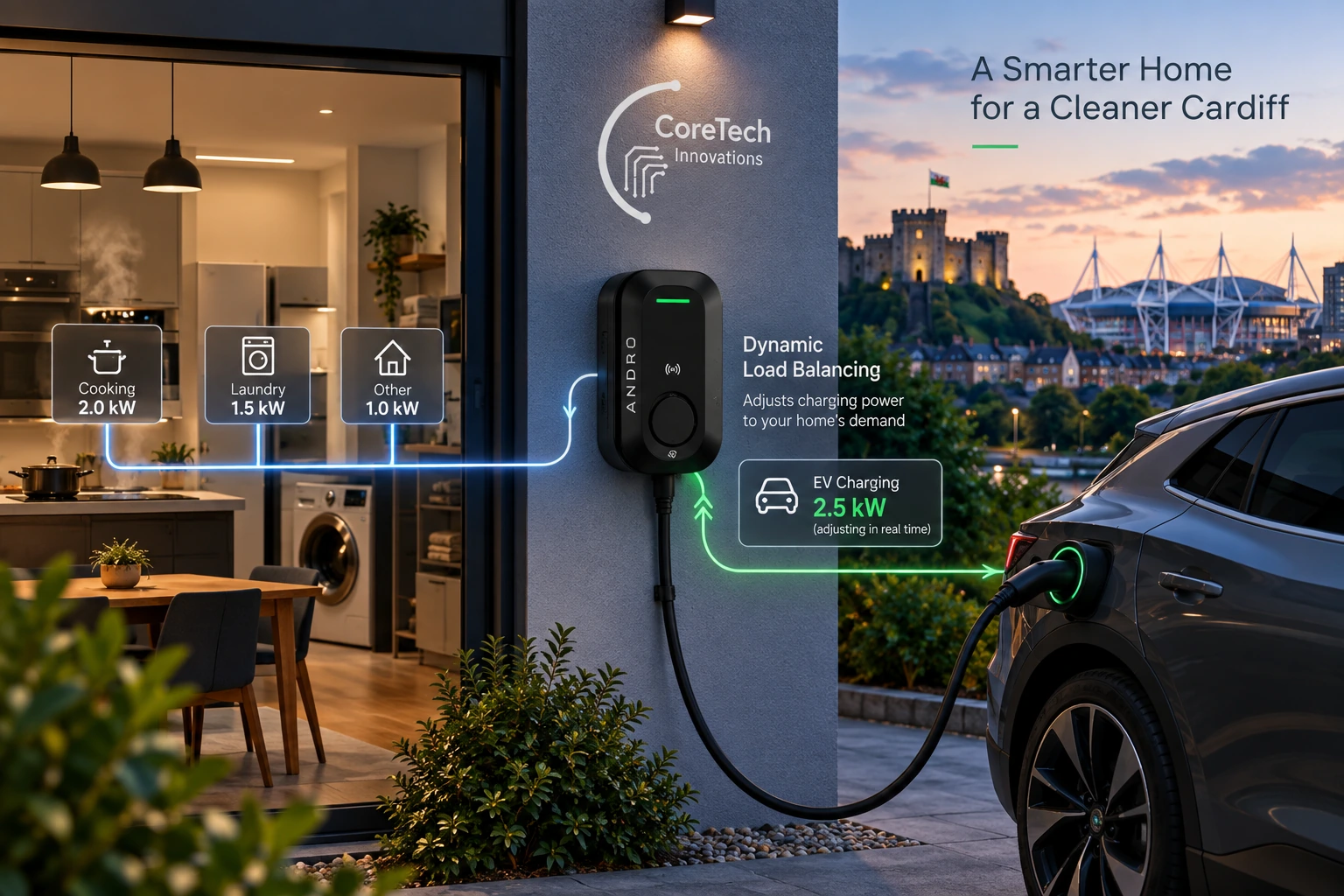
In simple terms, the system monitors household electricity demand and can adjust the charging power available to the vehicle accordingly.
When electricity demand elsewhere in the property increases, the amount of power available for EV charging can be reduced. When household demand falls again, more charging power may become available.
The purpose is to make EV charging more responsive to the changing electricity requirements of the property.
CoreTech's Andro Max and Andro Vision wallbox chargers include Smart Load Management (DLB). According to their technical specifications, this function automatically adjusts charging power based on household electricity demand.
How Does Dynamic Load Balancing Work?
Imagine an EV is connected to its home charger during the evening.
At the same time, several electrical appliances may be operating inside the property.
Household electricity demand is therefore not fixed. It rises and falls depending on what equipment is being used.
Without dynamic management, EV charging does not necessarily respond to those changing demands in the same way.
With Dynamic Load Balancing, the charging system can take household demand into account.
A simplified example might look like this: Household demand increases → EV charging power is adjusted
Later: Household demand decreases → More charging capacity can become available
This process can happen automatically, reducing the need for the homeowner to continually think about which appliances are operating while the vehicle is charging.
It is important, however, not to treat DLB as a substitute for an appropriate electrical installation. The suitability of the property, electrical supply and charging equipment still needs to be properly considered when an EV charger is installed.
Why Can Household Electricity Demand Matter When Charging an EV?
A home has a finite electrical supply, and different appliances draw power from that supply throughout the day.
Adding an EV charger introduces another significant electrical demand.
How important that additional demand is will depend on the individual property.
One household may have relatively modest electrical demand when the vehicle is normally charged. Another may regularly operate several higher-demand electrical appliances during the same period.
The charging habits of the driver can also make a difference.
Someone who usually plugs in overnight, when household demand is relatively low, may have a different usage pattern from someone who regularly charges during busy evening periods.
This is why Dynamic Load Balancing should be considered in the context of the whole property, rather than simply as another feature on an EV charger specification sheet.
Do Cardiff Homes Need Dynamic Load Balancing?
There is no single answer that applies to every Cardiff property.
Cardiff has a varied housing stock, and households can differ significantly in their electrical setup, parking arrangements, energy use and EV charging requirements.
The relevant question is therefore not simply:
“Is Dynamic Load Balancing good?”
A more useful question is:
“Would Dynamic Load Balancing be useful for the way electricity and EV charging are likely to be used at this particular property?”
For some homes, active load management may provide a useful additional level of flexibility.
For others, the electrical setup and normal charging pattern may mean the benefits are less significant.
This is one reason why the requirements of the property should be assessed before deciding which EV charging solution is most appropriate.
When Might Dynamic Load Balancing Be Particularly Useful?
DLB may be worth considering where EV charging is likely to overlap regularly with other household electricity use.
For example, a household may often charge its vehicle during periods when cooking equipment, laundry appliances or other electrical systems are also operating.
It may also be relevant where homeowners want the charging system to respond automatically to changing household demand rather than relying solely on manually choosing when to charge.
The value of the feature will ultimately depend on the property and how electricity is used.
For this reason, DLB should not automatically be treated as essential for every EV driver. It is better viewed as one part of a wider home charging setup.
Dynamic Load Balancing vs Scheduled EV Charging
Dynamic Load Balancing and charge scheduling are related to smart charging, but they perform different roles.
Charge scheduling allows the user to choose when EV charging starts and stops.
For example, a driver may prefer the vehicle to begin charging later in the evening rather than immediately after arriving home.
Dynamic Load Balancing, on the other hand, responds to electricity demand within the property while charging is taking place.
The distinction can be summarised simply:
Scheduling = When should the vehicle charge?
Dynamic Load Balancing = How should charging respond to changing household electricity demand?
The two features can therefore complement one another rather than performing the same function.
CoreTech's Andro Max and Andro Vision include both charge scheduling and Smart Load Management, giving users different ways to manage their home charging.
What Is the Difference Between Andro Core, Andro Max and Andro Vision for Load Management?
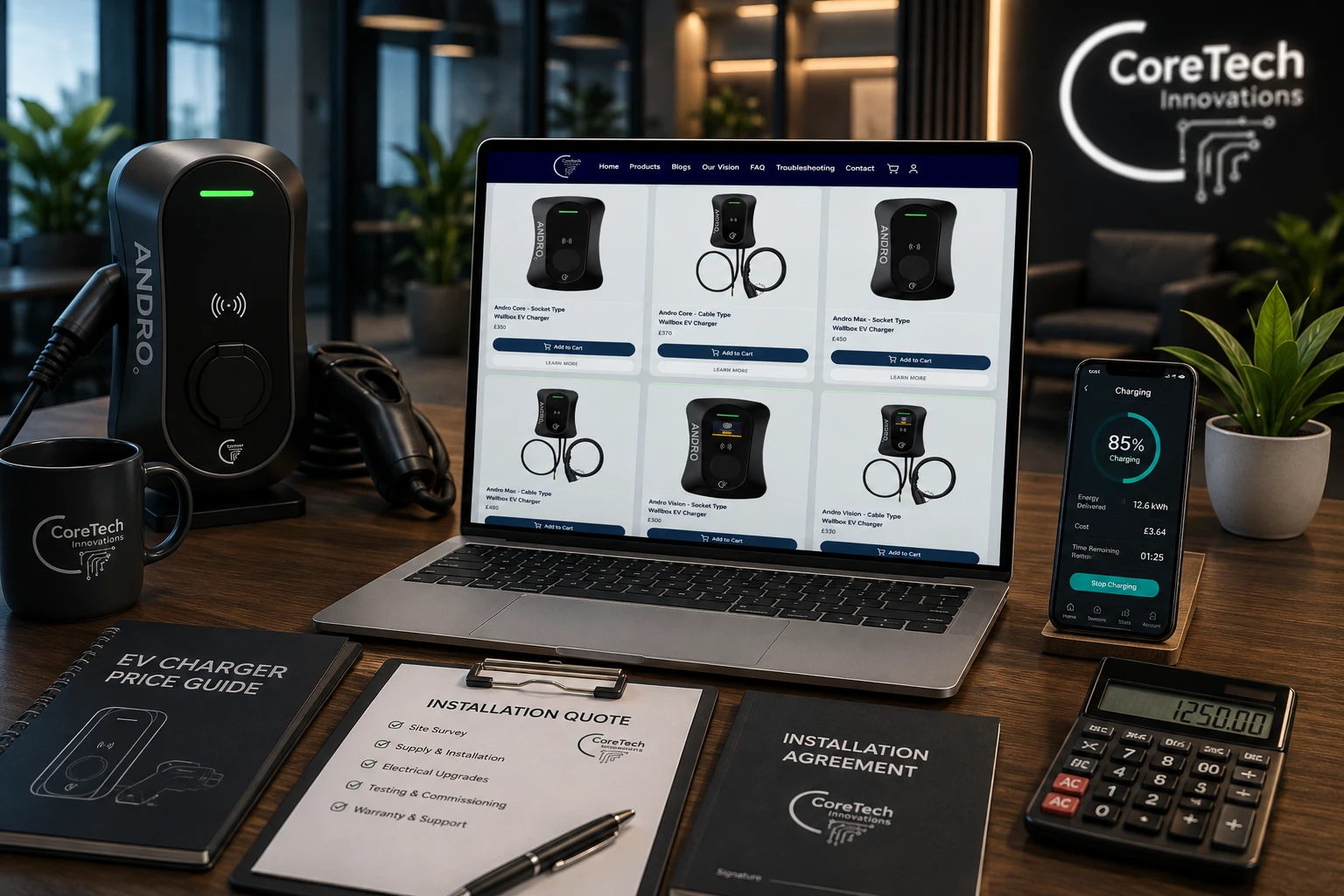
CoreTech currently offers several 7kW home wallbox options, but their smart functionality is not identical.
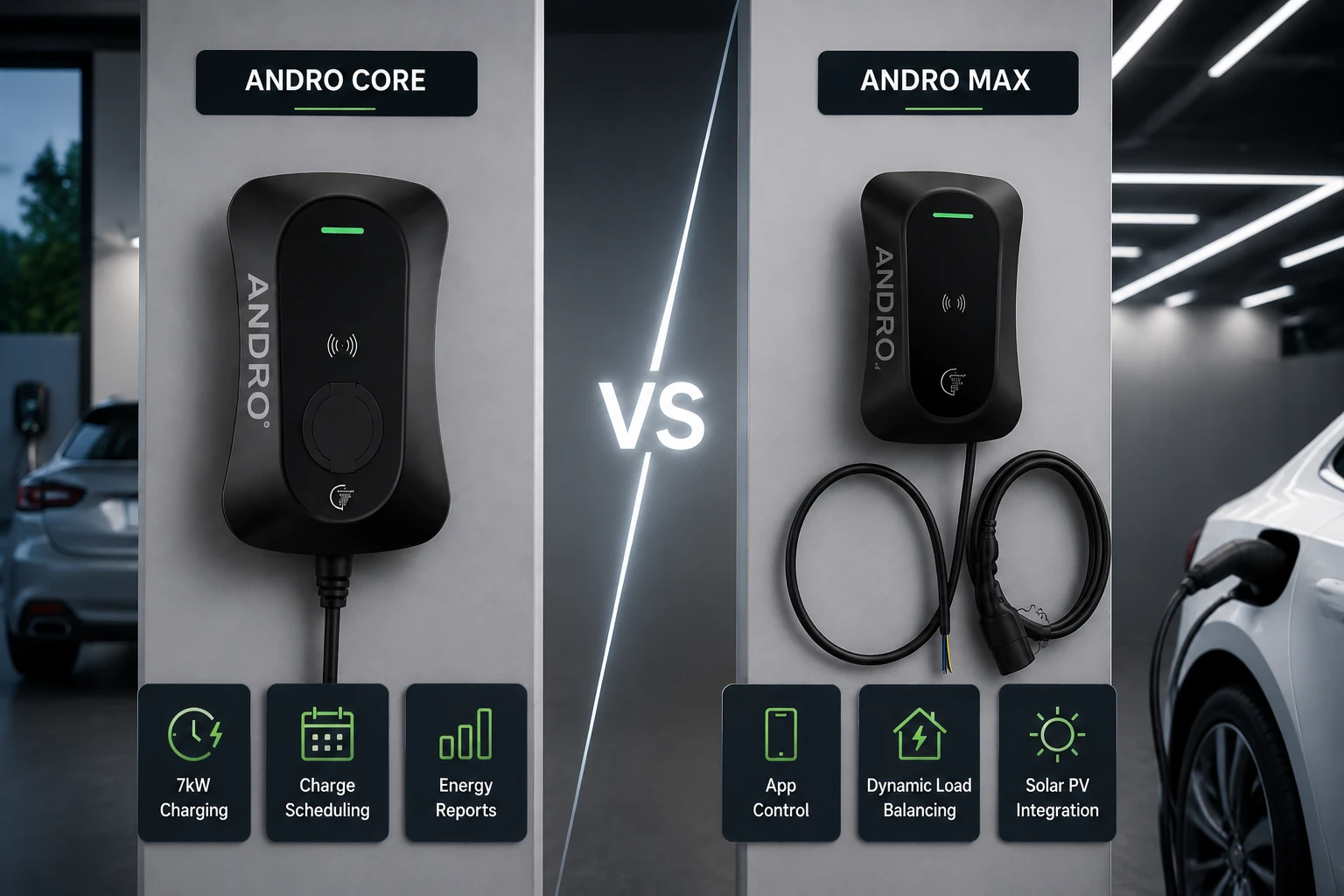
The Andro Core is a 7kW Type 2 wallbox that includes charge scheduling, energy consumption reporting and remote software updates.
The Andro Max adds further smart functionality, including Wi-Fi and Bluetooth connectivity, mobile app control, Dynamic Load Balancing and solar PV integration.
The Andro Vision also provides 7kW Type 2 charging together with Wi-Fi, Bluetooth and mobile app control, Dynamic Load Balancing, solar PV integration, scheduling and energy consumption reporting.
For a homeowner specifically interested in Dynamic Load Balancing, the important distinction is therefore straightforward: Andro Max and Andro Vision include DLB, while it is not listed as a feature of Andro Core in the current CoreTech product catalogue.
That does not mean one charger is automatically the right choice for every household. The appropriate option depends on which features are relevant to the customer and the requirements of the installation.
Does Dynamic Load Balancing Make an EV Charger “Smarter”?
DLB is one example of how a smart EV charger can do more than simply deliver electricity to a vehicle.
However, smart charging is broader than load balancing alone.
Depending on the charger, smart functionality can include features such as: - charge scheduling; - energy consumption reporting; - app-based control; - Wi-Fi or Bluetooth connectivity; - solar PV integration; - remote software updates; and - Dynamic Load Balancing.
These functions address different aspects of the charging experience.
For example, energy monitoring can help a driver understand charging consumption, while scheduling can control when charging takes place. Solar integration can allow compatible systems to make use of solar energy, while DLB focuses specifically on managing charging power in relation to household demand.
The usefulness of each feature therefore depends on what the homeowner wants from their charging setup.
Dynamic Load Balancing and Solar EV Charging
Homeowners considering solar energy may also notice that DLB and solar integration often appear among the features of more advanced smart chargers.
They are related to energy management but should not be confused.
Dynamic Load Balancing manages EV charging in relation to household electricity demand.
Solar PV integration is designed to allow solar energy to be used for vehicle charging where an appropriate solar setup is available.
CoreTech's Andro Max and Andro Vision include both Dynamic Load Balancing and solar PV integration.
For households considering a broader approach to home energy management, having these functions available within the charging setup may therefore be useful.
However, the suitability and configuration of any solar and EV charging arrangement will depend on the individual property and its energy system.
Is Dynamic Load Balancing the Same as Faster Charging?
No.
Dynamic Load Balancing should not be confused with increasing the maximum rated charging speed of the charger.
Andro Max and Andro Vision are both rated at 7kW according to CoreTech's current product specifications.
DLB is designed to manage the charging power available in response to household demand, rather than turn a 7kW charger into a higher-powered charger.
At times of higher household electricity use, charging power may be adjusted. When more capacity becomes available, the system can respond accordingly.
The benefit is therefore intelligent power management, not simply greater maximum charging speed.
What Should Cardiff Homeowners Consider Before Choosing a Charger with DLB?
Dynamic Load Balancing can be a valuable feature, but it should not be considered in isolation.
Before choosing an EV charger, homeowners should think about the wider charging setup.
This includes the electrical requirements of the property, where the vehicle will normally be parked, the location of the charger, typical charging habits and which smart features are genuinely useful.
Some drivers may prioritise simple, dependable home charging.
Others may want more advanced control through an app, Dynamic Load Balancing, solar compatibility and greater visibility of their charging activity.
The best solution is therefore not necessarily the charger with the longest feature list. It is the one whose capabilities match the property and the driver's actual requirements.
Choosing a Smart EV Charger for Your Cardiff Home
Dynamic Load Balancing can make home EV charging more responsive to the way electricity is being used elsewhere in a property.
Rather than treating EV charging as an isolated electrical demand, DLB allows charging power to respond to changing household requirements.
For Cardiff homeowners, whether that functionality is necessary or useful depends on the individual property, its electricity usage and the driver's charging habits.
CoreTech's current range provides different levels of smart functionality.
Andro Core offers 7kW Type 2 home charging with features including scheduling and energy reporting, while Andro Max and Andro Vision add Dynamic Load Balancing alongside app connectivity and solar PV integration.
Understanding those differences can help homeowners avoid paying attention to features simply because they sound advanced and instead focus on the functions that are genuinely useful for their home.
Ultimately, Dynamic Load Balancing is not about making every EV charger more powerful. It is about making charging more responsive to the electricity demands of the property around it.