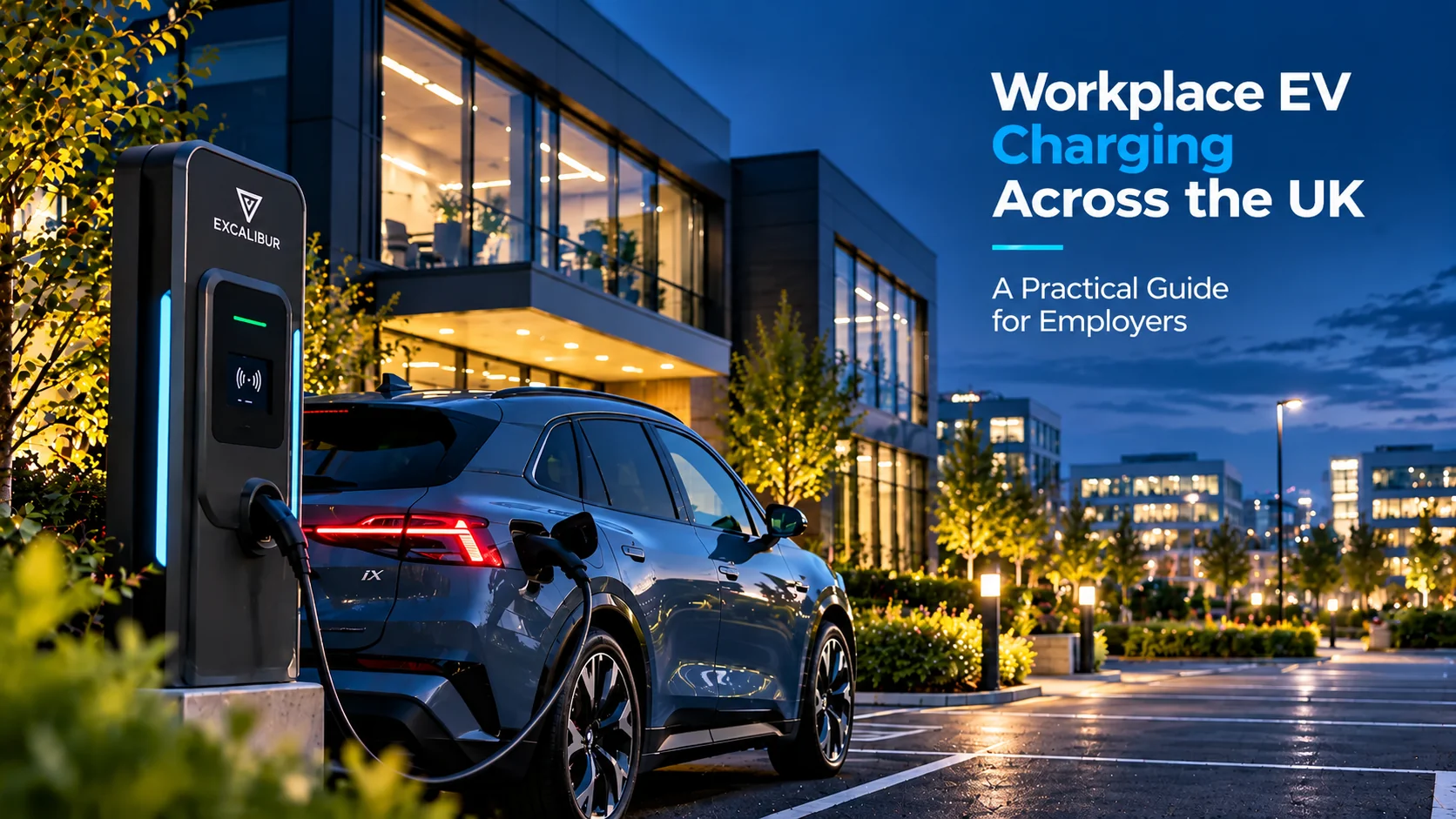
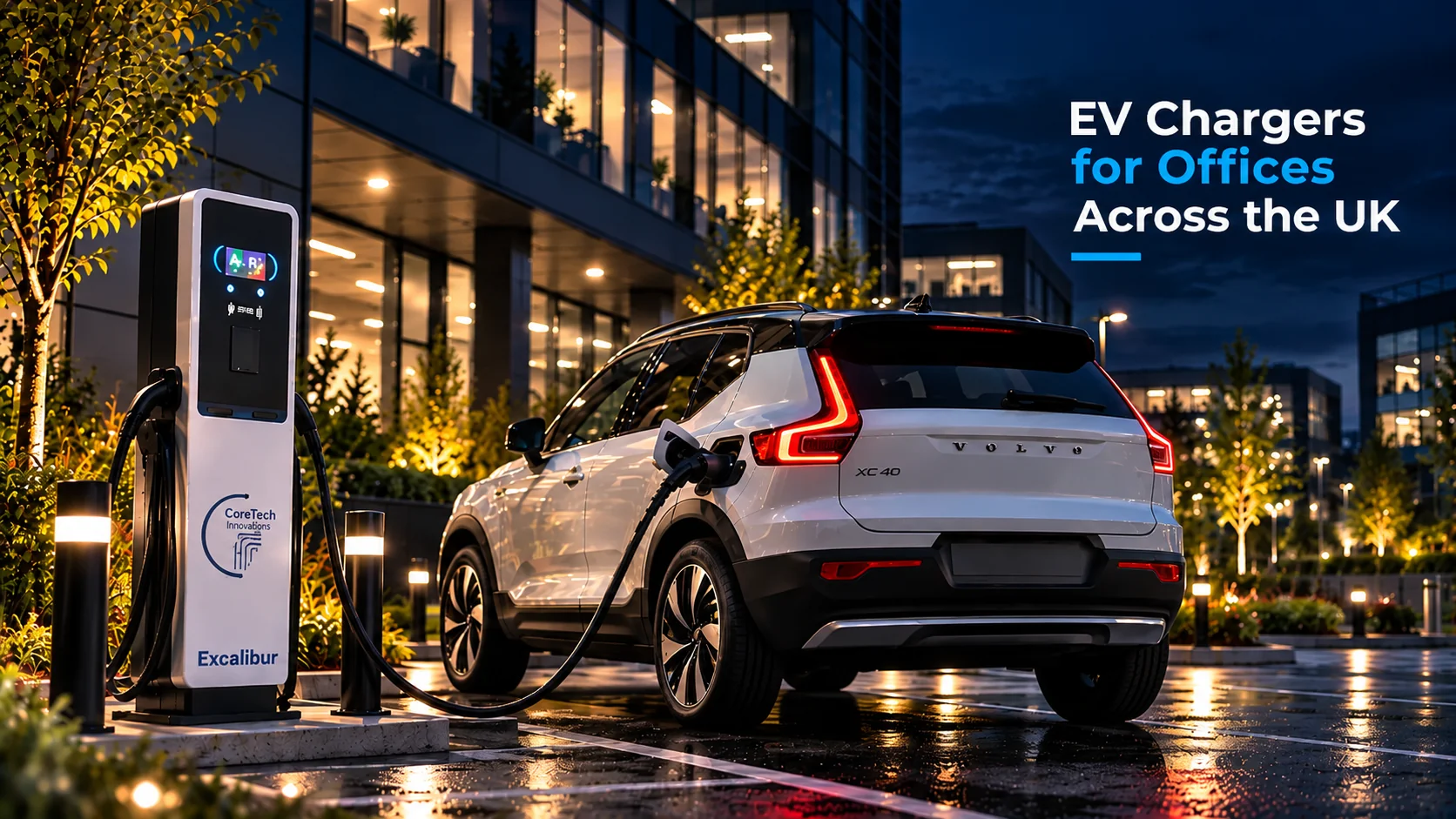
EV Chargers for Offices in the UK: Workplace Charging Guide

- Office EV charging should be planned around employee, visitor and fleet demand rather than charger power alone.
- Electrical capacity, vehicle dwell times and load management determine how many charging sessions a site can support.
- Parking layout, accessibility, permissions and cable routes should be assessed before installation.
- RFID or app-based access, energy reporting and a clear operating policy can make shared office charging easier to manage.
- CoreTech Excalibur is a commercial AC charging option; verify the current configuration and site compatibility before purchase.
- CoreTech is Cardiff-based and supplies EV charging products across the UK; installation arrangements require individual confirmation.
Planning office EV charging in the UK? Learn how to assess workplace demand, electrical capacity, employee and visitor access, running costs and commercial chargers.
EV Chargers for Offices in the UK: A Practical Workplace Charging Guide
Office EV charging is becoming an important consideration for UK employers as more staff, visitors and company drivers use electric vehicles. A workplace charger can make use of the hours vehicles already spend parked, but a successful project starts with understanding how the site operates rather than choosing equipment from a specification sheet.
This guide explains how to assess demand, choose parking locations, plan electrical capacity, manage access and evaluate commercial charging equipment. CoreTech Innovations is based in Cardiff and supplies EV charging products across the UK; installation feasibility and arrangements should be confirmed for each site.
Define the Business Case Before Buying Chargers
An office may want charging to support employee commuting, company cars, pool vehicles, visitors or a combination of these. Each use case creates a different pattern of demand and may justify a different approach to access and payment.
Start with a simple survey: how many drivers currently use electric vehicles, how far do they typically travel, how long do they park and how often would they need a charge? Consider whether the business will provide charging as an employee benefit, recover electricity costs or reserve bays for operational vehicles.
The objective is to specify a service that solves an identified need, not to install the maximum number of charge points immediately.
Understand Employee, Visitor and Fleet Charging Patterns
Employees may remain parked for six to nine hours, allowing energy to be delivered gradually. Visitors often have shorter stays, while pool or fleet vehicles may need a dependable state of charge before their next journey.
Separate these user groups in the planning brief. A visitor bay close to reception may be convenient, but it may not be the best place for a charger intended to serve vehicles parked all day. Clear signage and a parking policy can reduce conflict between charging and ordinary parking.
Choose Charger Power Around Dwell Time
Charging power is only one part of the decision. Actual charging speed is constrained by the vehicle’s onboard AC charger, the charge point, the available site supply and any active load management.
For long-stay office parking, lower-power AC charging can often meet daily energy needs. Higher-power three-phase AC equipment may be useful where compatible vehicles have shorter dwell times, but a charger labelled 22 kW will not make every car charge at 22 kW.
Calculate required energy using realistic daily mileage and consumption, then compare that need with the hours each vehicle is available to charge. This is a better starting point than choosing a unit solely because it has the largest advertised output.
Assess the Building Electrical Supply
Before selecting equipment, a qualified electrical designer or installer should review the incoming supply, existing peak demand, distribution boards, protective devices, earthing arrangements and possible cable routes.
A site may have spare capacity at some times but limited headroom during business peaks. Adding several charge points without a load assessment can create avoidable costs or operational constraints. Depending on the proposed demand, the local distribution network operator may need to be consulted about the connection.
Ask for a documented assessment of present capacity, proposed charging demand and the options for future expansion. Do not assume that a solution used at another office will fit this building.
Use Dynamic Load Management Where Appropriate
Dynamic load management can allocate available electrical capacity among charging sessions while respecting a configured site limit. This may help a business support more charging connections without treating every outlet as though it will run at maximum power simultaneously.
However, load management does not create extra electricity supply. Its value depends on real demand, vehicle dwell time, the number of outlets and how the system responds when several drivers connect at once.
Ask suppliers how the selected hardware and software handle prioritisation, connectivity failures and reporting before relying on load management in a business-critical charging plan.
Plan Parking Layout, Accessibility and Cable Routes
Charge point placement affects installation cost and daily usability. Consider the distance to electrical infrastructure, trenching requirements, pedestrian routes, vehicle turning space, lighting, drainage, impact protection and maintenance access.
Cable reach matters for cars with different charge-port locations. A practical design should minimise trailing cables across walkways and avoid creating obstacles for people with limited mobility. Review relevant accessibility guidance and site-specific obligations rather than assuming a standard bay layout works everywhere.
If the office leases its premises or shares a car park, obtain the necessary property-owner and management approvals early.
Decide Who Can Start a Charging Session
Offices often need different permissions for employees, visitors and company vehicles. Depending on the chosen equipment and management platform, access may be controlled using RFID, an app or another authorised method.
Decide whether sessions should be free, restricted to named users, billed internally or made available to visitors. Where payment is involved, clarify the pricing policy, user communications and operational responsibilities before launch.
A simple access policy is often more valuable than a complicated system that reception or facilities staff cannot administer reliably.
Track Electricity Use and Running Costs
Workplace charging creates an ongoing electricity cost as well as equipment and installation costs. Estimate energy use in kWh, then apply the business’s actual electricity tariff and any relevant standing, demand or network charges.
For example, ten sessions of 15 kWh represent 150 kWh of delivered charging energy before accounting for charging losses. The financial impact depends on when charging occurs, tariff structure and site operations.
Energy reporting can support budgeting, internal cost allocation and review of charger utilisation. Check whether the selected equipment provides the measurement and reporting functions your organisation requires.
Consider Smart Scheduling and Operational Policies
Scheduling can help coordinate charging with vehicle availability and site electricity demand. In some offices, charging later in the day may reduce pressure on the building; in others, drivers need their cars ready for afternoon travel.
Create practical rules for moving vehicles after charging, reporting faults, visitor access and handling bays occupied by vehicles that are not charging. Assign responsibility for user support, software administration and maintenance.
If chargers depend on internet connectivity for optional management functions, establish what remains available during an outage and document the recovery process.
Evaluate CoreTech Excalibur for Commercial Office Sites
CoreTech’s Excalibur commercial range is intended for workplace and other business charging environments. The supplied catalogue describes a three-phase commercial model with two 22 kW AC outputs, Type 2 connections, RFID or app-based authentication options, energy metering and OCPP-related management capabilities.
Those catalogue specifications describe a particular configuration; availability, software features and suitability should be verified against the current product documentation before procurement. Two nominal 22 kW outputs do not guarantee that a given site can deliver 44 kW continuously, or that connected vehicles will accept that power.
Compare the equipment with the site’s supply assessment, expected users and required management functions. View CoreTech’s current range at https://www.coretechinnovations.co.uk/evchargers/.
Budget for the Whole Project, Not Just the Hardware
The total cost of office EV charging can include equipment, electrical design, connection work, trenching, civil works, protection, signage, networking, commissioning, software subscriptions and ongoing maintenance.
Ask for quotations that distinguish essential works from optional upgrades and state assumptions about the existing supply. A low equipment price may not mean a low project cost if the chosen charger requires substantial electrical changes.
Funding and tax treatment can change. Confirm any current UK incentives or employer obligations with official guidance and qualified advisers rather than building the business case around an assumed grant.
Design for Expansion Without Overbuilding
If only a few employees currently drive electric, a phased installation may be sensible. Future-ready planning could include spare routes for cables, distribution-board space, a scalable management approach and an agreed process for adding charge points.
Review utilisation after launch: which bays are busiest, when demand peaks and whether vehicles are consistently ready when needed. Expansion should follow measured demand, not just forecasts.
Keeping the initial design flexible can reduce disruption later while avoiding expenditure on equipment that may remain unused.
A UK Office EV Charging Planning Checklist
Before procurement, record the intended users, number of parking spaces, vehicle dwell times, estimated daily energy needs, site electrical constraints, access policy and operating budget.
Next, commission an appropriate site assessment, compare charger configurations, confirm permissions, document accessibility and cable routing, and establish who will maintain and administer the system.
Finally, test the full user journey during commissioning: finding a bay, starting a session, viewing status, ending charging and getting help when something goes wrong. CoreTech can provide information about its available commercial charging products for UK businesses.
Frequently Asked Questions About Office EV Chargers
Can offices in the UK provide EV charging for staff? Yes. The appropriate setup depends on the premises, electrical capacity, parking arrangements and business policy.
Is a 22 kW charger always faster than a 7 kW charger? Not necessarily. The vehicle’s AC charging limit, site supply and load management determine the power actually delivered.
Can employees and visitors share office charge points? They can where the access and parking arrangements are designed to support both groups. Clear rules help avoid congestion.
How many chargers should an office install? Base the initial quantity on real user demand, parking dwell times and available capacity, with an expansion plan if uptake increases.
Does CoreTech install chargers throughout the UK? CoreTech supplies EV charging products across the UK. Installation coverage and project arrangements should be confirmed directly rather than assumed.
Where can I compare commercial products? Visit https://www.coretechinnovations.co.uk/evchargers/ and request the current specifications for the relevant Excalibur configuration.