Workplace EV Charging UK: A Practical Guide for Employers

- Workplace EV charging should begin with a clear employer policy covering eligibility, access, bay etiquette and operational ownership.
- Employee surveys and realistic utilisation assumptions help employers phase charging capacity without unnecessary upfront expansion.
- Free, paid and subsidised charging each require transparent terms and may have different payroll, tax and administrative implications.
- Charging speed depends on vehicle compatibility, electrical capacity and load management, not simply the charger rating.
- Access control, privacy-aware reporting, safety and maintenance are essential parts of a dependable workplace charging service.
- CoreTech Excalibur commercial charging products may suit workplace projects when their verified configuration matches the site and policy.
A practical UK guide to workplace EV charging for employers, covering staff access, charging policies, costs, safety, reporting, rollout and commercial charger selection.
Workplace EV Charging in the UK: An Employer-Led Approach
Workplace EV charging is more than an electrical installation. For UK employers, it is a service that needs rules about who can charge, when bays are available, how energy costs are handled and who responds when something goes wrong. A clear operating policy makes a charging investment more useful to staff and easier for facilities teams to manage.
This guide focuses on the employer decisions that sit alongside the technical design: employee benefits, access permissions, charging etiquette, payment arrangements, reporting and phased rollout. For detailed office car-park layouts and cable routes, a separate office EV charging planning guide is the more relevant resource.
Define the Purpose Before Buying Chargers
Start by deciding whether charging is primarily an employee benefit, a facility for business vehicles, a visitor service or a combination. Each objective has different implications for pricing, availability and access. A company offering free employee charging may prioritise fairness and usage controls, while a business with shared pool cars may need guaranteed charging windows.
Write down the intended users, hours of access, likely number of sessions and the outcome the employer wants. This simple brief helps avoid buying equipment first and inventing the operating rules later. Review it with HR, facilities, finance and the people who will actually use the spaces.
Survey Employee Demand Without Overbuilding
An employee travel survey can identify how many people already drive electric vehicles, how often they commute, their typical working hours and whether they have reliable charging at home. Include hybrid workers and shift teams rather than assuming everyone is on site five days a week.
Survey results are a planning input, not a guaranteed forecast. Start with realistic utilisation assumptions and allow for changes as staff vehicles and working patterns evolve. Where demand is uncertain, a smaller first phase with a credible expansion plan may be more sensible than filling the entire car park with chargers.
Create a Fair Workplace Charging Policy
A written charging policy should explain eligibility, booking or queuing arrangements, maximum occupancy, charging-bay etiquette and what happens when a vehicle has finished charging. Without clear rules, a small number of charging spaces can create unnecessary friction between drivers.
Consider whether staff with limited access to home charging need additional support, while keeping the policy understandable and consistently applied. Communicate how visitors, contractors and company vehicles are treated. Review the policy after launch using actual demand rather than relying solely on assumptions.
Employee, Visitor and Company Vehicle Access
Not every charger should necessarily be open to every driver. A workplace might reserve some capacity for company vehicles while allowing employees to use other points during the day. Visitor charging may need a simpler temporary access process and clear signage.
Commercial charging equipment can offer different access methods depending on model and configuration, including RFID or app-based authorisation. Confirm exactly which functions are supported by the proposed hardware and management platform before promising them in an employee policy.
Free, Paid or Subsidised Charging?
Employers should choose whether charging is complimentary, charged at cost, offered at a fixed rate or managed through another documented arrangement. The choice affects staff expectations, administration and the information needed from the charging system. Electricity cost is only one part of the total expense; maintenance, network services and support can matter too.
Where charging is billed or treated as an employee benefit, ask qualified payroll and tax advisers to check the current UK rules and the facts of the scheme. Avoid treating a general article as a substitute for HMRC guidance or professional advice. Publish the charging price and any applicable terms clearly before staff begin using the service.
Managing Charging During the Working Day
Office and workplace charging often benefits from long parking dwell times, but that does not mean every vehicle needs to charge at full power throughout the day. Employees may arrive at similar times, creating a morning peak in demand, while others may only need a modest energy top-up before their journey home.
A practical operating plan can combine scheduling, shared bays and appropriate power management. If chargers support load management, assess how that capability interacts with the building supply and other electrical loads. The objective is dependable availability rather than maximising the advertised power of every socket at once.
Choosing Charging Power for Staff Vehicles
For many UK workplaces, AC charging can suit vehicles parked for several hours. A 7 kW charging point may be appropriate for some sites, while higher-power AC equipment can be useful where vehicles and electrical infrastructure support it. Actual charging speed is limited by the vehicle's onboard charger, site supply and any power-sharing controls.
Do not assume that a 22 kW AC outlet will charge every vehicle three times faster than a 7 kW unit. Match power to typical parking duration, vehicle compatibility and available capacity. A competent electrical assessment should inform the final choice and any necessary network or distribution upgrades.
Security, Authentication and Usage Records
Employers should decide what information is genuinely needed to operate the charging service. This might include session duration, energy delivered, charger availability and an identifier used to allocate access or costs. Reporting can help facilities teams understand utilisation and spot equipment that is frequently unavailable.
Charging platforms may process personal data about employees or visitors. Set appropriate permissions, retention rules and privacy notices, and assess the applicable UK data protection obligations. Avoid collecting detailed movement or usage histories without a clear business purpose and suitable safeguards.
Responsibilities Across HR, Facilities and Finance
A charging scheme works best when responsibilities are assigned before the first unit is switched on. Facilities may own maintenance and electrical safety, HR may communicate eligibility and etiquette, and finance may handle payments or employee expense questions. IT or a service provider may manage platform access and connectivity.
Nominate an owner for faults, disputes and changes to the policy. Decide how drivers report a broken charger, how quickly issues are escalated and what temporary arrangements apply if charging is unavailable. Clear ownership is often more valuable than adding another feature to the equipment specification.
Workplace Charging Safety and Accessibility
Safe operation requires more than the charger itself. Consider vehicle circulation, pedestrian routes, charging cables, signage, lighting and accessibility when establishing the charging policy. Equipment location and installation must be assessed by suitably qualified professionals in accordance with applicable UK requirements.
Keep charging spaces usable and avoid encouraging improvised extension leads or unsuitable socket arrangements. A routine inspection and maintenance plan should be agreed with the installer or responsible service provider. Where the workplace is leased or shared, confirm permissions and responsibilities with the relevant property stakeholders.
Excalibur and Commercial Workplace Charging
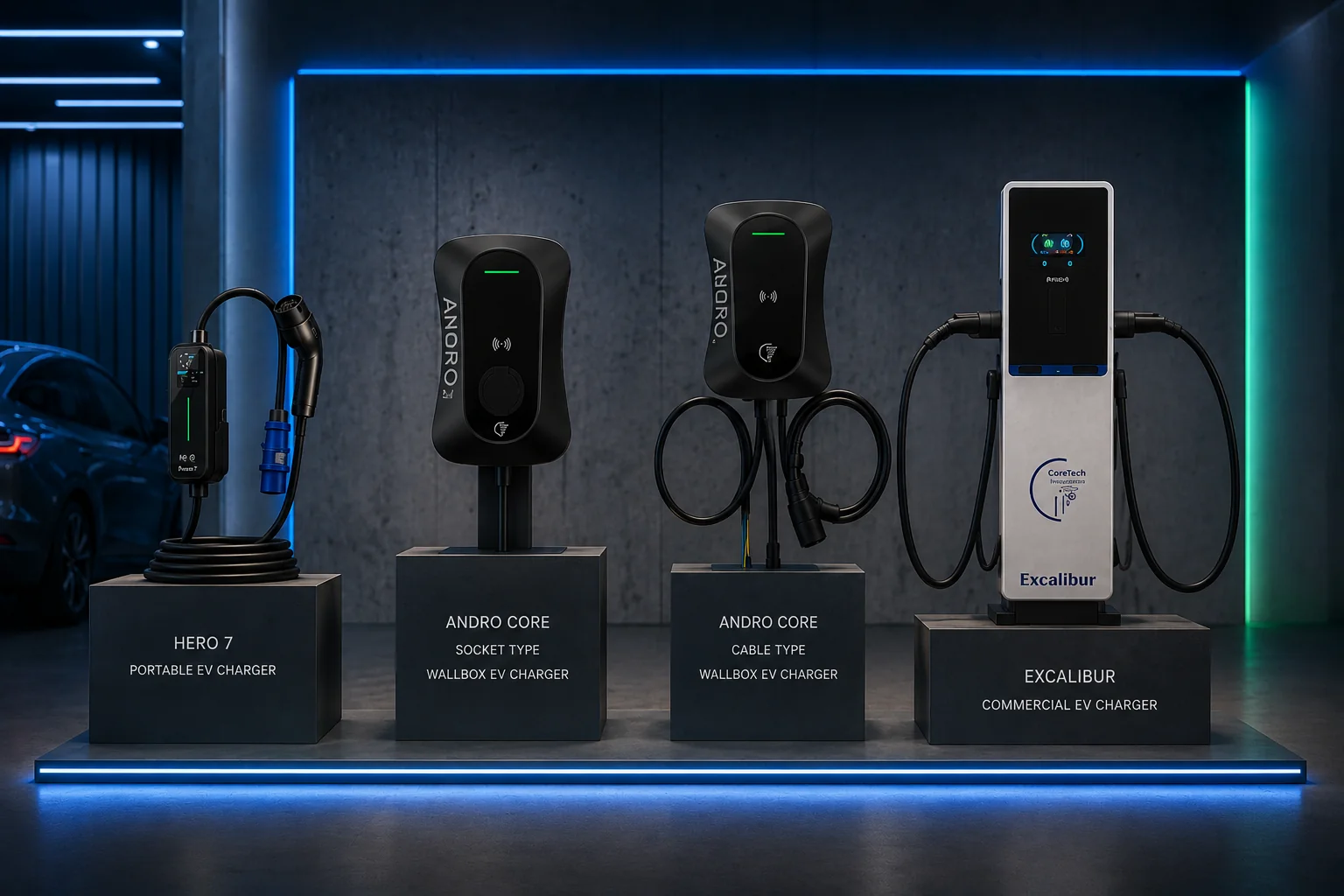
CoreTech Innovations supplies commercial EV charging products, including the Excalibur range. The product catalogue describes an Excalibur configuration with two 22 kW AC outputs, Type 2 connections, RFID and app or QR-based authentication options, and OCPP 1.6J support. The exact features depend on the model and supplied configuration.
For an employer, these capabilities are useful only when they match the intended charging policy, site supply and management arrangements. Confirm product specifications, compatible software, connectivity and current availability directly before purchase. CoreTech is based in Cardiff and offers EV charging products for customers across the UK; installation coverage should be confirmed separately for each location.
A Phased Rollout for UK Employers
A phased approach gives employers a chance to learn from real use. Begin with a clear demand assessment and site survey, agree the charging policy, select suitable hardware and test access and billing workflows with a limited group. Gather feedback before expanding the scheme.
Useful measures include charger availability, sessions per week, average energy per session, time spent occupying a bay after charging and reported support issues. These are operational indicators, not targets that every business must meet. Review the results alongside employee experience and future vehicle demand.
How Workplace Charging Differs from Office and Fleet Projects
Workplace charging is an umbrella term, but the primary decision in this guide is how an employer operates a charging service for people at work. An office EV charger planning article should go deeper into office parking geometry, landlord approvals and physical infrastructure. A fleet charging article should focus on vehicle duty cycles, depot return times and dispatch readiness.
Keeping those topics separate helps employers find the guidance that matches their problem. It also avoids treating every commercial EV charging query as interchangeable. For equipment selection and product availability, explore CoreTech's EV charger catalogue and contact the team with your workplace requirements.
Workplace EV Charging UK: Frequently Asked Questions
Should workplace EV charging be free for employees? There is no universal answer. Consider the employer's goals, operating costs, fairness and any relevant tax treatment before setting a policy. Can employees and visitors share charging points? Yes, where the site design and access system support it, but clear allocation and signage are important.
How many chargers should an employer install? Base the first phase on surveyed demand, parking duration, electrical capacity and expansion plans rather than a fixed charger-to-employee ratio. Can CoreTech Excalibur support workplace charging? It is designed for commercial applications, but suitability depends on the chosen configuration and a professional site assessment. Where can I compare products? Visit the CoreTech EV charger catalogue for current options.