EV Chargers for Taxi Drivers: Home, Portable or Commercial Charging?

- An EV charger for taxi drivers should be chosen around daily mileage, time between shifts, access to off-street parking and the vehicle’s charging limits.
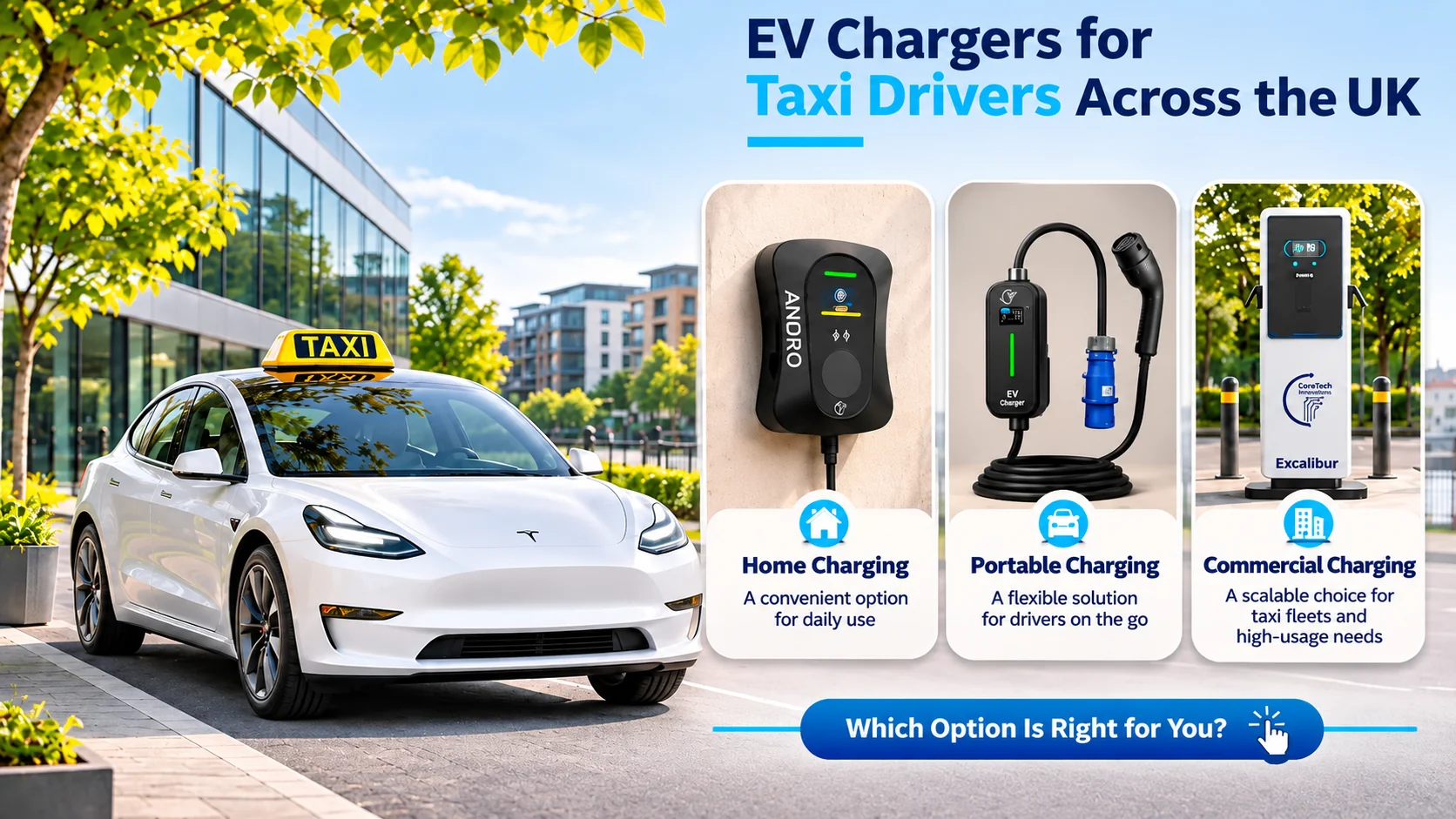
- Home charging can be practical for taxi and private hire drivers with suitable parking and an approved electrical installation.
- Portable charging may provide flexibility at suitable electrical connections, but it is not a substitute for checking socket safety and manufacturer instructions.
- Public AC and rapid or ultra-rapid DC charging can complement home charging, especially during long shifts or when home installation is not possible.
- Compare the total cost per usable kWh, charging time, access arrangements and potential downtime rather than charger power alone.
- CoreTech supplies EV charging products across the UK from its Cardiff base; product supply does not imply installation availability in every location.
A practical UK guide to EV chargers for taxi and private hire drivers. Compare home wallboxes, portable charging, public rapid charging, shift planning and running costs.
EV Chargers for Taxi Drivers: Home, Portable or Commercial Charging?
For taxi and private hire drivers across the UK, reliable EV charging is part of planning a working day. The best charging arrangement depends on mileage, shift patterns, parking, the vehicle and the time available between fares.
This guide compares home wallboxes, portable EV charging equipment and public or commercial charging. It explains practical trade-offs for licensed taxi drivers, private hire drivers and small fleets without assuming one solution suits everyone.
CoreTech Innovations is based in Cardiff and supplies EV charging products across the UK. Installation availability and site suitability should be confirmed separately.
What Makes EV Charging Different for Taxi and Private Hire Drivers?
A private motorist may be able to leave a vehicle parked for most of the day. A taxi or private hire driver may need to cover repeated journeys, work late shifts and keep the vehicle available for passengers.
Before choosing equipment, record typical daily mileage, the highest-mileage working days, the time the car is parked at home and the locations of dependable public chargers.
Also check the vehicle’s AC charging limit, DC charging capability and any requirements set by your local taxi or private hire licensing authority. Licensing requirements vary by authority.
Home EV Chargers for Taxi Drivers
For drivers with a driveway or other suitable off-street parking, a dedicated home EV charger can make it easier to recharge during rest periods. A qualified installer should assess electrical capacity, earthing arrangements, cable routing and any permissions needed.
Home charging can reduce reliance on public charging, but it may not replenish enough energy between shifts for every driver. Compare available parking hours with the vehicle’s actual AC charging rate.
If you rent your home or use shared parking, seek the property owner’s or managing agent’s permission where required before planning an installation.
Andro Home Chargers: A Fixed Charging Option
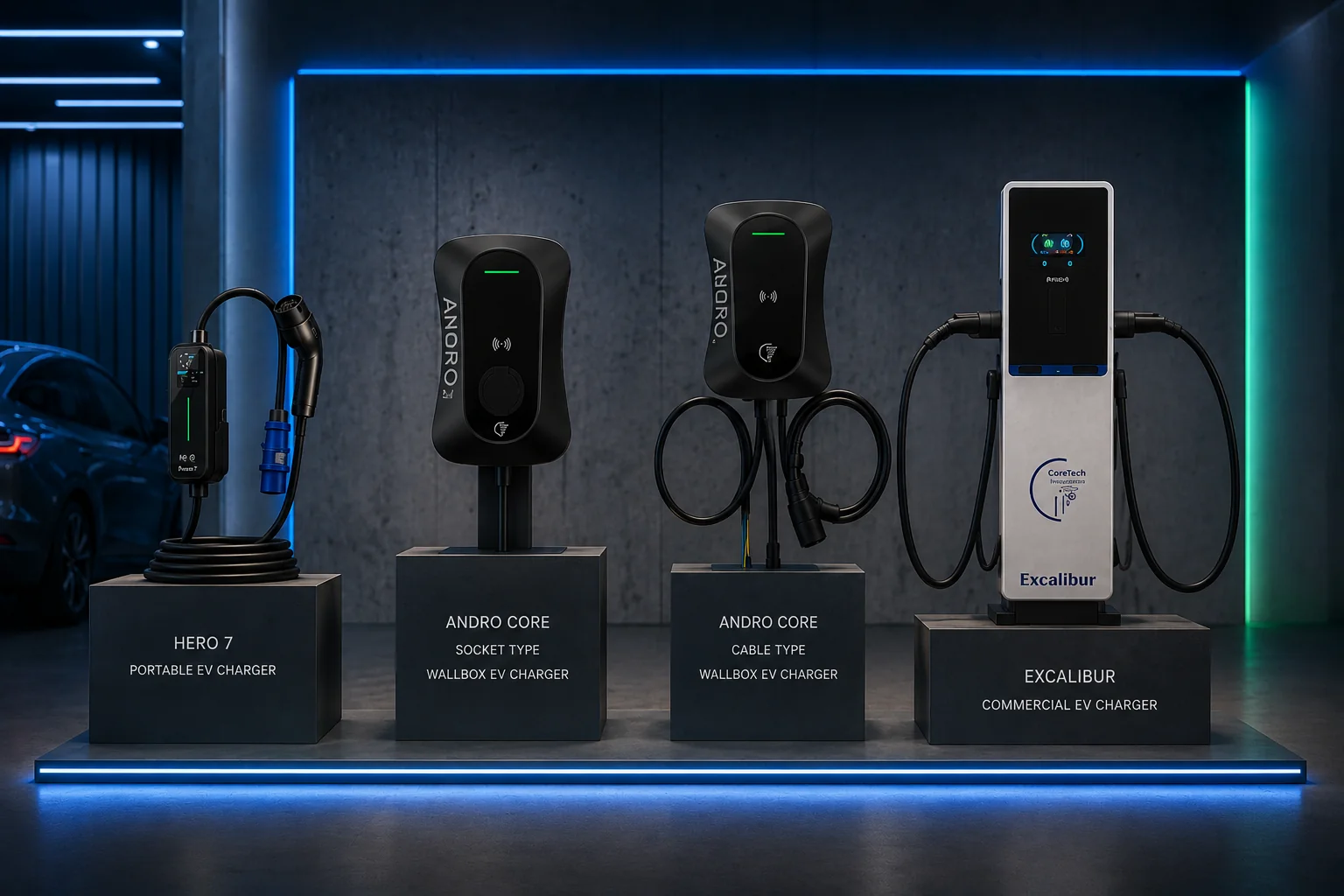
CoreTech’s Andro range includes wall-mounted charging products for residential use. For taxi drivers who regularly park at home, a fixed charger may be more convenient than repeatedly setting up portable equipment.
Check the current Andro model specifications, connector compatibility, electrical requirements and any available smart charging features before purchase. The right product depends on the vehicle and property, not simply the maximum advertised power.
Explore the current CoreTech product range for model-specific information and confirm installation requirements with a suitably qualified professional.
Portable EV Charging for Taxi Drivers: When Does It Make Sense?
A portable EV charger such as CoreTech’s Hero 7 may be useful where a suitable, permitted electrical connection is available and flexibility matters. Portable does not mean that every domestic socket, extension lead or outdoor connection is suitable.
Always follow the product and vehicle manufacturers’ instructions. Avoid assuming an ordinary socket is appropriate for repeated high-load charging; the supply and protective arrangements should be checked by a competent electrician.
Portable charging may be a supplementary option for some drivers, but it is generally less predictable than a properly planned fixed charging installation or reliable public charging access.
Public AC, Rapid DC and Commercial Charging
Public AC charging can suit longer stops, while rapid or ultra-rapid DC charging may be useful when a driver needs to return to work sooner. Actual charging speed depends on the vehicle, battery temperature, state of charge and charger availability.
Public charging prices and access arrangements vary. Check the operator’s current tariff, payment methods, parking restrictions and any additional fees before relying on a location during a shift.
Drivers without home charging may benefit from identifying several reliable charging locations along their regular routes, including a backup if a charger is busy or unavailable.
How Much Charging Does a Taxi Driver Need Each Day?
Estimate energy demand using daily distance and the vehicle’s real-world energy consumption. For example, 150 miles at 0.30 kWh per mile represents approximately 45 kWh of driving energy before charging losses. This is an illustration, not a prediction for a specific vehicle.
If a vehicle can accept 7 kW AC charging, six hours at that rate represents up to 42 kWh delivered before losses and any reductions in charging power. The actual energy added can be lower.
For high-mileage shifts, combine a realistic overnight charging estimate with a plan for occasional public top-ups. Use your own vehicle data rather than relying solely on brochure range.
AC vs DC Charging: Which Fits Your Taxi Shift?
AC charging is often practical when the car can remain parked for several hours. A fixed home wallbox is an AC solution, and the vehicle’s onboard charger limits the AC rate it can use.
DC charging can be substantially faster for compatible vehicles and suitable battery conditions, but public DC charging may cost more per kWh and can involve travel, queues or parking restrictions.
The best choice is often a combination: planned home AC charging when possible, with public charging used when shift length or unexpected mileage requires it.
Comparing Home and Public Charging Costs
Calculate charging cost by multiplying the energy purchased in kWh by the applicable electricity tariff, then account for charging losses and any session, parking or idle fees.
For example, 40 kWh at an illustrative tariff of £0.25 per kWh costs £10 before other charges. The same 40 kWh at £0.65 per kWh costs £26. These figures are examples, not current UK tariffs or CoreTech prices.
For home installations, also consider the purchase and installation cost of equipment, the electricity tariff and how frequently the charger will be used. Compare total cost over time rather than a single charging session.
Planning Charging Around Day, Night and Split Shifts
If you work a regular daytime shift and park at home overnight, home charging may cover a large share of your needs. Drivers on night shifts should check whether their available daytime parking window is long enough.
Split shifts and airport runs may create irregular charging windows. Identify safe, convenient places to charge without disrupting passenger bookings and allow for delays or charger outages.
Avoid planning to arrive at a charger with no practical energy reserve. The right buffer depends on your vehicle, weather, route and access to alternatives.
What If You Cannot Install a Home Charger?
Drivers living in flats, rented properties or homes without off-street parking may need to rely on public charging or explore permitted shared and workplace options.
Check local authority schemes and the latest eligibility rules for any relevant grants or infrastructure support. Availability and requirements can change, and not every driver or property will qualify.
If considering an on-street or cross-pavement arrangement, obtain the necessary permissions and use an approved, safe solution; do not route an unprotected cable across a public footway.
Choosing Between Andro, Hero 7 and Public Charging
Choose a fixed home charger such as an appropriate Andro model when you have suitable parking, an approved installation and predictable parking time. Consider a compatible portable product such as Hero 7 only where the supply and usage conditions are suitable.
Use public or commercial charging when home charging is unavailable or insufficient for your mileage. A blended approach can be more resilient than relying on one charger.
Before buying, confirm connector and vehicle compatibility, electrical requirements, warranty terms and the exact features of the current product model.
EV Charger Products for Taxi Drivers Across the UK
CoreTech Innovations is based in Cardiff and supplies EV charging products across the UK, including England, Scotland, Wales and Northern Ireland.
Taxi and private hire drivers can explore CoreTech’s home and portable charging options and contact the team for current product information. Product delivery and installation are separate services; installation coverage and site requirements must be confirmed for each location.
The charging principles in this guide apply to drivers in cities, towns and rural areas, but public charger availability, property permissions and local licensing rules differ.
Frequently Asked Questions About EV Chargers for Taxi Drivers
What is the best EV charger for a taxi driver? The best option depends on daily mileage, vehicle compatibility, parking access, shift pattern and budget. A fixed home charger may suit drivers with off-street parking, while others may rely on public charging.
Can a taxi driver charge an electric vehicle at home? Yes, where the property, electrical installation and permissions allow a suitable charging point. A qualified installer should assess the site.
Is a portable EV charger suitable for private hire drivers? It may be useful with a compatible vehicle and appropriate electrical supply, but not every socket or location is safe or permitted for charging.
Is rapid charging better than home charging for taxis? Rapid DC charging can save time during a working day, while home AC charging may be more convenient for longer parking periods. Costs and actual charging speeds vary.
How much does it cost to charge an electric taxi in the UK? Multiply the kWh purchased by the applicable tariff and include any extra fees and losses. Actual costs depend on the vehicle, charging method and provider.
Does CoreTech supply EV chargers outside Cardiff? Yes. CoreTech supplies EV charging products across the UK. Installation availability should be confirmed separately.