Fleet EV Charging UK: A Practical Guide for Businesses

- Plan fleet charging around routes, daily energy use and vehicle departure times rather than vehicle count alone.
- Depot, workplace, home and public charging can serve different roles in a UK fleet strategy.
- A 22 kW AC charger does not guarantee 22 kW charging because vehicle and site limits apply.
- Load management and operational priorities can help share constrained electrical capacity across vehicles.
- Compare total project costs, software, maintenance and downtime instead of equipment prices alone.
- CoreTech supplies commercial EV charging products across the UK; confirm model specifications and installation arrangements separately.
Plan fleet EV charging across the UK with practical guidance on depot charging, vehicle schedules, electrical capacity, load management, costs and commercial AC chargers.
Fleet EV Charging in the UK: Start with Operations, Not Hardware
Switching a company fleet to electric vehicles changes how drivers plan routes, where vehicles stop and when they can recharge. A fleet charging strategy must therefore begin with operational data, not a catalogue of chargers.
Across the UK, businesses may operate depot-based vans, company cars, service vehicles or mixed fleets. Each has different dwell times, mileage patterns and parking arrangements. This guide explains how to turn those details into a practical charging plan without assuming that one charger specification fits every site.
Map Vehicle Duty Cycles and Daily Energy Demand
Record each vehicle's typical mileage, routes, shift start and finish times, overnight parking location and expected time at base. Separate predictable daily journeys from exceptional high-mileage days. This reveals how much energy must be replenished before the next departure.
A useful planning estimate is daily miles multiplied by expected energy consumption per mile, with an allowance for weather, payload and operational uncertainty. Actual consumption varies by vehicle and route; validate estimates using vehicle data or a controlled trial rather than treating a single figure as universal.
Depot, Workplace, Home and Public Charging: Choose the Right Mix
Depot charging can suit vehicles that reliably return to a common base. Workplace charging may support company cars and pool vehicles parked during business hours. Drivers who take vehicles home may need an agreed home-charging policy, reimbursement method and installation assessment.
Public rapid charging can provide resilience for long-distance work or unexpected changes, but relying on it for every routine journey may introduce downtime and variable costs. Consider a blended strategy and document which vehicles depend on which charging locations.
Match Charging Power to Parking Time
For vehicles parked overnight, AC charging may replenish the required energy without the cost or grid demand associated with faster infrastructure. A vehicle that stops only briefly may need a different approach. Evaluate energy required during each available charging window rather than choosing the highest advertised kilowatt rating.
The vehicle's onboard AC charger can limit the power it accepts. A 22 kW AC charge point does not guarantee a vehicle will charge at 22 kW; the vehicle, supply, configuration and site conditions all matter. Charging rates can also vary through a session.
Plan Site Electrical Capacity Before Ordering Chargers
A fleet depot's existing electrical supply also serves lighting, heating, equipment and other building loads. Adding several chargers can materially change peak demand. A competent electrical designer should review supply capacity, distribution boards, protection, earthing, cable routes and potential network-operator requirements.
If available capacity is constrained, staged deployment and managed charging may be more economical than immediately seeking the largest possible connection. Any decision should be based on a site-specific technical assessment and the fleet's actual departure deadlines.
Dynamic Load Management and Charging Priorities
Load management can allocate available power across multiple charge points while respecting site limits. This is especially valuable when vehicles arrive together but do not all need a full battery by the same time.
A more useful operational rule than first-come, first-served is to prioritise vehicles by next departure, required energy and operational importance. Check whether the selected hardware and management platform support the required controls; capabilities differ by model and software.
Fleet Charging Software, OCPP and Reporting
For multi-vehicle operations, visibility matters. Useful reporting may include session energy, charger availability, faults, user identification and cost allocation. Some platforms support open communication protocols such as OCPP, which can help evaluate interoperability between chargers and management software.
Do not assume every charger or software version supports the same OCPP functions. Confirm protocol version, supported profiles, remote management features, data export and support arrangements before procurement. Define who monitors the chargers and who responds when one becomes unavailable.
Access Control for Drivers and Shared Vehicles
Shared depots need a clear policy for who may use charging bays and how sessions are attributed. Depending on the equipment, access can be controlled through RFID, an app or another supported method. Choose a method that works for shift changes and occasional drivers.
Set out simple rules for parking, moving vehicles once charged, cable handling and reporting faults. Physical layout and operational discipline can be just as important as the charger management platform.
Design Safe and Practical Depot Parking
Review vehicle turning circles, bay dimensions, pedestrian routes, cable reach, bollards and charger protection. Chargers should be positioned so drivers can connect without blocking access or creating avoidable trip hazards.
Consider accessibility, lighting, drainage and the ability to maintain equipment without disrupting the whole site. A professional site survey should determine suitable locations and installation requirements under applicable UK electrical and building rules.
Understand Total Cost of Ownership
The price of a charging unit is only one part of a fleet project. Budget for surveys, electrical works, civil engineering, network upgrades where required, software subscriptions, maintenance, energy and potential downtime.
To compare options, calculate expected charging energy, tariff assumptions, operating hours and utilisation over several years. Consider the cost of vehicles waiting for a charger or leaving the depot undercharged. Do not treat illustrative savings or payback figures as guaranteed outcomes.
Tariffs, Scheduling and Electricity Demand
Where a suitable business electricity tariff offers lower-cost periods, charging schedules may reduce energy expenditure. However, the lowest unit rate is not necessarily the cheapest overall option if demand charges, contract conditions or vehicle departure requirements are ignored.
Coordinate schedules with fleet dispatch. A vehicle needed at 05:00 should not be delayed merely to capture a cheaper charging period. Review bills and measured charging data periodically to refine the strategy.
Pilot the System Before Scaling Up
Start with a representative group of vehicles and drivers. Measure actual energy use, arrival and departure times, charge completion, charger reliability and driver feedback over a meaningful operating period.
Use the results to adjust charger quantity, power allocation, parking arrangements and training. A pilot can uncover issues such as unexpected overnight demand, awkward charging-port locations or inconsistent access to shared bays before they affect the entire fleet.
Build for Future Fleet Growth
A phased approach can avoid overbuying hardware while preserving options for expansion. During initial works, consider spare ducting, suitable cable routes, panel capacity and space for additional bays where practical.
Revisit forecasts when vehicles, shifts or routes change. The right future-proofing investment depends on the likely growth of the fleet and the cost of later disruption, not simply the maximum number of chargers that could fit in a car park.
Where CoreTech Excalibur Fits
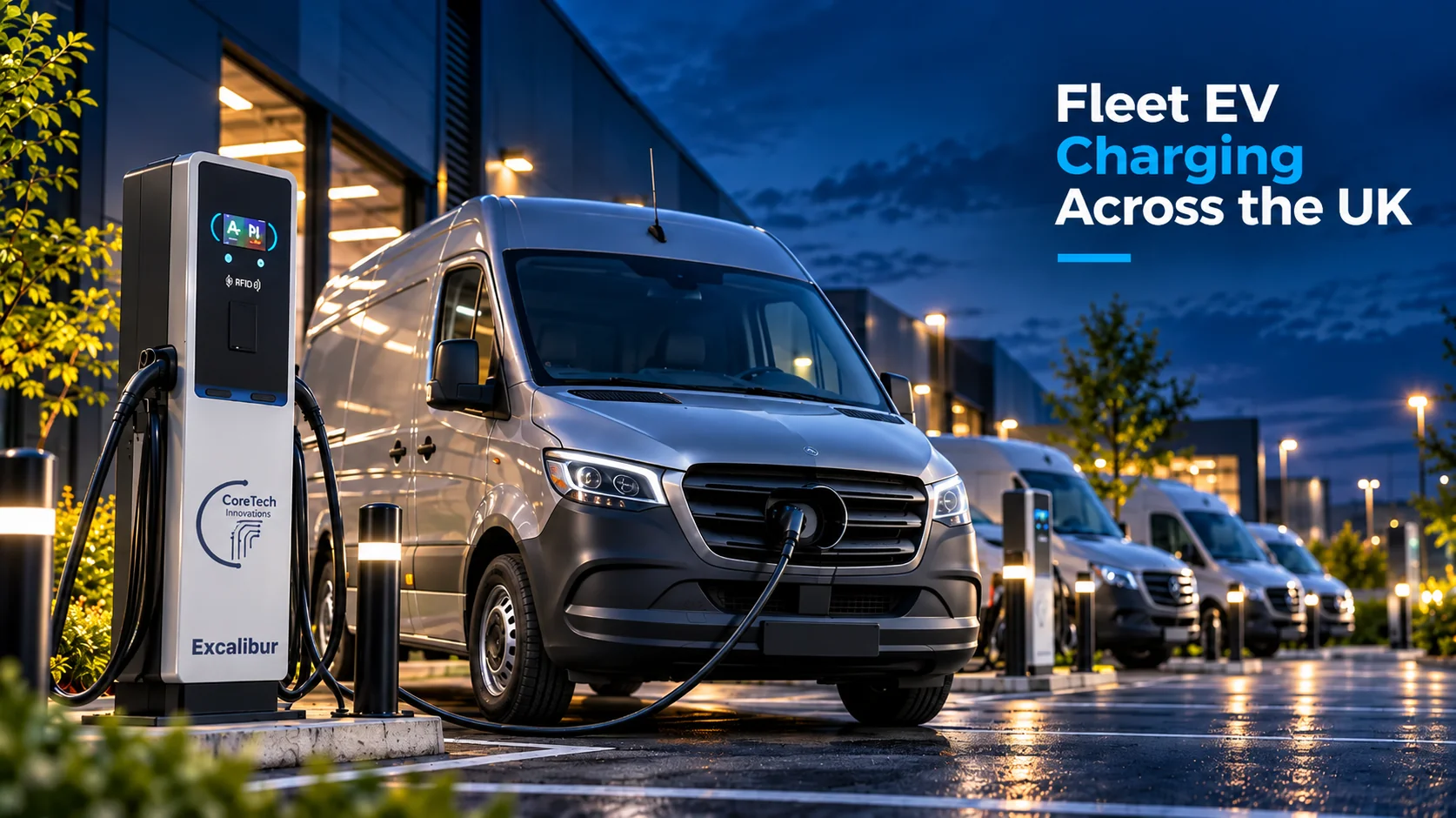
CoreTech Innovations, based in Cardiff, supplies EV charging products to customers across the UK. Its Excalibur range is positioned for commercial applications and may be relevant to depot and business-site charging projects.
Assess the specific Excalibur model against vehicle compatibility, AC power requirements, electrical supply and any software or access-control needs. Confirm current specifications and integration options with CoreTech rather than assuming that all configurations have identical capabilities. Explore the current range at /evchargers/.
Frequently Asked Questions About UK Fleet EV Charging
How many fleet chargers do we need? Start with vehicle energy demand, dwell times, departure deadlines and charger availability. The number of vehicles alone is not enough to size a site.
Is 22 kW charging always better for fleets? No. A vehicle's onboard AC charging limit, available supply and parking duration determine whether higher-power AC equipment provides a practical advantage.
Can several vehicles charge at once? Potentially, provided the site has suitable electrical capacity and an appropriately designed installation. Load management may help distribute power within site limits.
Should we use public charging for company vehicles? It can complement depot or home charging, particularly for longer journeys. Evaluate reliability, cost and driver downtime against your operating pattern.
Does CoreTech install fleet chargers throughout the UK? CoreTech supplies charging products across the UK; installation availability and project arrangements should be confirmed directly rather than assumed.
Next Steps: Build a Fleet Charging Plan
Begin with a vehicle and route audit, then assess parking and electrical infrastructure. Compare charging approaches on operational fit, reliability and total cost rather than headline charger power alone.
For a UK business considering commercial AC charging, review CoreTech's EV charger range and discuss product suitability for the intended fleet. A qualified installer or electrical designer should assess the specific site before any installation decision.