Tethered vs Untethered EV Chargers: Which Is Better for Cardiff Homes?

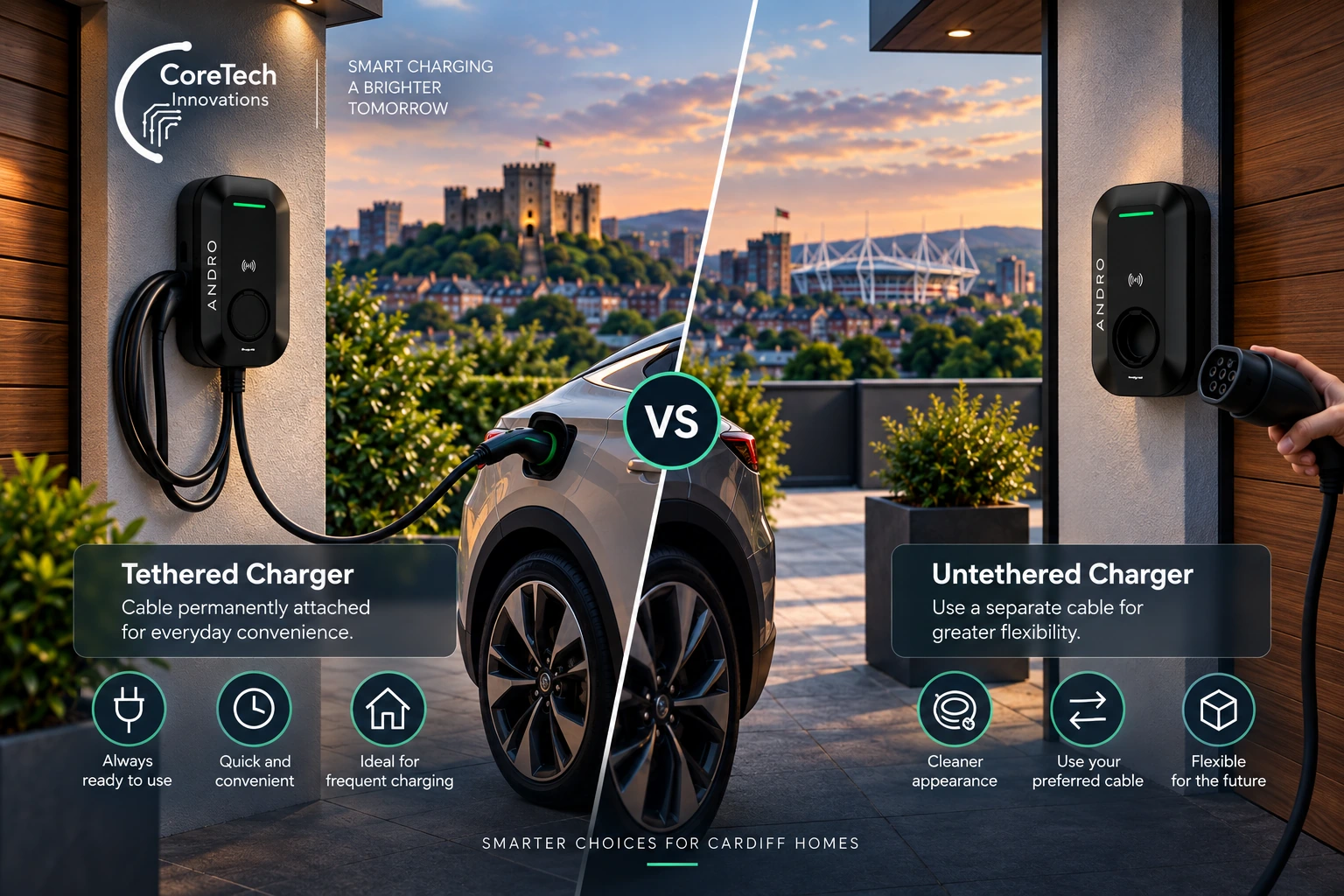
- A tethered EV charger has a charging cable permanently attached to the unit, while an untethered charger uses a separate removable cable.
- Tethered chargers can make everyday home charging more convenient because the cable is already available when you park.
- Untethered chargers can give the installation a tidier appearance when the cable is removed and may provide greater flexibility over which compatible cable is used.
- Cable storage, parking position and the distance between the charger and the vehicle's charging port are important considerations for Cardiff homes.
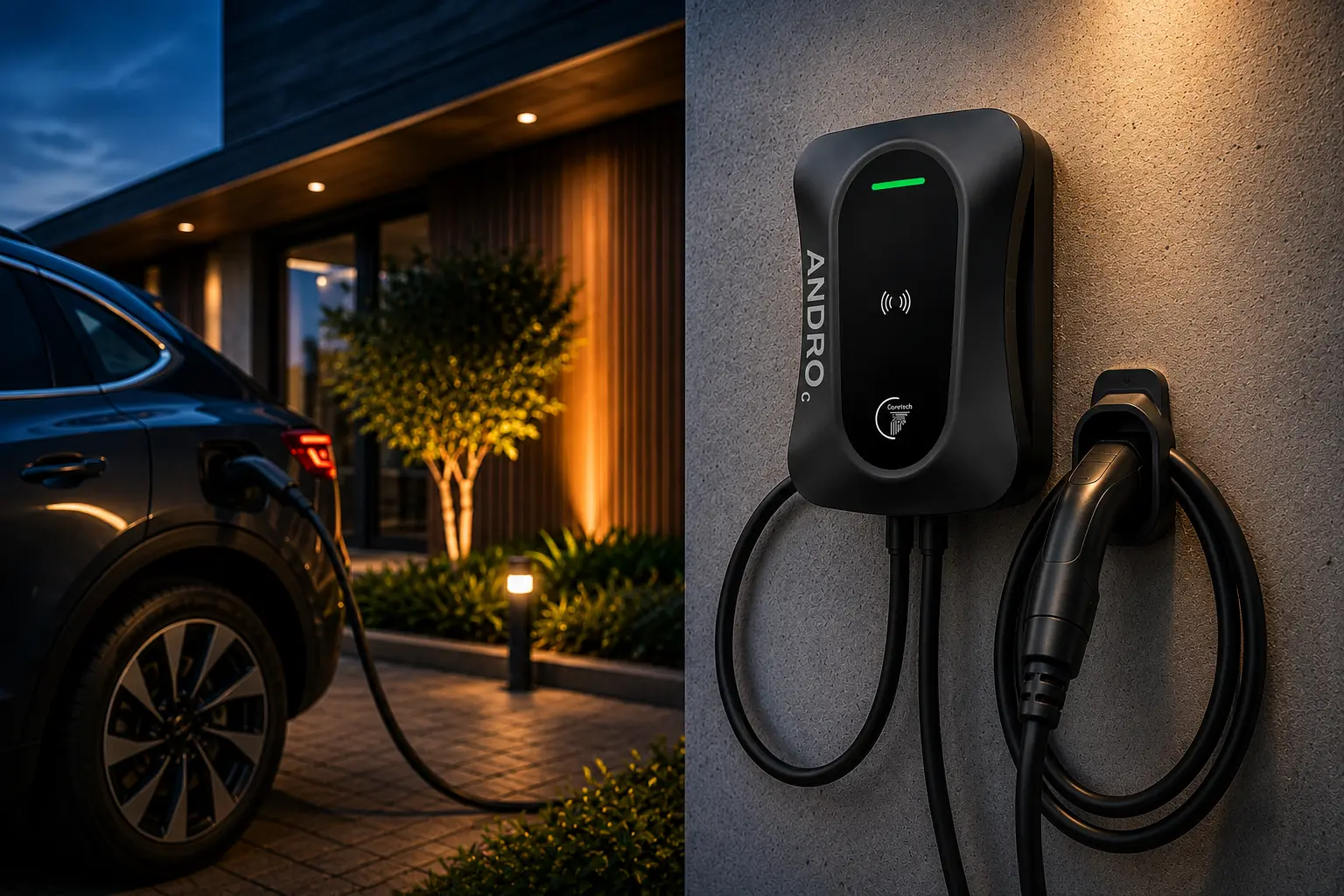
- CoreTech's Andro Core, Andro Max and Andro Vision 7kW Type 2 wallboxes are available in both socket and cable versions.
- Neither format is automatically better for every household. The right choice depends on the property, vehicle and normal charging routine.
Compare tethered and untethered EV chargers for Cardiff homes, including convenience, cable storage, flexibility, property layout and everyday charging use.
Tethered vs Untethered EV Chargers: Which Is Better for Cardiff Homes?
When choosing a home EV charger, much of the attention naturally goes to charging power and smart features. But there is another practical decision that can make a noticeable difference to everyday use:
Should you choose a tethered or untethered EV charger?
The distinction is straightforward. A tethered charger has its charging cable attached to the wallbox, while an untethered charger has a socket and requires a separate cable to connect the vehicle.
Both approaches can work well for home charging. The better option depends less on which design is more advanced and more on how the charger will actually be used.
For Cardiff homeowners, factors such as parking position, available space, cable storage and the location of the vehicle's charging port can all influence the decision.
What Is a Tethered EV Charger?
A tethered EV charger has a charging cable permanently connected to the wallbox.
When you arrive home, the cable is already at the charging point. You simply take it from its storage position and connect it to the vehicle.
For many drivers, the main attraction is convenience. There is no need to take a separate charging cable from the car or another storage location each time the vehicle needs charging.
This can be particularly useful for households where the EV is plugged in frequently and the priority is making the daily charging routine as straightforward as possible.
However, because the cable remains with the charger, homeowners also need to consider where it will sit when it is not being used.
What Is an Untethered EV Charger?
An untethered charger, sometimes referred to as a socketed charger, does not have a permanently attached vehicle charging cable.
Instead, the driver connects a compatible cable between the wallbox socket and the vehicle when charging is required.
Afterwards, the cable can be disconnected and stored elsewhere.
This can create a cleaner appearance around the charging point when the unit is not in use. It also means the cable is a separate component rather than a permanent part of the wallbox.
The trade-off is that connecting the vehicle involves an additional step, and the cable needs to be stored somewhere convenient when it is not being used.
What Is the Main Difference Between Tethered and Untethered Chargers?
For everyday home use, the main difference is how the charging cable is handled.
With a tethered charger:
Park → Take the attached cable → Plug into the EV
With an untethered charger:
Park → Get the charging cable → Connect it to the charger → Connect it to the EV
Neither process is particularly complicated, but the difference can become more noticeable when repeated several times each week.
A driver who values quick, simple connection may prefer tethered charging. Someone who prefers to remove the cable completely after charging may find an untethered wallbox more suitable.
Is a Tethered Charger More Convenient?
For many households, convenience is one of the strongest arguments for a tethered charger.
Because the cable stays with the wallbox, it is ready whenever the vehicle arrives home. This reduces the number of steps involved in starting a charging session.
That can be useful if the car is plugged in most evenings or if several journeys are made throughout the week.
There is also no need to remember where a separate cable has been stored.
However, convenience is not only about plugging in. The attached cable also needs to be kept organised when it is not in use.
For a well-positioned charger with suitable cable storage, this may be straightforward. At another property, the cable could be more noticeable or less convenient to manage.
Why Might Someone Choose an Untethered Charger?
An untethered wallbox can appeal to homeowners who prefer a simpler appearance when the charger is not being used.
Once charging is complete, the cable can be removed entirely from the unit.
This can be particularly attractive where the charger is installed in a prominent position on the front or side of a property and the homeowner would rather not have a charging cable permanently visible.
A socketed charger also separates the wallbox from the charging cable itself. If the household's requirements change, the appropriate compatible cable can be considered separately from the fixed charging unit.
The main practical consideration is storage. The cable needs somewhere suitable to be kept so that it remains convenient to access whenever the vehicle needs charging.
Does Cable Length Matter?
Yes. Cable length can be an important part of choosing and positioning a home EV charger.
The charging cable needs to reach comfortably from the wallbox to the vehicle's charging port when the car is parked in its normal position.
This is particularly relevant because charging-port locations vary between vehicles. The port may be positioned towards the front, rear or side depending on the model.
CoreTech's Andro Core, Andro Max and Andro Vision specify a 7-metre output cable for their cable-type configurations.
Rather than considering cable length on its own, homeowners should think about the complete parking arrangement: where the charger will be installed, how the vehicle normally parks and where its charging port will sit relative to the wallbox.
Why Does the Property Layout Matter in Cardiff?
Cardiff has a wide variety of residential property types, so there is no single charger arrangement that will suit every home.
A wallbox beside a driveway may present a very different cable-management situation from a charger installed near a parking space with a longer or less direct route to the vehicle.
The most useful approach is to consider how the charging point will work in everyday use.
Questions worth asking include:
- Where will the EV normally be parked? - Which side of the vehicle faces the charger? - Where is the vehicle's charging port? - Will an attached cable be easy to store neatly? - If the charger is untethered, where will the separate cable be kept? - Is the proposed charger position practical for regular charging?
These details can have more impact on everyday convenience than simply choosing one format because it appears preferable in general.
Which Option Looks Tidier?
An untethered charger can offer a cleaner appearance when it is not in use because the charging cable can be removed.
This may matter where the wallbox is clearly visible from the street or forms part of the front elevation of a home.
A tethered charger will always have its cable at the charging point, although appropriate cable management can help keep the installation organised.
Appearance is therefore partly a matter of personal preference and partly a question of installation.
A neatly positioned tethered charger can work well at one property, while another homeowner may strongly prefer the uncluttered appearance of a socketed unit.
Which Option Is Easier for Regular Charging?
If an EV is connected almost every day, a tethered charger may offer the simpler routine.
The driver arrives home, takes the attached cable and connects it to the car.
With an untethered charger, the separate cable must also be connected to the wallbox before charging begins and disconnected afterwards if the homeowner wants to store it away.
For occasional charging, this extra step may make very little difference.
For frequent charging, some drivers may value the convenience of having the cable permanently ready.
The choice therefore comes down to how much importance the household places on speed and simplicity compared with removable cable storage.
Are Tethered and Untethered Chargers Different in Charging Power?
The cable format alone does not determine the rated charging power of the wallbox.
A tethered charger is not automatically faster than an untethered one, and choosing a socketed model does not inherently mean accepting slower charging.
For example, CoreTech's Andro Core, Andro Max and Andro Vision are 7kW Type 2 wallboxes available in both socket and cable configurations.
The tethered-versus-untethered decision should therefore be viewed primarily as a question of connection format and everyday usability, rather than charging speed.
What About Smart Charging Features?
The choice between tethered and untethered should also be separated from the choice of smart features.
Functions such as charge scheduling, energy monitoring, app connectivity, Dynamic Load Balancing and Solar PV Integration relate to how the charger manages or provides information about charging. They are not defined simply by whether the charging cable is permanently attached.
Within CoreTech's home range, Andro Core provides features including charge scheduling and energy consumption reporting, while Andro Max and Andro Vision add functions including app connectivity, Dynamic Load Balancing and Solar PV Integration.
Homeowners can therefore consider two questions separately:
Which charging features do I need?
and
Do I want the charging cable permanently attached or removable?
Keeping these decisions separate can make it easier to choose a charger based on practical requirements rather than one feature alone.
Tethered or Untethered: Which Is Better for Your Cardiff Home?
There is no universal winner.
A tethered charger may suit you better if:
- you want the quickest possible everyday plug-in routine; - the EV is charged frequently at home; - you have a convenient place to keep the attached cable organised; and - you prefer not to handle or store a separate charging cable.
An untethered charger may suit you better if:
- you prefer to remove the cable when charging is finished; - the appearance of the charging point is important to you; - you already have a suitable compatible charging cable; or - you prefer the cable to remain separate from the wallbox.
Neither choice should be made in isolation from the property itself.
The normal parking position, wallbox location, charging-port position and cable route should all be considered before deciding which format will be easier to live with.
Choosing the Right Home EV Charger in Cardiff
Tethered and untethered EV chargers ultimately perform the same core task: providing a dedicated way to charge an electric vehicle at home.
The difference is largely about how you connect the vehicle and how you want to manage the cable between charging sessions.
For some Cardiff households, having a cable permanently attached will make daily charging simpler. For others, being able to remove the cable and leave a cleaner-looking wallbox will be more appealing.
CoreTech's Andro Core, Andro Max and Andro Vision provide 7kW Type 2 home charging with both socket and cable configurations available, allowing the connection format to be considered alongside the smart features required.
Rather than asking whether tethered or untethered charging is better in general, the more useful question is:
“Which option will be easier to use with my vehicle, parking space and normal charging routine?”
For most homeowners, answering that question will provide a much clearer basis for choosing between the two.