Wallbox or Portable EV Charger for Cardiff Properties Without a Driveway?

- The first question for Cardiff residents without a driveway is where the vehicle can be charged safely and practically, not whether the charger is fixed or portable.
- A portable EV charger offers flexibility but does not make it appropriate to run a charging cable across a public pavement.
- A fixed wallbox is generally most suitable where private parking and a permanent charging arrangement are available.
- Cardiff residents relying on street parking should check current local requirements before purchasing a wallbox or planning any pavement-related charging arrangement.
- For some households without driveways, workplace, destination, public or other suitable charging facilities may be more practical than home charging.
Compare wallbox and portable EV charging options for Cardiff properties without driveways, including pavement restrictions, safety, charging flexibility and practical alternatives.
Why Properties Without Driveways Need a Different Approach
Home EV charging is simplest when the vehicle can be parked on private land and the charging cable remains entirely within the property.
For households relying on street parking, a pavement or other public space can affect cable routing, accessibility and whether home charging is practical.
Cardiff residents without private parking should therefore consider their normal parking arrangements and available charging options before buying equipment.
Public and future on-street charging provision can also provide an important alternative for residents who cannot charge safely within their own property boundary.
Wallbox vs Portable EV Charger: What Is the Difference?
A fixed wallbox is permanently connected to the property's electrical installation and is designed primarily for regular home charging.
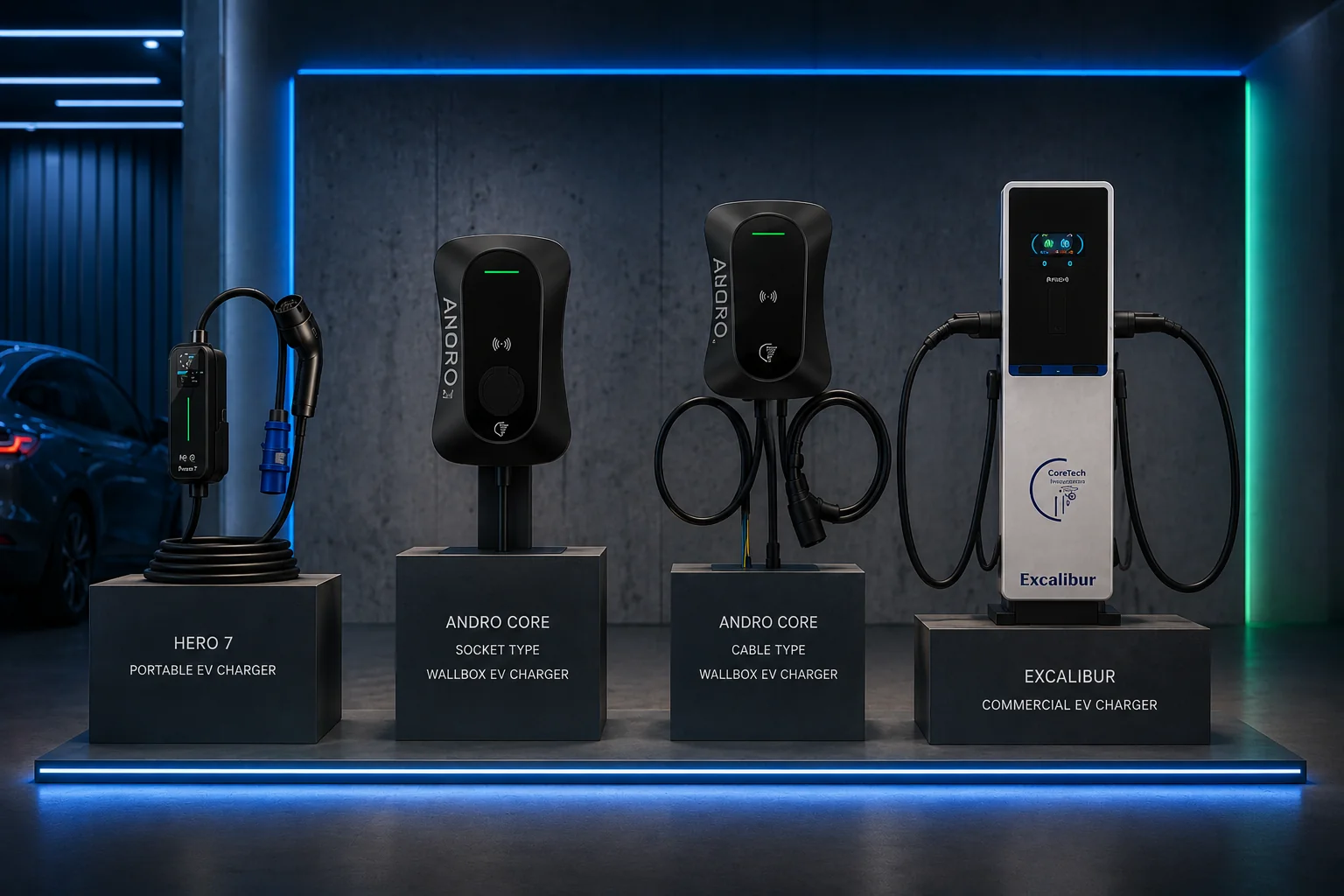
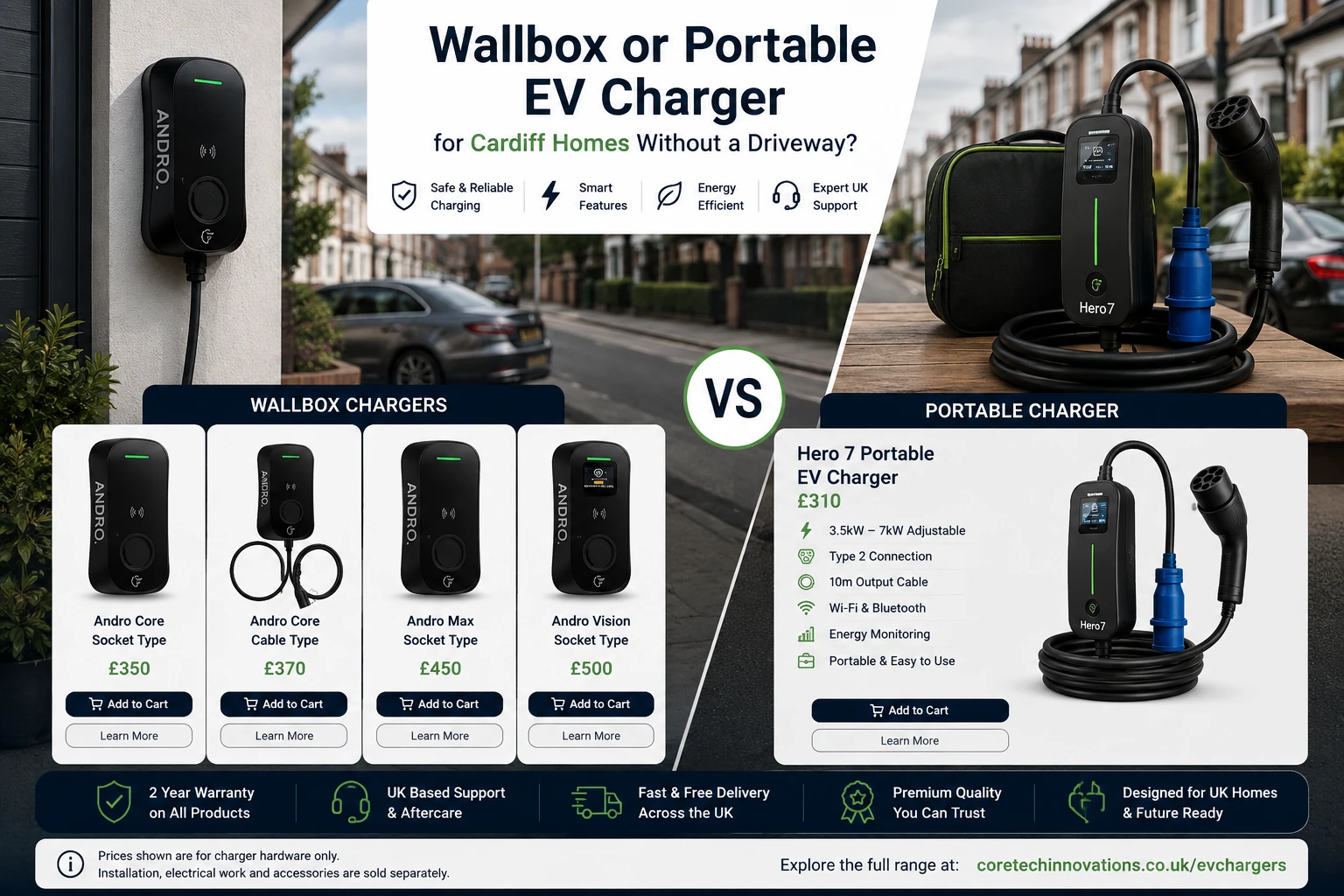
CoreTech Innovations offers domestic wallboxes including the Andro Core, Andro Max and Andro Vision, with features that can include 7kW charging, scheduling, energy monitoring, RFID access and additional smart-energy functions.
A portable EV charger is designed to travel with the driver and can be used at different locations where suitable parking and an appropriate electrical supply are available.
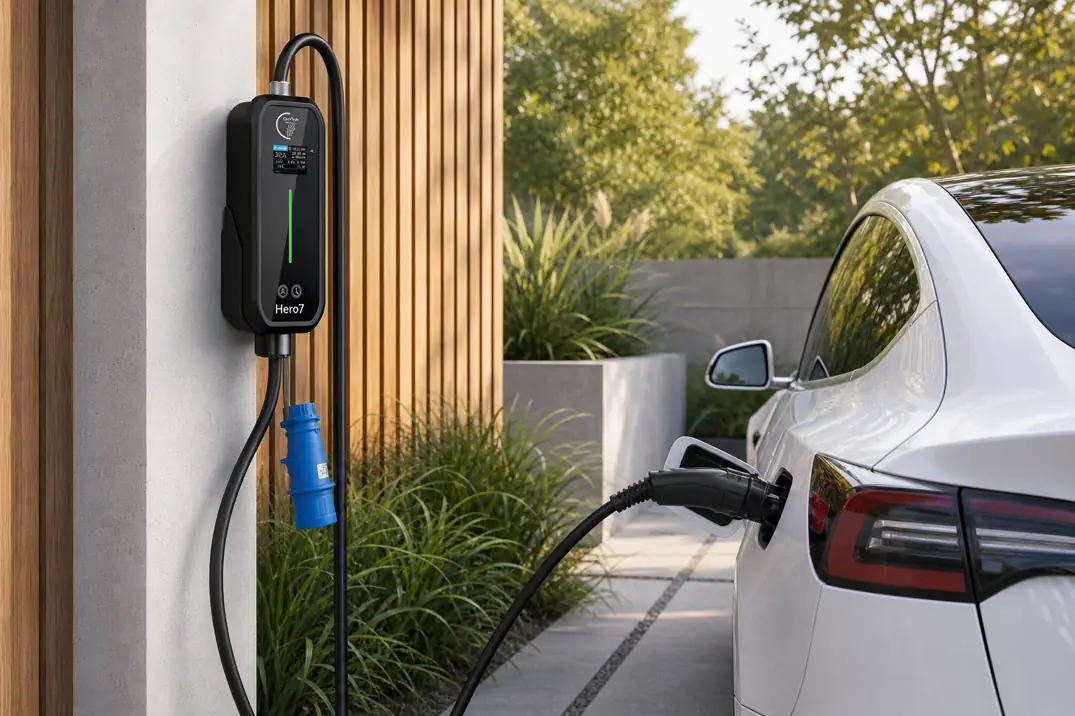
The Hero 7 provides flexible charging capability, Type 2 compatibility, connectivity and app-based monitoring, making it useful for drivers who regularly charge at more than one suitable private location.
A Portable Charger Does Not Solve the Pavement Problem
A portable charger should not be treated as a simple way to run a charging cable from a house across a public pavement to a vehicle parked on the road.
Loose or poorly positioned charging cables can obstruct pedestrians, wheelchair users, people with visual impairments and parents using pushchairs.
The key issue is not whether the charger can be moved, but whether the vehicle and electricity supply can be connected at an appropriate location without creating access or safety problems.
For Cardiff households relying entirely on street parking, this practical limitation should be understood before purchasing a portable charger for home use.
Can You Install a Wallbox Without a Driveway?
For Cardiff residents, installing a wallbox without private parking requires particular care because the parking arrangement and local requirements determine whether home charging is suitable.
Cross-pavement charging solutions are developing in parts of the UK, but their use depends on local policies, permissions and the suitability of the individual location.
Cardiff homeowners without a driveway should check the latest local guidance before purchasing a wallbox or planning any charging arrangement involving a public pavement.
Resolving the parking and permission questions first is preferable to buying charging equipment and later discovering that it cannot be used as intended.
Wallbox vs Portable Charger: Practical Comparison
A wallbox provides a permanent charging solution intended mainly for regular home use and normally requires professional installation.
A portable charger offers greater flexibility because it can be taken to different suitable charging locations with appropriate electrical supplies.
Both charger types can provide useful smart features, but neither automatically solves the problem created by a public pavement between the property and the parked vehicle.
For homes without driveways, the parking and charging location should determine the charger choice rather than the charger being selected first.
When a Wallbox Makes More Sense
A wallbox generally makes more sense when the vehicle can be parked on suitable private land close to the property and a permanent charging installation is practical.
Its main advantages include convenient overnight charging, scheduled charging, energy monitoring and a dedicated setup for regular EV use.
For drivers who charge at home frequently, these benefits can be more useful than the ability to move the charging equipment between locations.
Households relying entirely on public street parking should establish whether home charging is actually practical and permitted before investing in a fixed wallbox.
When a Portable Charger Makes More Sense
A portable charger can be more useful when the driver regularly has access to suitable private charging locations away from home.
This could include a workplace, a family member's property, a second home or another private parking location with an appropriate electrical supply.
In these situations, the ability to take the charger between locations provides a genuine practical advantage.
The Hero 7 is designed for this type of flexible use, but the electrical supply at every charging location still needs to be appropriate for EV charging.
A portable charger should therefore be considered flexible charging equipment rather than a workaround for unsuitable parking at home.
Safety Considerations for Properties Without Driveways
For properties without private parking, the charging location should be considered before the charger itself.
Important factors include the electrical supply, where the vehicle will be parked, how the cable will reach it and whether the charging arrangement affects public access.
Temporary or unsuitable charging arrangements can create unnecessary safety risks and everyday inconvenience.
Where there is uncertainty, a professional assessment can help establish whether home charging is practical or whether workplace, destination or public charging is more appropriate.
Cost: Wallbox or Portable Charger?
The cost of the charging equipment is only one part of the overall decision.
A fixed wallbox usually requires professional installation and may involve additional electrical work, while a portable charger avoids a permanent installation but still requires access to a suitable electrical supply wherever it is used.
The cheapest charger is therefore not automatically the most cost-effective option.
The better-value choice is the charger that matches the driver's actual charging routine and can be used safely and conveniently.
Product prices, specifications and availability may change, so customers should check the latest CoreTech Innovations EV Chargers page before purchasing.
Which Option Is Better for Cardiff Homes Without a Driveway?
There is no single charger that suits every Cardiff property without a driveway.
A wallbox is generally the stronger option where suitable private parking and a permanent installation arrangement are available.
A portable charger may be more appropriate where the driver regularly charges at different suitable private locations and flexibility matters more than having a permanent charger at home.
For households relying entirely on street parking, neither option should be purchased on the assumption that a charging cable can simply be run across the pavement.
Public, workplace, destination or other suitable charging facilities may provide a more practical solution in those circumstances.
Cardiff's EV Charging Future Beyond the Driveway
The challenge of EV charging without private parking affects many UK cities with large numbers of terraced homes and on-street parking.
As EV ownership grows, charging provision will increasingly depend on a mix of home charging, public on-street infrastructure, workplace facilities, destination charging and rapid charging.
For Cardiff residents without private parking, continued expansion of public and on-street charging infrastructure will remain particularly important.
Cross-pavement charging solutions may also develop further, although their suitability will continue to depend on local approval and individual site conditions.
The most practical charging arrangement will therefore vary from household to household.
Final Verdict
For a Cardiff property without a driveway, the first question should not simply be whether to choose a wallbox or portable EV charger.
The more important question is where the vehicle can actually be charged safely and practically.
A fixed wallbox is usually the stronger long-term option where suitable private parking and a permanent installation are available.
A portable charger such as the Hero 7 can offer greater flexibility where the driver has access to appropriate private charging locations elsewhere.
Neither option should be treated as a simple solution for running a charging cable across a public pavement.
Once the parking arrangement, electricity supply, local requirements and everyday charging routine are clear, choosing between a wallbox, portable charger or alternative charging solution becomes much easier.