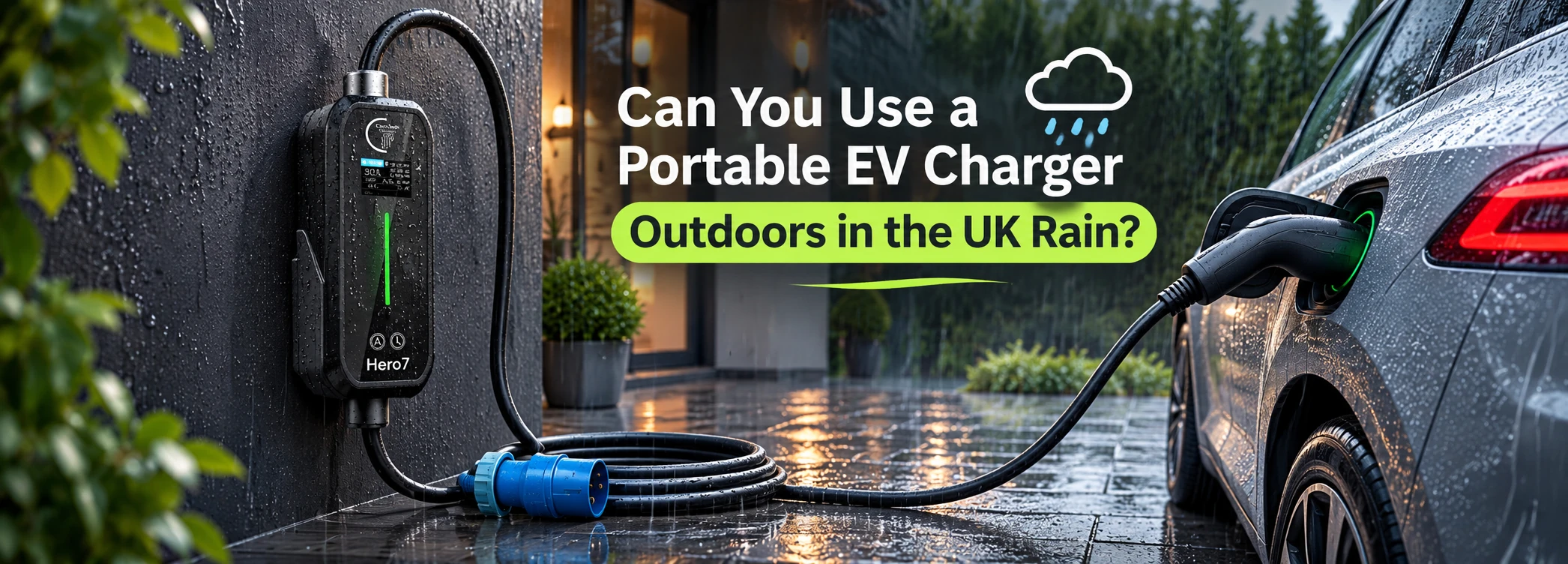
Can You Use a Portable EV Charger Outdoors in the UK Rain?

- Outdoor EV charging in UK rain is possible only with a complete, suitable charging setup.
- IP54 means defined dust and splash protection, not waterproofing or immersion resistance.
- The mains socket, plug and adaptor need their own environmental suitability checks.
- Never use ordinary domestic multi-socket extension leads or daisy-chain leads for EV charging.
- Hero 7 lists IP54, but its 3.5–7 kW range depends on a suitable electrical supply.
- Stop and seek professional help when connections are wet, damaged or show fault symptoms.
Can you safely use a portable EV charger outdoors in UK rain? Learn what IP54 means, how to protect connections and when to stop charging.
Can you charge an EV outside when it rains?
Yes, outdoor EV charging can be possible in rainy UK weather, but only when the charger, plug, connector, electrical supply and installation are suitable for the conditions. A weather-resistance rating is not permission to leave plugs in puddles or use an unsuitable domestic socket.
Before connecting, check the manufacturer’s instructions for the exact model and the permitted outdoor arrangement. If the supply or connection is uncertain, do not start charging; ask a competent electrician to assess it.
Rain-resistant does not mean waterproof
People often use “waterproof” to describe chargers, but it is too broad a promise. Equipment is tested against defined conditions, and a rating cannot predict every combination of driving rain, pooling water, damaged seals and prolonged exposure.
Treat every component as part of the charging system: the portable control box, supply plug, adaptor, vehicle connector and the socket feeding it. The least suitable component can determine whether a setup is safe.
What IP54 actually means
The first digit, 5, indicates protection against dust ingress sufficient to avoid harmful deposits; it does not mean the enclosure is dust-tight. The second digit, 4, describes protection against splashing water under defined test conditions.
IP54 is not a rating for submersion, pressure washing or indefinite exposure to flooding. It also does not independently establish that an attached mains plug or adaptor has the same protection.
Does the Hero 7 have an IP rating?
CoreTech lists IP54 protection among the Hero 7 portable charger specifications, alongside over-temperature, over-current, ground and voltage-related protections. These are useful product characteristics, not substitutes for a suitable electrical supply or safe handling.
The Hero 7 is listed as a Type 2 portable unit with a 10-metre output lead and a rated 3.5–7 kW output range depending on the supply arrangement. A standard UK 13A socket must never be assumed capable of supplying 7 kW.
The biggest outdoor risk may be the supply connection
A portable charger may have a protected enclosure while the mains socket, plug adaptor or connection point is vulnerable to rain. A socket inside a building does not automatically make a cable routed through an open door or window suitable for charging.
Do not put a domestic plug-and-socket joint on wet ground, under a vehicle or where rainwater can collect. Do not improvise weatherproofing with bags, tape or containers that could trap heat.
Can you use a normal UK three-pin socket?
Some portable charging arrangements use a UK three-pin plug, but sustained EV charging places a significant load on the electrical circuit. Electrical Safety First advises having household wiring checked before charging from a 13A mains socket.
A qualified electrician should confirm that the socket, circuit, protective devices and proposed use are appropriate. Never use an ordinary multi-socket extension lead or chain extension leads together.
Avoid standing water and damaged connections
Inspect the equipment before every session. Do not connect if there are cracked housings, damaged insulation, bent contacts, corrosion, loose fittings, moisture inside a connector or signs of overheating.
Keep supply connections above ground and away from puddles, vehicle tyres and runoff. If a connector or electrical contact is wet, follow the manufacturer’s procedure rather than attempting to charge immediately.
What about the Type 2 vehicle connector?
A Type 2 connection is designed for EV charging, but the permitted exposure of the connector depends on its construction, whether it is fully mated and the manufacturer’s instructions. Do not infer that an uncapped connector has the same protection as the charger enclosure.
Keep unused connector ends protected as directed, and avoid placing them on the ground. Never touch exposed electrical contacts or attempt to clean a live connector.
Where should the portable control unit sit?
Place the unit according to its operating instructions, with appropriate support, ventilation and cable routing. Avoid locations where rainwater accumulates or where the device can be struck by a vehicle or pulled by a taut cable.
Do not cover the control unit with a blanket, plastic bag or improvised enclosure. Covering it can interfere with heat dissipation and may introduce additional hazards.
Charging overnight in wet weather
An overnight session increases the time the equipment is exposed to changing conditions. Before leaving a charging session unattended, confirm that the entire arrangement is approved for that use and that weather conditions are within the manufacturer’s limits.
If the supply connection cannot be protected in the prescribed way, use a suitable fixed charge point or another appropriate charging location instead.
What to do if charging stops during rain
A stopped session or fault indication may reflect a protection feature, a supply issue or a vehicle-side condition. Do not repeatedly reset a protective device without investigating the cause.
If there is visible damage, water ingress, smoke, unusual heat or a burning smell, stop using the equipment if it is safe to do so, keep clear and seek qualified assistance. For immediate danger, follow emergency procedures.
Rain, wind and cable trip hazards
Rain is not the only outdoor factor. Wind can move unsupported cables; traffic can crush them; and cables across walkways can create trips and access problems.
Plan a route that does not cross a public pavement or obstruct pedestrians. Do not run cables across public routes without the necessary lawful, approved arrangements.
A practical pre-charge checklist
Confirm the charger and every connection are approved for the intended outdoor conditions. Inspect the cable, plugs and seals; verify the socket and circuit are suitable; check that connections are dry and protected; and position the unit clear of pooling water.
Ensure the cable is not strained, pinched or exposed to traffic. If any of these checks fail, postpone the session until the problem is corrected.
When a fixed wallbox is the better choice
For regular charging at one property, a professionally installed home wallbox is often a more convenient and controlled arrangement than repeatedly connecting a portable unit. Its suitability still depends on correct installation and site conditions.
Portable charging is valuable for flexibility, but it should not be used to bypass electrical assessment or permanent charging infrastructure when that is the safer option.
Frequently asked questions
Is IP54 waterproof? No. It describes specific dust and splash resistance tests, not immersion or every weather condition.
Can I leave a portable charger outside all night? Only if the exact equipment, supply connection and manufacturer instructions permit that use in the expected conditions.
Can I use an extension lead in the rain? Do not use an ordinary domestic multi-socket extension lead or daisy-chain leads for EV charging. Seek a suitable charging arrangement assessed by a competent electrician.
Does a UK plug adaptor make 7 kW charging possible? No. Charging power is limited by the approved supply and equipment; a normal 13A socket is not a 7 kW supply.
Choosing a safer outdoor charging setup
The useful question is not simply whether a charger can survive rain, but whether the complete charging arrangement is appropriate for the site. Compare equipment specifications, check the manufacturer’s instructions and obtain professional electrical advice where necessary.
Explore CoreTech’s Hero 7 product specifications and its EV charger range to understand available options, without assuming that a listed protection feature removes the need for a suitable supply.